
29.10.2026
Readying for the next stage
November 5 sees the trade unions calling a general strike. It will be massive. Till then, argues Jean Laurel, the left needs to keep up the momentum of protests and demonstrations. The left also needs to promote the idea of the organised working class maintaining discipline and good order
France is experiencing a social movement that shows no signs of slowing down. On the contrary, after weeks of protests in high schools and then universities, street demonstrations are being maintained.
Images from October 17 made headlines in media outlets around the world. After a month of youth protests, this day - heralded for over a month as the ‘return of the Yellow Vests’ against the cost of living, particularly petrol prices - became truly mass, with 800,000 people taking to the streets across France. October has seen the largest mobilisations since January 2023 against the pension reform.
The Yellow Vests repertoire of actions was indeed put to use again: hundreds of roundabouts were occupied, traffic was slowed, toll booths were made free of charge, and attempts were made to block refineries and petrol stations. From this perspective, it was a far greater success than the last ‘return of the Yellow Vests’, which had been announced on September 10 2025. Nevertheless, this minor aspect of the mobilisation was completely overshadowed by the events taking place across the country at the same time.
Large-scale demonstrations and rallies took place in most cities, including medium-sized ones. After a week of escalating tensions, the police used excessive force and non-lethal weapons against the demonstrators. Once again, two teenagers lost eyes, and another had a hand blown off. Many protestors were severely beaten. In some cases, it was not possible to organise marches: demonstrators were tear-gassed before they could even reach the gathering points, leading to the proliferation of smaller marches. Everywhere, the clear objective was to force them to go home, using tear gas and kettling tactics. The police were extremely aggressive: numerous scenes show them insulting or provoking the protestors. On the other side, the anger was intense. There were numerous clashes.
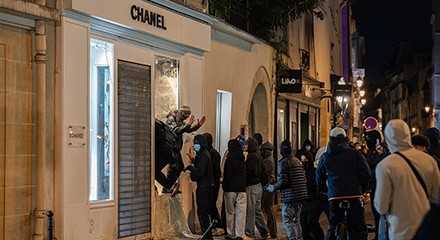
Despite all this, the images circulating in the French and international media highlighted not so much the arbitrary nature of police violence as the acts of vandalism that took place on the fringes of the protests. It is true that these incidents were far more numerous than usual. Indeed, in several city centres, stores were stormed and looted. These were mainly large chains and luxury brands, but the media focus, of course, was on small business owners, who were interviewed in tears the next day. Images of damage to public property - particularly historic buildings set on fire - were broadcast in the days that followed.
The dominant narrative on the far right was that of an invasion of cities by hordes of Islamist barbarians from the suburbs, allied with bloodthirsty Antifa activists. The government and the mainstream media were not much more nuanced, but targeted the leftwing La France Insoumise (LFI) and its alleged ‘proxies’. This term, borrowed from the military vocabulary used to describe Iran’s allies, is supposed to refer to revolutionary organisations (never specifically named), which are said to be ‘ultra-left’ and seeking to destroy society, while being somehow remotely controlled by Jean-Luc Mélenchon. A pro-Macron MP even called for LFI to be held accountable for the damage. Bruno Retailleau, the presidential candidate for the traditional Gaullist rightwing, Republicans, demanded that LFI should be banned - a stance that earned him the support of the president of the French senate.
The situation has become so absurd that even within the state apparatus voices have been raised to denounce this crude narrative: intelligence agents have testified in the press that they were ordered to incriminate LFI at all costs in their reports.1 Far-left activists are, of course, opposed to LFI’s policies, and in any case represent a very small minority of what is loosely referred to as casseurs - a term equivalent to ‘vandals’, used in France to describe the irresponsible minority among protestors, who are in the main actually anything but coordinated or politically coherent.
Mélenchon has rightly said that rioting and looting are “contrary to our methods”. At the same time he has placed the blame for social alienation squarely on a failing education system, austerity and police violence. True, there are those who want to see ‘Paris burn’ and revel in the ‘joy of destruction’. Anarchists celebrate rioting and looting as being the prerequisite for building the ‘stateless Commune’. Not Marxists. We value discipline and organisation. Not imposed through the state and its hated police force, but democratically, through our own parties, trade unions and defence units. Shops, bars, cafes, offices and other workplaces ought to be guarded against criminal actions.
Marxist left
Despite the undeniable strength of the movement, it is, of course - for now - highly misleading to describe the current situation as revolutionary or pre-revolutionary. Yet this is the thesis defended by the Morenist group, Révolution Permanente, which is close to the Argentinian Trotskyist party, Partido de los Trabajadores Socialistas. RP’s justification for this is “the combination of a prolonged political crisis at the top and this independent outburst of the masses from below”.2
The political crisis is said to be linked to the difficulties the police encountered in containing the situation on October 17. It is, however, particularly strange to view the police’s rout as anything other than, at best, a symptom of the intelligence services’ incompetence (which is unlikely), or, at worst, a deliberate strategy to obtain images of vandalism and looting for the media. The number of police officers deployed was even lower (60,000 versus 80,000) than during the last Yellow Vests protest on September 10 2025, which drew half as many demonstrators. Furthermore, when the interior minister tendered his resignation, Emmanuel Macron did not even need to accept it, and the minister was able to remain in post. We are, therefore, clearly far from a situation in which the French bourgeoisie would have run out of ‘scapegoats’ to use or no longer have the means to maintain order.
The idea of a ‘mass uprising from below’ must be put into perspective. It is true that many high-school students are taking action for the first time, and that the student mobilisation extends beyond the campuses that are usually involved. But, for now, it would be wrong to claim that the majority of students are engaged in the movement, and this is even less true of the majority of workers. We must, of course, encourage events to move in this direction, but it is a mistake to assume that the work of building mass support is already complete. That all that is needed now is to organise general assemblies in the workplaces. It is likely that Révolution Permanente’s position stems less from an analysis of the situation than from the need to adopt triumphalist slogans in order to appeal to radical students.
Another problem with the Marxist left is particularly evident in the actions of the NPA-Révolutionnaire (a splinter group of the United Secretariat of the Fourth International) within the student movement: the lack of a distinct political voice and a clear socialist perspective. A majority of their activists are students, so they are able to make an impact in student general assemblies. They strive to present themselves as being the best student union activists, rather than seeking to assert themselves politically. They never justify their actions on the basis of their largely hidden political perspectives (build and broaden the movement to achieve a general strike and seize power by building soviet-style structures under their leadership). Instead, they adopt a technical standpoint (structure and mass mobilisation are necessary to keep the movement alive).
The week following the events of October 17 - which was less intense due to high schools being closed for vacation - was marked by an unprecedented media campaign against the movement’s ‘violence’, and by authoritarian announcements from the government. In many cities curfews were imposed. Gatherings were banned, police patrolled the streets and helicopters flew over Paris. The government was clearly seeking to intimidate.
Macron stated in an official address that, from now on, no-one except the major unions would be allowed to organise a demonstration. The centrist presidential candidate, Macron’s former prime minister Gabriel Attal, called for a social media blackout, similar to what Nepal experienced in September of last year (perhaps he was not informed about what followed that!).
Tensions escalated further following a heinous racist attack in the Paris suburb of Trappes on October 23. A man drove around shooting at every black and Arab person he came across. A 26-year-old passerby died, and several others were seriously injured. When arrested, the perpetrator reportedly claimed that he wanted to “avenge the shopkeepers”, following the looting on October 17.3
Right to protest
There was a great deal of uncertainty surrounding the October 24 demonstration. Protests had been banned in several cities, where police completely blocked access to certain areas. However, the demonstration was permitted in Paris, but its route - near the ring road, far from the city centre - was very different from the one the unions had announced. Yet, despite the difficulties and fear, the movement did not waver: 800,000 people came out once again. The focus of the day - in addition to protesting the high cost of living and the demands of young people - was to defend the right to protest, which is under serious threat from the government.
The day was a success and saw far fewer incidents of vandalism than the previous week. The media then had to fall back on the usual images of burning trash cans. They did not, however, broadcast other images: those showing small fascist groups operating with complete impunity in certain cities, attacking protestors and then retreating behind police lines. This complicity - or even collaboration - between police and fascists is clear. But not new.
Two days later, on October 26, the government finally made some announcements. Rather than concrete measures, it presented a vague “roadmap” - a series of “discussions” that have been set in motion. Prime minister Sébastien Lecornu announced plans to review the admissions platform (Parcoursup) in the coming years, allocate €5 billion to renovate buildings, and create 15,000 additional places in higher education (not the 250,000 demanded by students). A figure made all the more ridiculous by the government having cut 10,000 places last year alone. As for the cost of living, the automatic annual increase in the minimum wage has been brought forward by three months. All of this is, of course, far below the protestors’ demands for profound social change - whether in education or, more broadly, in the living conditions of the working class.
The immediate outlook now is set for repeats of the weekly Saturday protests, as was the case during the Yellow Vests movement. The goal is, at the very least, to maintain the movement’s momentum until November 5, when the unions have called for a general strike. There is reason to hope that this day will see a massive mobilisation, which will be necessary if we are to obtain real progress from the government.
-
www.mediapart.fr/journal/france/191026/nous-demande-d-ecrire-que-lfi-est-derriere-le-mouvement-autour-du-17-octobre-la-fabrique-d-un-bouc-emissai.↩︎
-
www.revolutionpermanente.fr/Du-crepuscule-de-la-Macronie-a-la-crise-d-autorite-de-l-Etat-41821.↩︎
-
www.lemonde.fr/societe/article/2026/10/24/attentat-raciste-de-trappes-le-tireur-presume-a-dit-avoir-voulu-venger-les-commercants-pilles-le-17-octobre-et-avoir-cible-des-personnes-de-couleur_6799689_3224.html.↩︎