
15.10.2026
Youth take the lead
High schoolers have blockaded their schools and taken to the streets in unprecedented numbers. They have been joined by university students, teachers and parents. And on November 5 there is the call for a one-day general strike and mass demonstrations. Jean Laurel reports
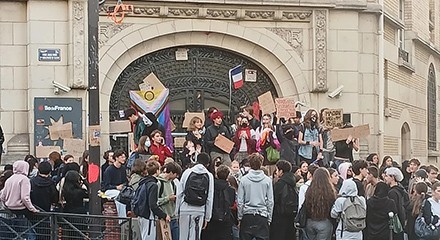
For the past few weeks, France has been in the middle of an intense youth social movement that has drawn international attention. The movement started at a high school in the Paris suburb of Créteil, beginning with a teachers’ strike, before students joined in late September. They shared videos and pictures of their school’s terrible run-down condition, showing, in particular, leaks in the ceiling and crumbling walls. These images went viral on social media and quickly spread the idea of blockading schools among students, many of whom face the same problems.
All over France, and particularly in the most disadvantaged areas, high school students are denouncing decrepit facilities, overcrowded classrooms that become unbearable in the heat, and a lack of staff of all kinds: teachers (with 10% of classes not being taught nationwide), but also nurses, social workers, school monitors, cleaning staff ... They are also demanding an end to absurd schedules (some school days last from 8am to 6pm).
High schoolers are also opposing university selection. In France, college education is supposed to be free and accessible to anyone who has obtained a high school diploma. But successive governments have created cryptic selection platforms that mainly serve social selection. This is part of a wider trend of dismantling higher education, aimed at making it inaccessible to the working class. The blockades are also clearly politicised against President Emmanuel Macron, as well as the far right, with many slogans against the increase in the military budget (and the lack of increase in any other public sector).
High schoolers are rebelling against a sense that their future is sacrificed by the current system. During the week beginning September 28, the situation took on a whole new dimension. Since then, hundreds of high schools have been closed each day. The mobilisation is surprising, both because of its spontaneity and because of the scale of the state’s repression against it. Police violence has escalated, with numerous images circulating showing mistreatment, unprovoked charges and the completely unjustified use of weapons. It was the riot police who were deployed in front of high schools to try to disperse the students. In addition to batons and shields, they are making extensive use of flashballs, tear gas and stun grenades. Flashball shots have horribly mutilated some students. One lost an eye, one a hand, and another all of his lower teeth due to a short-range shot in the face. Police vehicles have also been filmed driving aggressively toward groups of protesters.
Police arrests
The police are treating this like a civil war, with the goal of intimidating the youth. Some officers are clearly enjoying beating up non-white kids, and it feels like they are doing everything in their power to raise the tension. The cases have been referred to the police watchdog (IGPN), but, of course, we cannot expect any form of justice from it. More than 7,000 people have been taken into police custody, including 2,000 on October 1 alone, most of whom are 15-16 years old. Multiple accounts report mistreatment (and even sexual assaults) inside police stations, the full extent of which remains unknown for now. For comparison, there were 12,000 arrests over the entire Yellow Vests movement in 2018-19 (over a full year, compared to just two weeks for the current movement).
Unsurprisingly, the repression is harshest in working class neighbourhoods and against youth from a migrant background. The arbitrariness and violence that can be seen online is revolting.
High school students have gradually been joined by college students throughout the week. The shocking nature of the images sparked support and solidarity in front of high school gates, with adults forming human chains to prevent riot police from charging at the students.
The mobilisation peaked on October 6, the day when education sector unions had called for a strike and a demonstration that drew 450,000 people. On that day, 90% of universities and 50% of high schools were closed (either blockaded by students or closed pre-emptively to prevent such actions). A week later, on October 13, more than 450,000 people again took to the streets.
The movement is not as massive as the opposition to the pension reform in 2023 (which brought 3.5 million people into the streets at its height), but it is different from usual mobilisations because of the unprecedented number of high schoolers in the protests. Amongst the youth, its support is also wider than usual: many universities and schools that usually never join social movements have joined this one.
The bourgeois media analysis focuses, as usual, on images of burning trash cans, which take up the vast majority of airtime, while journalists and politicians take turns condemning the so-called “violence” of the high schoolers. The few students who get to speak are drowned out by representatives of puppet student organisations controlled by the government, reactionary commentators and police officers.
Organised left
The media also focuses heavily on the alleged responsibility of La France Insoumise (LFI - ‘France Unbowed’, the party led by Jean-Luc Mélenchon). Like other left-wing organisations LFI supports the movement, and it is the only political force outside the far left that does not unequivocally condemn ‘student violence’. LFI leaders are accused of being behind the movement like puppet masters (the government even implied that it had insider info about their responsibility from the intelligence services). Despite that, it is clear that this is a spontaneous movement. In reality, LFI MPs are showing up on blockades, where they are quite popular, wearing their official tricolour sashes, in order to “defuse tension” between the students and the cops.
For its part, the Marxist left is struggling to find its place in the movement. Because of their presence in the education sector or in student unions, and despite their small numbers, the various Trotskyist groups manage to be heard in high school and university general assemblies. However, their only real message is often the need for a general strike of the entire working class for the movement to have any impact (sometimes without even thinking whether this is actually possible right now). And their sole short-term objective is actually to recruit young people into their own student union, or directly into their organisation. Their lack of unity does not help matters.
As for the Parti Communiste Français, confusion reigns. One day, PCF national secretary Fabien Roussel calls for the creation of “people’s courts” to put former education ministers on trial, and to “make the revolution now in the streets”. The next day, he condemns the violence of the high schoolers as well as that of the police, calling for a “republican pact” that would bring together the right and the left around cross-party measures for education. This is symptomatic of the contradiction that drives the PCF - between the need to satisfy its younger or more radical members and the desire of its leadership and elected officials to be accepted by the political and media establishment.
The inter-union coalition, outside of the education sector, has not called on its members to join the ongoing mobilisations, and is only calling for a strike on November 5, which is ridiculously far from the ongoing events. The more left-wing unions, like the General Confederation of Labour, wanted to join the movement starting on October 15, but they backed down to preserve “unity” with the more right-wing unions.
The government has not yet clearly responded to the movement, probably hoping it would die down. It has not. A “time for internal democracy” in every school has been announced, and 3,000 teachers have been urgently reassigned. High schoolers are asked to write down their problems and demands on forms, which is reminiscent of the empty “democratic” initiatives that led nowhere during the Yellow Vests movement. This satisfies no one.
The next big step will be the mobilisation on October 17. This date has been announced as “the return of the Yellow Vests” for two months now, mainly in reaction to the rising cost of living. Such a revival was attempted in September last year and was a relative failure, but this time it is blending into the already existing youth movement. So far, only the CGT has called on its members to join the demonstration.
This weekend also marks the beginning of a two-week school holiday, during which there will, of course, be no blockades. There is no certainty that the movement will continue after this break, but the lack of a concrete response from the government and the prospect of a cross-industry mass strike on November 5 gives reason for hope.
It is uplifting to see such a movement with roots amongst the youth, even though it still lacks a clear political perspective.