
15.10.2026
Soft left strengthens Vox
Housing, migration and the prospect of the hard right entering government for the first time since 1975 are the dominant issues, says Paul Davies. But what about the democratic republic, Nato and working class rule?
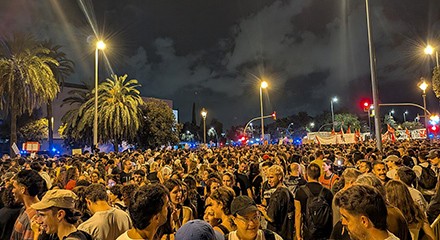
Prime minister Pedro Sánchez has called a snap general election for November 29. This follows the defeat of his centre-left coalition’s two emergency decrees on housing, which were, of course, triggered by the forced eviction of Maricarmen Abascal, an 87-year-old pensioner, from her Madrid apartment. Her plight sparked massive street protests across major Spanish cities (she has since died).
Junts, the centre-right Catalan independence party, broke its already fragile parliamentary arrangement with the minority governing coalition, dominated by Sánchez’s Socialist Workers Party (PSOE), over accusations of corruption, cover-ups and incompetence. Junts has explicitly ruled out supporting Sánchez’s re-election after November.
Housing is central to the PSOE election campaign (a rent cap, expanding legislation against evictions and restrictions on corporate ownership of the housing stock). Meanwhile, the reformist left remains glued to the PSOE, mainly out of fear of the right and the far right.
As for the country’s right and far-right parties, the Popular Party and Vox, they are making anti-corruption, anti-immigration and anti-state controls their rallying call. The promise is that with tax incentives the free market will solve the chronic shortage of affordable housing.
At the moment it looks like neither of the two main parties - PSOE and PP - are likely to go past the 176 seats needed to gain a majority in the congress of deputies. However, Sumar, the PSOE’s main left coalition partner over the past three years, is predicted to lose support, while the far-right Vox, which stresses family, Catholic values and a single and indivisible Spain, is predicted to make massive gains. Latest polls put it on some 18% of the vote and securing from 61 to 72 MPs (up from 33 in 2023).
If that turns out to be correct, the PP could end up forming a majority coalition with Vox - a first for the far right since the death of Franco in 1975. In recent years, Vox has gone from being unacceptable to acceptable in PP eyes: it is now in coalition in four regional assemblies.
It is this possibility of a right/far-right coalition government that is getting the left into something verging on blind panic. There are overexcited warnings about a return to the “dark stone of Francoism”. Rallies and demonstrations ring to the ‘¡No pasarán!’ (they shall not pass) republican slogan of the 1936-39 civil war. Of course, there are real dangers - to continued regional autonomy, women’s rights, LGBT+ people, trade union collective bargaining, migrants, etc. Note, however, neither Vox, nor any other far-right party, has got a paramilitary wing. While it sometimes includes retired generals on its election lists, Vox’s main emphasis is expanding the role of the state’s military in dealing with illegal migrants. There is nothing like the Falange.
Sánchez poses the choice facing electors as a ‘progressive government’ or a ‘coalition of reaction’. Obviously, going for a snap general election was a gamble, but it is hardly a new tactic. Sánchez is a canny political operator. He successfully brought in tow both Podemos and Sumar. He secured a deal with the Catalan separatists by getting the highly controversial amnesty law over all the parliamentary and legal hurdles (this allowed Junts leader and former Catalan president, Carles Puigdemont, to return from his Brussels exile). This is what got Sánchez the votes of the seven Junts MPs and allowed him to stay on as prime minister in 2023. And Sánchez wants to be seen to stand up against Israel and Trump. He has been vocal in his condemnation of Israeli expansionism and the genocide in Gaza. Unlike other Nato countries, his Spain has not gone along with demands for upping the arms budget to 3.5% of GDP.
Twin issues
Whether or not the electorate is convinced by the PSOE’s radical promises remains to be seen. Of course, the housing crisis is hardly anything new - many working class people are being priced out of affordable housing. They find themselves spending half their incomes (or more in major cities) just to keep a roof over their heads.1 The fact that Sánchez has been prime minister since 2018, but has failed to address the issue, will not easily be overlooked. It is not surprising that the country is still experiencing mass housing protests, with permanent ‘tent cities’ established in Madrid, Barcelona and Málaga.
Clashes with the police are reported regularly and the country’s biggest unions, the Workers Commissions (CCOO) and the General Workers Union (UGT) last week announced a general strike on November 11 over the housing question. Sánchez will no doubt make some more concessions - he is clearly calculating that he can score points against his right and far-right rivals over housing.
The other main issue that will dominate the election presents him with something more of a challenge. PP and Vox have persistently waged a war against Sánchez over the question of migration, particularly since his adoption earlier this year of what has been called a ‘pro-migrant’ stance. The granting of legal status to 500,000 undocumented migrants certainly enabled Sánchez and the PSOE to present themselves as the champions of human rights … as well as helping to sustain Spain’s relatively buoyant economic growth. But it caused a storm on the right, especially since the mass border crossing in July of 70,000 people from Morocco into Ceuta, Spain’s enclave on the coast of north Africa.
The right paints immigration as a ‘threat to Spanish society’. For PP, the continuing situation in Ceuta has graphically highlighted the weakness of Spain’s borders and apparently put in jeopardy its 140,000 inhabitants. Calls from the party leader, Alberto Núñez Feijóo, for the “defence” of the territory against the “invasion”, on the basis that “Ceuta is Spain”, have been commonplace. That despite the fact that the majority of those who entered Ceuta eventually returned to Morocco voluntarily. However, the 5,000 who remain - a third of whom are children - live in squalor beside the enclave’s small beach. There are frequent reports of verbal and physical (including sexual) abuse from anti-migrant vigilante thugs.
Vox has fuelled the fire no end. Essentially, its slogan is Make Spain Great Again. That means no more inward migration, an end to regional autonomy and rolling back civil rights. Vox, it should be added, shows a distinct fondness for the days of Francoism. For example, it strongly opposed the exhumation of Franco’s body from the Valley of the Fallen and consistently demands the repeal of laws which brand his rule as a criminal dictatorship.
Sánchez’s predictable response was to plead that Ceuta’s migrants are not “invaders” but were “looking for a better life”. Meanwhile, he has ordered the construction of a 500-metre maritime barrier and despatched 3,600 extra police and soldiers. Of course, neither he nor his PSOE party have raised the need for a Spanish withdrawal from this remnant of empire.
Left forces
What of the main organisations of the left? The United Left (IU - essentially, the ‘official’ Communist Party of Spain, the main force in Sumar) is readying to select candidates. Podemos is yet to commit itself to Frente Amplio (‘Broad Front’), citing tactical differences as a problem.
When Sumar met earlier this year to start to plan an electoral alliance for the general election that was due to take place in 2027, the event was a top-down affair. Then it proposed (and decided) to call itself ‘Un Paso al Frente’ (‘One Foot Forward’) and omitted any time for debate on its political platform. Except for a name change, there is nothing to suggest that things are to be different this time around in terms of grassroots input. Indeed, its political aims - and its ways of ‘achieving them’ - appear to have already been established.
Soon after the election had been called, the parliamentary spokesperson for IU, leading Communist Party member Enrique Santiago, had already stated the alliance’s objectives: “Our task is to organise the Frente Amplio with a programme based on defence of the right to housing and the welfare state, guaranteeing social rights, labour and public freedoms in the face of the threat of fascism”. Arguments that go beyond that, including the need for a principled, transformative political programme, get buried (if they are fielded at all).
Frente Amplio is committed to maintaining the coalition with PSOE and therefore lucrative ministerial posts.2 The old Socialist International principle of not taking part in a bourgeois coalition is long forgotten.
Make no mistake. Sánchez and PSOE are not even republican when it comes to programme. Sánchez is committed to the post-1978 constitutional order, the monarchy, the two-chamber parliament, the Nato proxy war in Ukraine, etc. All in the name of stability. Yes, at its 2024 conference, PSOE voted to recognise the “historic” republican cultural tradition. Yes, half of PSOE’s membership and half of its voters say they are republican. Yes, its youth wing, Joventuts Socialistes, regularly pushes for the debate over the monarchy to be reopened. IU and Sumar also make a Platonic stand on republicanism. But to no effect. For Sánchez and PSOE the monarchy is non-negotiable.
Whether Sánchez’s left monarchism is enough for those who will be mobilised in November’s general strike is an important question. Small groups such as Izquierda Revolucionaria (the Revolutionary Left), have called for the general strike to be combined with an indefinite education strike (linking with the movement in France). The old idea being going from street protests to general strike and from general strike to soviets and from soviets to state power (the ‘transitional method’).
November 11, however, is not at all likely to be a prelude for an insurrection. How can it be? There is no mass revolutionary party. No armed popular militia. No revolutionary situation. Rather, the one-day protest strike will act as a safety valve and allow CCOO and UGT tops and the leaders of PSOE, IU and Podemos to adopt a radical pose.
PP and Vox will be hoping, on the other hand, that November 11 and the posturing rhetoric of the ‘official’ left will terrify the middle classes and have them rushing into their reactionary arms.