
29.10.2026
Pouvoir d’achat crisis
State education is in an advanced stage of decay. Over the last decade real spending per student has plummeted. Meanwhile the cost of living has soared, along with government borrowing costs. Michael Roberts investigates
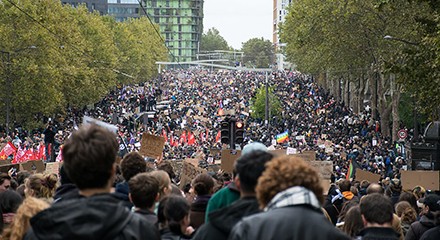
France’s high school and student protests have a simple objective: to get more resources for education. France’s education crisis is defined by severe teacher shortages, deteriorating student outcomes, and massive funding deficits - everywhere from primary schools to public universities. State education is among the most unequal in the developed world: schools in poorer areas are so under-resourced that the education system is cementing inequality.1 Students from the poorest neighbourhoods are disproportionately hard hit by staff shortages.
Students have experienced a catastrophic and unprecedented 20% drop in the education budget per student since 2017. Research by the economist Asma Benhenda, based on payroll data from the national education system, shows that the proportion of contract or beginning teachers in privileged areas like Paris or Hauts-de-Seine is just 10%.2 That figure rises to 50% in poorer departments, like Seine-Saint-Denis and Val-de-Marne, around the capital. The average salary per secondary-school teacher is about 20% lower in the poorest areas than in the wealthiest, even after taking into account the (meagre) bonuses awarded for priority education.
French teachers’ salaries consistently fall below the average for advanced economies.3 A French teacher with 15 years’ experience earns less than €40,000 - 20% below average. Early-career teachers in Germany earn twice as much as their French counterparts.4 Yet French teachers have to cope with longer hours of teaching and some of the worst pupil-teacher ratios in Europe. As a result, record numbers are leaving the profession.
To plug staffing gaps, the government launched a scheme in 2022 to recruit ‘contract’ teachers (as opposed to the standard tenure system, under which they count as fonctionnaires or civil servants). They were given four days’ training,5 despite often having no previous teaching experience. Predictably many quit within six months, owing to lack of adequate training or supervision.
And it is not just teachers who are leaving. With a dearth of supervisors, careers advisers, school doctors and nurses, among others, it is virtually impossible to deliver the school support services pupils need. The independent ‘defender of rights’ for France, Claire Hédon, warned last year that the shortage of qualified staff and suitable facilities meant that almost a quarter of all disabled children never go to school at all.6
No wonder then that, as state schools slowly disintegrate, more prosperous families are turning to private education.7 Few government ministers have any direct experience of the state school system, as many go to posh private schools. Yet these fee-paying schools also receive public funding. Meanwhile French public universities are grappling with an estimated €8 billion shortfall, which has pushed nearly all 75 public institutions into deficit budgets.
Christine Renon, the head of an infant school in Seine-Saint-Denis, committed suicide at her workplace in 2019.8 According to a letter she had sent to the school management board, she was “exhausted”. She went on to detail the deficiencies and inadequate resources of an organisation that had been left to rot. This tragedy should have shocked the authorities into a profound reappraisal. President Emmanuel Macron pledged to make education a priority for his second presidential term, but nothing has changed for the better - only for the worse.
Cost of living
While it is education that primarily worries students and teachers (and parents) in France, it is just one aspect of the deterioration of basic public services. France used to have a healthcare system that was the envy of the world, let alone Europe. Spending was high at 11.5% of annual GDP. As a result, life expectancy was much higher than the EU average. But, over the last few decades, government healthcare spending has been cut back well below the increased demand, as French people get older and need more health support. Before 2008, health spending was rising at 0.3% of GDP a year. Since 2009, the rate of health spending growth has halved to just 0.17% of GDP a year. And yet the proportion of over-65s in France has risen 40% over the same period, or more than 10 times the rise in health spending. As a result, life expectancy has virtually stopped rising.
Just as in all the major capitalist economies, the cost of living for the average French household has risen sharply, especially since the end of the pandemic slump that saw a significant inflation spike - more recently compounded by the energy shortages due to the ongoing Iran war. Price levels for average French households are now some 18%-20% higher than just four years ago and are continuing to rise as a result of the Middle East conflict. Real wages (after inflation) are up only 2.4% from five years ago and wage levels are still below where they were after the pandemic. Pouvoir d’achat (purchasing power) is continually falling.
After taking into account tax and benefits, the growth in average disposable income for French households (GDHI) has been on a downward trend in the first three decades of this century, slowing to under 1% a year under the Macron presidency.
In 2024, 9.8 million people in ordinary housing in metropolitan France were living below the monetary poverty threshold (€1,337 per month). The poverty rate is at its highest level (15.4%) since 1996, while the unemployed and single-parent families remain the groups most affected.
Although inequalities of income and wealth are not nearly so extreme as in the United States, they are still grotesque. Indeed, inequality has worsened in the last 40 years. In 1983, the top 1% of income earners took 7.5% of all personal income, 10% took 30%, and the bottom 50% received just 21.4%. By 2022, the top 1% took 12.7% (an over 60% increase), while the top 10% share rose to 34.8% and the bottom 50% share fell to 20.3%. Inequality of wealth (net personal wealth) is, as is usual in all major economies, much worse. In 1983, the top 1% of wealth holders owned 15.9% of all personal wealth in France, the top 10% had 50%, and the bottom 50% held just 8.9%. By 2022, those inequalities got even worse. The top 1% now had 24% (over a 60% increase), the top 10% now owned 57.7%, and the bottom 50% saw their share of personal wealth fall to just 5.1% (a 48% decline).
Retirement and pensions are key issues for working people. Pensions are not ‘welfare’ benefits, but ‘deferred’ wages deducted in contributions from current wages in order to provide a decent life in old age. French workers have fought over many decades to achieve pensions at a reasonable retirement age. France allocates around 14% of its GDP to pensions - one of the highest rates in Europe and significantly higher than countries like the UK, which spends around 5% of GDP and so delivers the lowest state pension in the advanced capitalist world. But contribution rates (deferred wages), from workers and their employers, are correspondingly high at 28%.
French businesses and successive governments have spent much energy over the last few decades trying to reverse these pension rights by a combination of increased contributions, reduced pensions in real terms and by extending the retirement age. The argument of governments, including the Macron administration, is that an ageing society can no longer afford ‘generous’ pensions. They claim that the pension system faces ‘structural deficits’: ie, the payouts are now regularly exceeding the contributions.
When Macron ran for re-election in 2022, he told voters that the retirement age would have to rise to ensure the continued viability of the country’s pensions system. He forced through a change in the retirement age from 62 to 64 years. But raising the retirement age and cutting pensions in real terms significantly hits French people’s living standards when they retire.
As in many other countries in Europe, France is also experiencing a deepening housing crisis. There are two million requests for social housing pending - they will never see their needs met. Rising rent prices, inflation and overall economic pressure are pushing families to the edge like never before. From overcrowded cities to skyrocketing living costs, the situation is becoming impossible for huge numbers. Millions of French citizens are now being forced to live in their cars, as the housing crisis across France continues to spiral out of control.
In sum, France’s public services - social care, roads, transport, youth facilities, garbage collections, sewage and water supply, etc - have been deteriorating for decades. Government after government responds by saying that these services are no longer ‘affordable’. And their mainstream economist apologists argue that the huge rise in public-sector debt and continual annual budget deficits must be ended. Over the past 15 years, the public debt ratio (debt to GDP) has risen significantly. French public debt reached 119% of GDP in mid-2026 and is expected to increase to 128% in 2027.
No alternative
Austerity is the message of the Macron government: there is no alternative, the public is told. The draft budget aims to reduce the public deficit to 5% of GDP in 2027 - it was 5.1% in 2025 and 5.4% in 2026. Such a reduction would require €43 billion-worth of ‘new measures’. Without them, the government estimates that the deficit would reach around 6.5% next year. Those ‘new measures’ would include the elimination of 3,000 civil service jobs by 2027 without replacement; a cap on government healthcare spending at €5 billion; reductions in unemployment insurance and pension schemes; the elimination of two national holidays (Victory Day and Easter Monday) to increase productivity; and yet again further reductions in regional and local expenditures.
Of course, there is one part of public spending that will not be cut: ‘defence’. On July 14 (‘Bastille Day’) 2025, Macron announced that France’s military budget will reach €64 billion by 2027, three years ahead of schedule. Specifically, €3.5 billion will be added this year, and another €3 billion in 2027 - all to meet the Nato pledge to increase national member defence spending to 5% of GDP by 2035 (3.5% for military expenses and 1.5% for infrastructure). As the head of state of a key Nato member, who perceives the ‘Russian threat’ as acute, Macron has committed his administration to meeting this target.
Le Monde, the French mainstream news source, reckons that France’s “top priority must be to reassure investors of its ability to repair its finances”.9 So the financial markets rule. But all this talk of profligate public spending and debt is a false flag by French governments, as well as the ‘bond vigilantes’ in financial markets, who are selling French government bonds and increasing the cost of borrowing for governments and households alike.
What is always ignored is that France’s non-financial, private-sector debt is actually much larger than public-sector debt. The former reached 134.2% of GDP in 2026, more than 30% higher than the average in the euro area. It is the private sector (with real estate and financial speculative borrowing) that is most vulnerable and, when a financial crash occurs in the capitalist system, it is the public sector that must bail out the private banks or major lenders. And, in capitalist slumps, the government must spend more on unemployment benefits and take in less in taxes, so government deficits spiral.
The history of France’s public debt shows that it is in periods of capitalist slumps and financial crises that public debt rises the most - and then afterwards bond-holders demand that the rest of us reduce this debt by cutting services and pensions and raising taxes. After the 1980-82 slump, faster economic growth and austerity measures stopped the debt ratio rising by 1987. Then the next slump of 1991-93 accelerated the rise in debt again, before economic recovery (and more austerity measures) eventually led to a fall in the debt ratio. Then the global financial crash and the ensuing great recession led to a 20% rise in the debt ratio. Severe austerity measures during the slow-growth long depression of the 2010s eventually stopped any further rise in the debt ratio, before the pandemic slump drove it up again. What this shows is that without the impact of several crises in capitalism, the government debt-to-GDP ratio would have hardly risen. Each batch of austerity measures aims to reduce the public debt ratio originally caused by busts in the private sector, where the debt goes on rising.
The real cause of France’s affordability crisis is its significant economic slowdown. In the 21st century, France has experienced low real GDP growth, steadily falling over the last 40 years. And now, in the 2020s, it has virtually ground to a halt.
Behind any relative stagnation in investment and productivity growth lies falling profitability of French capital. French capital’s profitability started to decline sharply at the beginning of the 21st century (on the advent of the euro) and gathered pace after the great recession. Average profitability is now near an all-time low after a fall during the pandemic slump l
Michael Roberts blogs at: thenextrecession.wordpress.com
-
See www.theguardian.com/world/2023/jul/02/no-hope-anger-poverty-riven-french-district-borny-france-riots.↩︎
-
www.fayard.fr/livre/tous-des-bons-profs-9782213717326.↩︎
-
www.liberation.fr/societe/education/classes-chargees-salaires-bas-les-profs-francais-moins-bien-lotis-que-leurs-voisins-20221223_JDQZLAMQEBH57BIUCVP4NCNZYM.↩︎
-
www.touteleurope.eu/societe/le-salaire-des-enseignants-en-europe.↩︎
-
www.lesechos.fr/politique-societe/societe/rentree-scolaire-prof-en-quatre-jours-1784970.↩︎
-
www.tf1info.fr/societe/video-a-une-semaine-de-la-rentree-scolaire-l-unapei-alerte-sur-la-scolarisation-des-enfants-en-situation-de-handicap-2267945.html.↩︎
-
www.lexpress.fr/societe/a-lyon-lenseignement-prive-comme-refuge-face-aux-ghettos-du-public-2U4UDZHULBBNZPUJI6C73Y6CMU.↩︎
-
www.huffingtonpost.fr/life/article/je-suis-tellement-fatiguee-la-lettre-de-christine-renon-la-directrice-de-maternelle-de-pantin-avant-son-suicide_152261.html.↩︎
-
www.lemonde.fr/en/opinion/article/2026/10/16/la-france-insoumise-s-alternative-budget-the-uncertain-gamble-of-a-stimulus-plan_6758676_23.html.↩︎