
08.10.2026
Two out of three
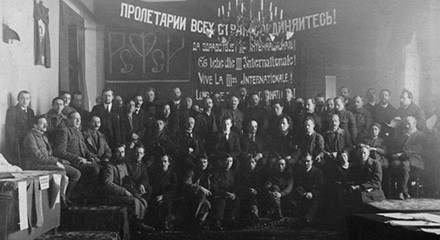
Should we strive to re-establish Comintern? If not, what sort of international organisation do we need and what can we achieve in the altogether famished here and now? Mike Macnair outlines our broad approach. This is an edited version of his Online Communist Forum talk
I respond here to an article by Edith Fischer of Australian Communist Unity and Elise van der Doelen of the Netherlands Revolutionair Socialistische Partij that has been published - if not quite simultaneously, then very nearly so - in four places.
In this paper it appeared as ‘Re-establish Comintern’.1 On the US website, Cosmonaut, it ran as a letter - ‘Back to Comintern: the struggle for international communist regroupment’.2 In Australian Communist Unity’s Partisan it carried the same title.3 And in Prometheus, here in Britain, it appeared as ‘The struggle for international communist regroupment’, dropping the reference to Comintern altogether.4 I am not going to apologise for our editor’s choice to make ‘Re-establish Comintern’ the title - a newspaper headline has to be snappy. Nor do I think the Prometheus comrades need to apologise for their decision to cut Comintern out of theirs.
The article sets as its strategic goal the refoundation of the Communist International, which it says was illegally (better, arbitrarily) abolished by the leadership of the Communist Party of the Soviet Union in 1943. I want to be a little cautious about the word, “illegally”. Consider, by comparison, the decision of the Taaffeites to exclude the majority of the international executive committee and the sections of their organisation, the Committee for a Workers’ International. They justified it on the grounds that most CWI members were in Britain and backed Taaffe. I do not know whether that was true - I suspect it was not. If it had been, the logical course would have been to hold a congress and let the split come afterwards, once Taaffe’s opponents on the IEC had been shown to be a minority.
Now apply the same logic to Comintern in 1943. Since the CPSU held state power, it is almost certain that the majority in Comintern were CPSU members. There is an English company law principle, from the case Re Duomatic, which says that if you had the majority needed to do something formally, it does not matter that you did it informally. In that sense, Comintern was a creature of the Russian Communist Party, later the CPSU, almost from the outset - and certainly by the time of its 1935 seventh congress. For the CPSU to dissolve it was therefore not “illegal”. It was politically objectionable.
Towards the goal of re-establishing Comintern, the article sets three immediate tasks:
- Building systematic fraternal relations among the advocates of principled international communist regroupment - what people have called the ‘partyist’ trend.5 That means reprinting one another’s articles, translating material where needed, circulating it, and keeping in correspondence.
- Establishing a correspondence committee to organise those fraternal relations in practice.
- Launching an international campaign for a new international, uniting Marxists in an international faction - in the article’s words, “a fighting formation within and among the existing international formations”.
I should say that I am not speaking formally on behalf of the CPGB’s Provisional Central Committee. We have discussed this, and the comrades on the PCC are broadly in agreement, but what follows is my view rather than a PCC position.
On the first proposal - systematic, organised fraternal relations within this trend - I and the PCC are absolutely and unambiguously for it. On the second, the correspondence committee, we are also for it, provided we can make it work. There are serious practical difficulties: the Australian comrades are 10 or 11 hours ahead of UK time, and the American comrades between five and eight hours behind. It is not easy to organise, but we should do it.
The third proposal - an international faction, or a campaign for an international, as “a fighting formation within and between the existing international formations” - is, I think, seriously problematic.
I also think that the strategic line of campaigning to re-establish Comintern is the wrong way to pose the question of international organisation. I will return to my reasons after addressing some of the more general issues the comrades raise.
Common ground
I start with what I think is common ground: the workers’ movement objectively needs an international. This is fundamental to Marxism. It goes back to the Communist manifesto of 1848, drafted by Marx and Engels for an organisation made up mainly of migrant workers in London from all over Europe - hence its statement that communists of various nationalities have come together to write it. The next step was the founding of the First International in 1864.
The step beyond that is Marx’s Critique of the Gotha programme (1875). Point five of the draft programme said that the working class strives for its emancipation “first of all within the framework of the present-day national state, conscious that the result of its efforts, common to the workers of all civilised countries, will be the international brotherhood of peoples”. Marx replied that “Lassalle, against the Manifesto and all earlier socialism, had conceived the workers’ movement from the narrowest national standpoint - and was being followed in this even after the work of the [First] International.” He went on:
It is altogether self-evident that, to be able to fight at all, the working class must organise itself at home as a class and that its own country is the immediate arena of its struggle. In so far as its class struggle is national, not in content, but, as the Communist manifesto says, “in form”. But the “framework of the present-day national state” - for instance, the German empire - is itself, in its turn, economically “within the framework” of the world market, politically “within the framework” of the system of states. Every businessman knows that German trade is at the same time foreign trade, and the greatness of Herr Bismarck consists, to be sure, precisely in his pursuing a kind of international policy.6
The fundamental point is this: there is no socialism in one country, because there is no capitalism in one country. Capitalism is an international social formation. It grew up on the basis of the international shipping industry, which was the core of the capitalist circuit M-C-P-C′-M′- money, commodity acquisition, productive labour under a dictatorial factory-management regime, returning the resulting worked-up commodity to money. The ships and the docks were the first factories involving the real subsumption of labour to capital. Shipping reorganised production around itself, in both the Mediterranean and the North Sea, and capitalism developed from the start as an international formation.
The consequence is that capitalist political power necessarily aspires to global reach. The Dutch Revolution immediately drew the Netherlands into worldwide wars with Spain, reaching as far as Taiwan, Malacca, Brazil and Indonesia. The English Revolution’s seizure of power immediately entailed the bourgeoisie’s conquest of Scotland and Ireland, followed rapidly by large-scale naval operations and the colonisation of Jamaica. The years 1689-1713 were, again, a global war. Capitalism is an international order.
It follows that attempting to take power in a single country is hopeless. Socialists have believed in it episodically: Georg von Vollmar argued in 1878 for the “isolated socialist state”, and Karl Kautsky, in his 1891 The class struggle, argued that the introduction of socialism - meaning the dictatorship of the proletariat, the first stage of the overthrow of capitalism - would reduce international trade and lead to nationally structured production. The idea has resurfaced again and again, but it is a dead end.
Because capitalism is an international economic and political order - a world market and system of states, to use Marx’s terminology - the question of revolution is posed in the context of international revolutionary waves. That said, the comrades make what I think is a mistaken claim: that an international revolutionary wave is possible only when combined with pre-existing revolutionary organisation, and that it was the pre-existing internationalist organisation in Europe that made the post-1917 wave possible.
This is wrong. 1848 was an international revolutionary wave. The Paris Commune of 1871 was the high point of another, visible also in the American Civil War and in the first Spanish republic of 1873-74. And we have seen revolutionary waves without any powerful, effective internationalism, after Comintern was dissolved: one from 1944 to 1949, and another running roughly from 1967 to 1979 or 1980 - at a time when the ‘official communist’ movement was actively promoting socialism in one country and national roads to socialism.
So we do not need organisation in order to have international revolutionary waves. There will be such waves, because capitalism is an international formation. Many other consequences follow from that fact; the so-called ‘law of uneven development’ is really a misdescription of the way capitalism, as an international order, normally involves an imperial state exercising control over a subordinated country and adapting the latter’s economy to the interests of the imperial economy.
What political party organisation is needed for, is reaching for power. In a revolutionary wave the workers throw up improvised organisations of struggle - Maciej Zurowski has a useful letter in the October 1 Weekly Worker about the workers’ councils in the Austrian revolutionary crisis. But without a party that seeks to overthrow the existing political order and create a new one, the wave grows, breaks, wears itself out and collapses in demoralisation.
Global dual power
My second, more general point is about understanding where we have been and what that means for where we are. From 1944 to 1991 world politics was characterised by a sort of duality of class power. On one side stood the Soviet regime. It was not the dictatorship of the proletariat, in the sense that the proletariat was not in charge. But it stood in an inextricable social relationship to the proletariat as a class: it held itself out as the proletarian, socialist state, and it drew a significant part of its cadre from the urban working class - even though the rank and file of its army were mainly peasants.
In the conditions of the global popular front between the USSR and the ‘democratic’ imperialists between 1941 and 1944, the war massively increased Soviet power and allowed the USSR to extend itself geographically: into eastern Europe, into Korea, and into Afghanistan. Afghanistan, though a feudal monarchy, was a subordinate Soviet ally, and between 1945 and the Saur Revolution of 1978, its army officers were trained in Soviet military institutions.
This general extension of Soviet power between 1945 and 1949 carried with it the victories of the Chinese, Yugoslav and Albanian revolutions - not through Soviet armed forces directly, as in North Korea, but through armed communist parties taking power. It created the conditions for the Vietnamese revolution, the Cuban revolution of 1959-61 and the South Yemeni revolution of 1967-70.
The result is that the left as a whole, the Trotskyist left included, became addicted to the idea of revolution in a single country - and to the idea that such revolutions occur naturally, on timescales set by long-run historical national development and essentially separate from international political rhythms. The Spartacist International Communist League currently promotes small-nation nationalism - which could only have a strategic value for communists if the aim was to follow the national revolutions of the cold war era. Under present conditions it serves the geostrategic interests of the USA: small states can more easily be coerced.
On this point I am on common ground with comrades Fischer and van der Doelen: the idea of a chain of national revolutions fails, and it became obvious after 1979 that it fails. Nicaragua is the clearest example. Nicaragua could not follow Cuba, because the Soviet Union did not want it to - and could not intervene there, as it had in Cuba. It had been able to do so in Cuba only because events took place in the lame-duck phase of the Eisenhower presidency.
It had done so because the Soviet leadership was then posturing to the left in competition with the Chinese in the early stages of the Sino-Soviet split. There were many other cases during the ‘cold war’ in which Soviet geopolitical and diplomatic interests led not to the creation of partial clones of the Soviet regime (as in Yugoslavia, Albania, China, Vietnam, Cuba, South Yemen), but to the defeat and destruction of powerful communist parties (as, for example, in Egypt, Iran, Iraq, Indonesia …)
Nicaragua demonstrated what has happened every time since, Venezuela included. There have been serious revolutionary movements, and people have attempted to create councils and take power. But without a Soviet Union - without global dual power - taking power in a single country simply fails. The imperialist state can crush you through a combination of economic sanctions, subversion and covert operations of one sort or another.
Even the Russian revolution was not really a socialist revolution in a single country. It was a socialist revolution in one of the great European empires, complete with most of its colonial possessions. The capitalists did manage to strip away eastern Poland and the Baltic states, and that mattered: they were major industrial centres and major concentrations of the proletariat, so their loss weakened the class position of the proletariat in the USSR.
So the need for an international is real, and the comrades are right to say that we cannot imagine one being created on the back of a revolution in a single country, so untouched by shortages, tyranny, sabotage and the need to fight sabotage, and by imperialist lies, that it becomes a shining beacon - a city on a hill that everyone else aspires to copy. The idea that Britain could do this because of its industrial strength is nonsense. The UK imports 40% of the food it consumes and much of the raw material for what remains of its industry. An attempt at socialism in one country here, without Europe-wide support, would end in catastrophe and mass starvation - and would teach everyone that revolutionary politics is a disaster and that we must work within whatever the United States allows us, which is less and less as time goes on.
Yet the bulk of the left still holds to the delusion that, if we could just make the revolution here, it would be a shining beacon and everyone else would follow, as with the Russian Revolution. That is completely false about the Russian Revolution itself. It took place in the midst of a world war, as part of a revolutionary movement that included the French army mutinies of 1917 and continued through the German, Austrian and Hungarian revolutions, the ‘world on fire’ of 1919 and the Biennio Rosso in Italy. The Russian Revolution was not the spark that lit the prairie fire: the prairie was already alight, and the Russian Revolution was part of that.
Too many
Comrades Fischer and van der Doelen go on to offer a descriptive criticism of the actually existing international organisations. It is an incomplete account, and the incompleteness matters.
One big absence is the Mandelites. I single them out because they are not an organisation with a single national mothership. The Mandelite Fourth International is a real organisation that is not immediately politically dependent on the French section - the former Ligue, now the Nouveau Parti Anticapitaliste - even if it is probably financially dependent on it. Compare the International Socialist Tendency, which is immediately dependent on the Socialist Workers Party; the Committee for a Workers’ International, dependent on the Socialist Party in England and Wales; and the Revolutionary Communist International, dependent on the Grantite Revolutionary Communist Party, formerly Socialist Appeal. I am not sure of the current position of the Spartacists, who had an American mothership in the Spartacist League of the United States, but now seem to have become more centred on their Quebec organisation. And there is a whole list of further absences: whatever the organisation around the French Lambertistes now is, the various organisations led out of Argentina, and so on.
This matters because the problem is not that people form national organisations in the belief that a breakthrough in one country will make world revolution possible. Rather, it is that the organisational conceptions underlying the Third International (and the Fourth) produce an endless proliferation of new internationals.
Nor is this only a Trotskyist phenomenon. There are multiple Maoist internationals. Besides the international meetings of ‘official communist’ parties that the article mentions, there is a splinter from them organised by the KKE, the Communist Party of Greece, which is distinguished by regarding Ukraine as an inter-imperialist war and by being more sceptical of the Chinese Communist Party than ‘official communist’ parties like the Morning Star’s CPB.
So the problem facing the left is not, as the comrades put it, that the chain of proletarian internationalism was broken in 1943. What we have instead is a multiplication - and a legitimation - of competing organisations at the international as well as the national level. This is shaped by particular political conceptions: anti-factionalism; the international as the “general staff of the world revolution”, an idea influenced in Comintern by the Prussian grosser Generalstab (‘great general staff’), the organising centre of the German armed forces in the 19th and early 20th centuries; and above all the notion that facing outwards to the masses lets you ignore ‘the sects’, meaning other groups you do not agree with.
The result is not that there is no international, but that there are endless internationals! There are too many internationals, just as there are too many left groups in every country - I cannot think of a country where there are not, though no doubt someone will.7
So the task of building an international is not posed as “reconstruct Comintern”, nor as “reforge the Fourth International”, nor as overcoming an excessively national left. On the contrary, the left is committed to internationalism. It is its other commitments - anti-factionalism, facing outwards to the masses, leapfrogging your competitors - that lead it to produce multiple, completely ineffective internationals.
Oil-slick
This brings us to the third element of comrade Fischer’s and van der Doelen’s proposal: an international campaign for a new international, uniting Marxists in an international faction. A faction of what?
I can imagine trying to build a faction within the KKE’s international conferences, or an external faction of the Mandelite Fourth International. I am not saying either would be right - only that these are the kinds of things an international faction could actually be a faction of. In our actual circumstances, there is no international equivalent of the Democratic Socialists of America in the US. Nor is there an international equivalent of the various broad-front attempts in this country - the Socialist Labour Party, the Socialist Alliance, Respect, Left Unity, Your Party. Nobody has attempted to build a broad-front international since the social forums movement lost its impetus with the return of imperialist war.
What remains of the Second International has been described as the ‘AFL-CIA’: the rightwing leadership of the American trade union movement allied itself with the CIA to reorganise labour movements elsewhere as vassals, held in subordination to the US. It has included - perhaps still does - the Pakistan People’s Party and the Indian National Congress: nationalist bourgeois parties. The international meetings of communist and workers’ parties do have serious political impact, which is why the KKE was forced to split over the question of inter-imperialist war. And then there are the competing groupings that Jack Conrad has rightly called ‘oil-slick internationals’: extraordinarily thin layers of communist oil spread across the vast, fluctuating sea of the international movement.
If the reality was the total absence of internationals, creating a new, ultra-small, organised international trend would be to raise the banner of the international. But the reality is multiple internationals. And, just like multiple small groups on the national level, the creation of multiple small internationals opposes the absolutely elementary interest of the working class in united action in spite of religious, etc, disagreement (which is the reason why the working class is the potential creator of socialism). The line of ‘facing outward to the masses’ supposes that the left is splintered because of its separation from the working class. The reality is the exact reverse: the left is separated from the working class because of splintering.
So it is useful and valuable for ‘partyists’ to get together and coordinate. Yes, talk, please! It is an immediate concern for us in the CPGB that the ‘partyists’ of Prometheus refuse to talk to the CPGB, or that Anne McShane is excluded from Irish People Before Profit and the Marxist Republican tendency within it - which self-identifies as ‘partyist’ - because of her association with the CPGB.
A permanent correspondence committee would be valuable. Multilateral contact would be valuable, in place of the very informal bilateral talks we have had from time to time. We want more of that, and we need to improve on it.
But an international campaign for a new international would come across as simply creating another oil-slick international - partly because the layer of oil is too thin. There just are not enough of us. The CPGB is really small. The RSP in the Netherlands is not very big either: it may think of itself as significant at a few hundred members, but, measured against the kind of party objectively needed, a few hundred in the Netherlands is microscopic. The Marxist Unity Group in the US has had real influence in the DSA, pushing it towards taking political stands rather than being a lobby for social reform within the Democratic Party. That is good, but on the scale of the US (a 342 million population) the DSA itself of around 120,000 is not large (0.3% of the population), and MUG is much smaller.
The problem with oil-slick internationals is not the bad faith of comrades wanting internationals in their own image, with a mothership in England, the US, Argentina or France. It is that, because the forces are so weak, any attempt to create an organised international simply produces another oil slick. Hence the advice we can offer from the CPGB, for what it is worth: caution.
Short history
Finally, and briefly, on Comintern and the history of the internationals. The First International was created in 1864-65 and lasted until 1870-71, when it split over whether to advocate participation in elections or oppose it - the latter being the position of the Bakuninist wing. Marx, Engels and others proposed moving its headquarters to New York, giving us a short-lived Marxist international based there, followed by an equally short-lived anarchist and possibilist international based in Europe.
The Second International was created in 1889 and took its definitive form in 1896, split decisively with the Bakuninists, and committed itself to being an international of parties that stood for electoral intervention, together with trade unions that did not oppose it. It lasted for roughly two decades and blew up in 1914 as a result of World War I. It is worth noting that it was not only the right wing - the advocates of gradualist reformism - who backed their own states. Leftwingers did too: Parvus and his co-thinkers in the Die Glocke group, who had been leaders of the anti-imperialist wing of the SPD, became advocates of German victory.
Comintern was created in 1919-20 and dissolved in 1943, by which point it had not held a congress since 1935 - and that congress came seven years after the one before. It, too, had a limited existence, just as the Second International did.
There were other attempts. A ‘Two-and-a-Half International’ was attempted in the 1920s. A left-communist Fourth International was attempted in the 1920s and failed. The Trotskyists’ Fourth International was founded in the late 1930s; in 1940 it split into two roughly equal halves over Soviet defencism, and split again, among those who had not already gone, over proletarian military policy versus revolutionary defeatism. As far as I can see, it was reassembled in 1946, largely on the basis of people who had broken with Trotsky before 1938 over their willingness to build broad fronts with popular-frontists - not entirely, but substantially. Since then there has been splinter upon splinter, alongside repeated attempts to reconstitute Comintern by the Maoists, and by the ‘official communists’ in the form of the Cominform and subsequent meetings of communist and workers’ parties.
The upshot is that calling for Comintern’s re-establishment does not make sense. I can see why the comrades might have taken this approach. We in the CPGB assert a title to our party’s name - not as a legal continuity, which we are not, but on the basis that in 1991 the comrades of the Leninist faction denied the Eurocommunists’ right to take away our CPGB membership rights and duties. We have maintained the name ever since. It might make sense to do the same with Comintern if some faction had denied the Soviet leadership’s right to wind it up in 1943 and had kept the idea alive ever since.
But to call for the reconstitution of Comintern 83 years after its dissolution is, in essence, to call for its uncritical restoration - complete with the reasons it failed. That is not the new international we need.
A new international will inevitably be built through a process of regroupment: splits and fusions among the existing Marxist left and the existing Marxist international tendencies. In that sense the comrades are right to talk of work within and among the existing international formations. But you cannot actually be a faction of a dozen, or two dozen, different organisations. In the present situation we are simply not in a position to pursue that policy.
Setting the goal as reconstituting Comintern is a misconception. It fails to take account of why Comintern failed, and of the fact that its other components were in no position to defend it against the CPSU. It is a misleading strategic objective. Of the comrades’ three more limited practical proposals, the first two are potentially useful. The third is not.
-
Weekly Worker September 24: weeklyworker.co.uk/worker/1602/re-establish-comintern.↩︎
-
cosmonautmag.com/2026/09/letter-back-to-comintern-the-struggle-for-international-communist-regroupment.↩︎
-
partisanmagazine.org/2026/09/22/back-to-comintern-the-struggle-for-international-communist-regroupment.↩︎
-
prometheus-mag.com/2026/09/15/the-struggle-for-international-communist-regroupment.↩︎
-
This label is potentially misleading, since some people identify themselves as ‘partyists’, but balk at the necessities of creating a party: that is, freedom of speech, the rejection of anti-factionalism and, on the other hand, the organising discipline needed to raise resources and publish. But let us use that label for now.↩︎
-
In the discussion at the OCF, comrade Jack Conrad pointed to the remaining ‘bureaucratic socialist’ regimes (or regimes with this political integument) as lacking multiple competing left groups (China, North Korea, Vietnam, Cuba) … Obviously, we do not favour the suppression of competing tendencies ‘from above’.↩︎