
26.11.2026
Challenging false assumptions
According to the standard Trotskyist narrative, the 1956 events in Hungary were an aborted political revolution. A comforting story that led them to celebrate the restoration of capitalism in eastern Europe and the former Soviet Union over 1989-91. Mike Macnair always had his doubts
Seventy years on, the Trotskyists of 2026 are repeating their old myths of Hungary 1956.
Thus the ‘Atlanticists for Workers’ Loyalism’ (Alliance for Workers’ Liberty) have a supplement in Workers’ Liberty reprinting articles from Hal Draper and others from the US Shachtmanite Workers Party’s Labor Action in 1956. Will Roberts, introducing them, says: “The Hungarian Revolution of 1956 lasted no longer than a few weeks, and was followed by a period of dark reaction, but it proved something that no moment before it had: that Stalinist dictatorship could not quell the workers’ inherent urge to fight for freedom.”1
Duncan Chapel has translated a speech by Ernest Mandel from 1976, making similar arguments,2 while Anti-Capitalist Resistance has a shorter piece by John Lister from 1996.3 For its part Workers Power reprints Dave Hughes from 1986, claiming that “The Hungarian uprising of 1956 contained the potential for the revolutionary destruction of Stalinism both within Hungary and beyond its borders. It opened the prospect of destroying the political rule of the Stalinist bureaucracy and replacing it with the direct political rule of the revolutionary proletariat.”4
It therefore seems worth (perhaps as a provocation!) finally publishing what I wrote 30 years ago about Hungary 1956 and the Trotskyists. The text that follows is one which I wrote before I came to the view that 1989-92 disproved Trotskyism as well as ‘official communism’ and Maoism. I had in 1985-86 written at considerable length on the history of the International Marxist Group-Socialist League, of which I had been a member (with a gap) since 1974. (This document is available on the ‘Red Mole Rising’ site, and has been recently critically reviewed by Duncan Chapel. I agree with comrade Chapel that it overestimates the significance of philosophical issues in the history of the IMG-SL, and underestimates the significance of the international issues in the 1985-86 split.5)
At the end of the 1985-86 IMG-SL history text I argued that the Fourth International itself was one of the sources of the persistent opportunism (in the sense of lack of stable strategic line and bandwagon-jumping, not of rightism) of the IMG-SL. I therefore embarked on writing a similar, long, critical document on the history of the Fourth International. This was mostly history from before I was involved (and quite a lot of it history from before I was born!). I went on working on this project after I left the ISG in 1993, but in the end I never carried it beyond 1967.
Part of the document was an argument about Hungary 1956 - an event which, I argued, was part of the process of disorientation of the Trotskyists (another important part of that process was the Cuban revolution).
It will be apparent from the text that it is significantly influenced by the arguments of Vince Copeland’s 1956 document, The class character of the Hungarian uprising, which is available on the Marxists Internet Archive;6 my view at the time of writing was that Copeland’s basic arguments were largely corroborated by sources that were not committed either to the ‘official communist’ or Trotskyist views, or to the 1950s-60s west European media promotion of the idea of a social democratic ‘third way’ in the cold war period.
More fundamentally, I thought in the 1980s-90s, and still think, that we have to read the very short-lived crisis of October-November 1956 in Hungary in the light of the political dynamics of 1980-82 in Poland and 1985-91 in the Soviet Union: in both cases there was more opportunity for the political dynamics of the crisis to develop, and those dynamics were clearly predominantly to the right.
The framing of the extracts that follow is that in my view Trotsky and his co-thinkers in 1938 radically misunderstood the nature and shape of the then-coming war, mistaking the death agony of the British world hegemony for the death agony of capitalism. Besides the disabling effect of this assessment in the war, the effects continued after the war, as the large majority of Trotskyists failed to grasp that the overthrow of sterling and the destruction and devalorisation of capital assets during the war and in its immediate aftermath would allow a new long boom period.
By assuming the ‘death agony of capitalism’, they had flattened out the global situation, with the result that they had also de facto committed to a ‘national roads to socialism’ approach. Contrary to Marx’s comment on the issue in the Critique of the Gotha programme,7 the global and geopolitical contexts of national events were practically ignored.
My text attempted to analyse in outline how the global boom in the cold war period reshaped the national political dynamics of what the Fourth International in 1963 was to characterise as the ‘three sectors of the world revolution’: the imperialist countries and ‘advanced’ settler-colonies, the several different parts of the colonial world, and the bureaucratic regimes (in the text below I characterised these as ‘workers’ states’). This general discussion was the context for a slightly later discussion of Hungary 1956.
I have adapted the text to Weekly Worker style guidelines, added the first names of leaders, expanded some abbreviations, and put in a couple of footnotes - but the extracts from the text are otherwise ‘warts and all’, as I wrote it in the early 1990s.
Boom
In the workers’ states too the boom of the world economy both stabilised and destabilised the bureaucratic regimes, producing episodic rather than endemic crisis. The nature of these crises, moreover, reflected primarily the pressure of the ascendant bourgeoisie rather than of the proletariat.
The war mobilisation in the USSR, and revolution in the other workers’ states, lent an impetus to economic development and provided a basis of mass loyalty to the regime in a certain generation of the working class. (Outside the USSR the extent of this impetus and loyalty varied with the relative weights of the mass movement and the Soviet Red Army in the social overturns.) The boom and ‘decolonisation’ gave considerable scope for increased trade between the workers’ states and the capitalist-dominated world, and in this way the world boom fed the economic development of the workers’ states. In these conditions the bureaucracy was able to devote considerable resources to keeping the industrial proletariat sweet: if the working and living conditions of the proletarians of these states did not match those of the better-organised sections of the proletariat in the imperialist countries, they far outstripped both pre-war and colonial and neocolonial conditions. This fact provided a solid basis for the ultimate stability of the Stalinist regimes in the boom period.
However, from the early 1950s it was clear that the workers’ states were still a long way behind the imperialist countries and that their economies were not growing as fast. Even the partially planned production that is possible by eliminating the national dictatorship of the bourgeoisie in a capitalist-dominated world can eliminate crises of overproduction. However, any growth in such a regime - and growth without the competition of private proprietors can only be politically motivated - is inevitably slower than the hectic accumulation of the upward phase of a capitalist cycle. This is both because it is partially planned, and because it is not based on screwing the last drop of surplus out of the productive workers. In addition to this ‘slow growth’, the Stalinist regimes faced the problems that:
(a) Before the revolutions, Russia and Czechoslovakia were sub-imperialist rather than true imperialist countries; eastern Germany was both smashed up in the war and plundered by the Soviet bureaucracy; and the remainder of the workers’ states were all semi-colonies. They started several steps behind the imperialist centres in culture and technology, and this lag could only turn to a lead if there were to be a major regression of the imperialist countries (highly destructive inter-imperialist war, not involving the workers’ states - a possibility actually excluded by the results of World War II).
(b) These reasons for a ‘lagging economy’ are exacerbated by the constant military pressure on the workers’ states maintained by imperialism. Indeed, part of the purpose of this military pressure is precisely to cause economic problems with the result of producing internal political crisis. The results of Hitler’s war clearly meant that the policy-making centres of US imperialism were not prepared to contemplate a frontal military assault on the USSR, especially after the USSR got the bomb. But these policy makers never abandoned the ultimate aim of the reconquest of the workers’ states - as has, in the event, ultimately happened.
(c) The Stalinist bureaucratic regime also exacerbates these problems, dislocating production through secrecy, corruption and arbitrary decisions, and wasting the social surplus on ‘prestige’ projects that lack material or real political value. The bureaucratic regime and the privileges of the bureaucracy act as a material disincentive to workers, exacerbating the problems of weakness of culture and technique. The concessions of the bureaucracy to bourgeois nationalism in the period of construction of new workers’ states tended to ‘Balkanise’ the part of the world economy removed from direct capitalist management.
This ‘growth gap’ and continuous military pressure acted together like a ratchet to tighten the squeeze on the workers’ states, while imperialist boom gave political attractiveness to the bourgeoisie, especially among the petty bourgeoisie, the bureaucracy itself and the youth. The political character of the bureaucracy made it inevitable that its response to these problems would be (1) to try, with little success, to force the workers to work harder, while (2) making concessions to the bourgeoisie, both economic (‘liberalisation’ and ‘marketisation’) and political-ideological (nationalism, cult of the family, accommodation to religion, ‘thaw’ for the intelligentsia).
These concessions had the effect of sharpening the antagonisms between the bureaucracies of the different workers’ states, and producing a series of episodic crises in individual workers’ states. Internationally, the Tito-Stalin split was followed by a series of show trials to reassert Kremlin control in eastern Europe. Then in 1959-61 came the biggest development: the Sino-Soviet split; and from that time on the assertion of a degree of autonomy by individual national Stalinist regimes became more and more common.
The national crises combined in varying degrees initiatives of sections of the bureaucracy towards ‘liberalisation’ and marketisation, and struggles of the proletariat against austerity and bureaucratic privilege. The Berlin uprising of 1953 and the Polish strikes of 1956 were clearly and unambiguously dominated by the proletariat; the Hungarian crisis of 1956 started from a ‘liberalising’ initiative by a section of the bureaucracy, but the leadership rapidly fell into the hands of a peasant-based bourgeois leadership; the Chinese ‘Cultural Revolution’ started with an intra-bureaucratic faction fight, which let loose a movement of workers and youth in the cities that had to be controlled by militarisation and mass deportations to the countryside; the Czech ‘Prague Spring’ began and ended as a liberalising movement of a wing of the bureaucracy, supported by the petty-bourgeois intelligentsia, without a significant political intervention of the proletariat on either side. In contrast the persistent crises in Poland and Yugoslavia from the 1970s to some extent shared the form of these earlier events, but without the context (the world boom) that made bureaucratic restabilisation possible.
The Berlin uprising of 1953 belongs, in terms of the history of the class struggle, with the crises of the boom period, but in terms of the history of the Fourth International (FI) it belongs with the 1953 split. The Berlin workers, having at this early stage no desire for the restoration of capitalism, did not in their struggle against the bureaucracy raise the slogan of withdrawal of Soviet troops (in Germany more than anywhere else the true meaning of this slogan - ie, introduction of imperialist troops - was obvious). The International Secretariat (ISec) side of the split did not raise this slogan either, explaining its failure to do so with the tailist argument that since the workers were not raising the slogan, the FI should not do so. The rightwing/‘International Committee’ (IC) side of the split interpreted this as further confirmation of the ISec’s evolution towards Stalinism.
The same year - 1953 - saw the death of Stalin and the beginnings of a ‘thaw’ or ‘deStalinisation’ in the USSR, initiated by the ‘collective leadership’ in their struggle against Lavrenti Beria, the first deputy chairman of the council of ministers. This development similarly formed part of the ISec-IC debate, with the ISec arguing that it was an aspect of the inevitable internal breakup of the bureaucracy; the IC that it was a left manoeuvre to head off the pressure of the masses. If any external pressures were involved, what was in question was a right shift in response to the pressure of imperialist democracy, mediated by the managerial and intellectual classes. The dominant character of the turn, however, was a short-term internal manoeuvre against Beria’s base in the secret police. After the fall of Beria, the ‘thaw’ slowed up sharply, but not before ‘liberalising’ and nationalistic leaderships round Władysław Gomułka and Imre Nagy had been installed in Poland and Hungary, only to be replaced (once Beria had been ousted and the ‘thaw’ had thus done its work) by resurgent ‘hardline’ groupings.
As the ‘collective leadership’ in the USSR began to break up in 1955-56, Nikita Khrushchev turned again to ‘deStalinisation’ as a political lever - this time against Georgy Malenkov - and at the 20th Party Congress of February 1956 he delivered the famous ‘secret speech’, acknowledging the ‘terror’ and blaming the personality cult of Stalin. The results of this political opening were that a wave of workers’ struggles in Poland was met by the restoration of Gomułka; and the Hungarian crisis.
Hungary
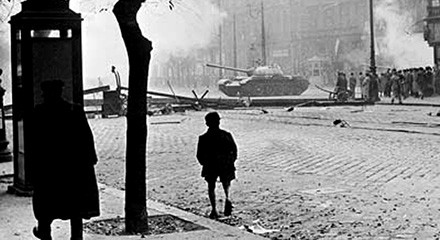
In July 1956 the ‘hardliner’, Mátyás Rákosi, was, in a cosmetic move, replaced as Hungarian party secretary by his lieutenant, Ernő Gerő. This was taken as a sign of weakness, and both the liberal party faction round Nagy and the non-party intelligentsia, backed by students, began to put the pressure on for wider reforms. On October 21 the return of Gomułka to power in Poland signalled that major change could be achieved: rioting broke out in Budapest round the demand for the restoration of Nagy, and on October 24 he became prime minister.
From this point on the mass movement, which had been started by students, became broadened and more sharply directed against the presence of Soviet troops. By October 27 the centre of gravity of the movement had shifted to the countryside; it was at this time that the Red Army temporarily withdrew. Nagy now promised free elections and began to bring the old bourgeois parties into the government.
At this stage the workers in Budapest were beginning to organise workers’ councils. The research of Gus Fagan (published in Labour focus on Eastern Europe in the 1980s) has clarified the nature of these councils. They were led by old social democratic and syndicalist militants. Their demands were primarily for the withdrawal of Soviet troops and free elections to a parliament. The power they sought for themselves was at most limited to workers’ control on the shopfloor; they made no claim to run society as a whole, though they insisted the factories should remain state property. They excluded from membership members of organised political parties - a familiar device of social democracy to prevent political debate. The workers’ councils therefore harnessed the struggles of the proletarian masses over their immediate conditions of life to the aims of the European social democracy and the defence of the Nagy administration.
On November 2 that administration - by now a government of bourgeois parties, including Cardinal Mindszenty as a representative of the church, with minority participation from a reorganised Communist Party - denounced the Warsaw Pact, announced Hungary’s neutrality, and called for UN (ie, Nato) intervention. The Suez crisis made this politically impossible, while the military relation of forces in central Europe made it militarily impossible. On November 4 Soviet troops re-entered Budapest in much greater force. The military resistance was rapidly crushed, and the government arrested and replaced by a Communist Party one led by János Kádár. (It is noteworthy that Kádár was a member of the same liberal tendency as Nagy and had been a member of the October 24 Nagy government.) The workers’ councils held out for a month. The Kádár regime tried to negotiate with them and only suppressed them on December 9.
It is worth emphasising the extreme rapidity of the Hungarian events: from the fall of Gerő on October 24 to the re-entry of Soviet troops on November 4 was a bare 11 days, and the subsequent resistance of the workers’ councils hardly more than a month. The Trotskyists only really began to sit up and take note of events in Hungary after the re-entry of Soviet troops, by which time the workers’ councils were the only remaining element of the opposition; and the Trotskyists concentrated on these, not on the Nagy governments, which were “merely symbolic”.
Trotskyists
In consequence, for practical purposes all tendencies both in the FI and the IC identified the Hungarian mass movement as primarily a movement of workers (which it only became after November 4) and therefore as the model for political revolution.
The IC-FI differences remained unresolved: the FI saw the Nagy faction as a genuine left wing within the bureaucracy (though Mandel compared it unfavourably to the Gomułka faction in the Polish United Workers Party), while the Healy group in Britain and the Lambertistes in France saw it as manoeuvring towards the working class, with the aim of saving bureaucratic rule, and the US SWP said that the Nagy government’s call for imperialist military aid showed a “lack of confidence in the working class”. All the IC tendencies insisted that the rise of the workers’ movement confirmed that fissures in the bureaucracy would be less important to political revolution than the independent movement of the working class, while the FI leadership argued that the origin of the crisis and the emergence of the Nagy faction showed the reverse, that the divisions in the bureaucracy were crucial.
In political line, however, the large majority both of the FI and of the IC adopted a common position: all power to the workers’ councils; Soviet troops out.
Only in the US does there seem to have been an organised opposition to the majority line: the Marcy tendency, which had stayed with the US SWP in the 1953 split. Isaac Deutscher saw the Hungarian rising as counterrevolutionary, but his earlier evolution to reform communism meant his views could have little impact.
The Marcy tendency’s development of a coherent alternative view on Hungary reflected, I think, three factors. The first was that the press in the US covered the evolution of the Nagy governments more fully than the press in Europe, and was more willing to depict the mass movement as anti-communist rather than just anti-Stalinist. This difference in coverage reflects the different geopolitical situation in the US, which was until 1969 out of range of Soviet nuclear attack, with a consequent difference in the attitudes of the foreign ministries and intelligence services and their spokespeople in the press - as well as the existence of mass social democracy and significant communist parties and fellow-travelling milieux in Europe. There were similar differences in the coverage of the Czech events, the Polish Solidarność and Gorbachev and Yeltsin.
The other two elements concerned the existing positions of the differing tendencies. On the world situation and the role of the workers’ states, for the IC the Stalinist bureaucracy was “organically counterrevolutionary” or “counterrevolutionary through and through”: only Stalinism held back the world revolution. Within this framework it was theoretically impossible that any opposition within the workers’ states could be characterised as to the right of Stalinism, since anything that weakened Stalinism would tend to undam the revolutionary pressure of the masses.
For the FI leadership, rightwing opposition to Stalinism was theoretically possible, true, but in their assessment of the world situation the revolutionary mass movement was absolutely predominant and US imperialism had its back to the wall; in such supposed circumstances a mass anti-communist movement in a workers’ state was hard to imagine.
For the Marcy tendency, on the other hand, the world situation was characterised by the intensification of contradictions, the penetration of the class struggle on a world scale into every country, and both the extreme centrality of the workers’ states and the extreme political bankruptcy of the Stalinist bureaucracy. Sam Marcy’s 1953 polemic against James P Cannon and Michel Pablo, ‘The global class war and the destiny of American labor’,8 had warned vigorously against one-sided optimism and rose-tinted spectacles. So for the Marcyites (as for Trotsky in 1938-40) there would be right oppositions in the workers’ states, against which Trotskyists would fight alongside the Stalinists (Transitional programme, section on the USSR, 9th and 10th paragraphs9). The Hungarian movement could be either political-revolutionary or counterrevolutionary, and had to be analysed to see which it was.
Thirdly, the Marcyites were unencumbered with the baggage of the property criterion for characterising a state as a workers’ state. The majority of the FI and the IC performed a simple pair of syllogisms:
A
1. The state is a workers’ state because of the nationalisations.
2. The Nagy tendency/mass movement do not propose to reverse the nationalisations.
3. Therefore the Nagy tendency/mass movement are not opposed to the workers’ state: ie, are not counterrevolutionary.
B
1. In the present epoch all political tendencies are in the last analysis either bourgeois or proletarian.
2. The Nagy tendency/mass movement is not bourgeois (point A3).
3. Therefore the Nagy tendency/mass movement is objectively proletarian: ie, a political-revolutionary movement.
For the Marcyites, because proposition A1 was rejected, the whole of the rest of the argument fell to the ground. Since for them the question of the class nature of the state was the class character of the central political authority that controlled the armed forces, the political character of the Nagy tendency, the mass movement, etc, depended on their attitudes to this question.
The Marcyites’ analysis of Hungary (as, also, their detailed analysis of China) was written by Vince Copeland. According to Copeland, the cardinal problem in Hungary was the lack of the working class’s programmatic preparation to assume the leadership of the struggle against the bureaucracy - so that the workers did not understand that, however much they hated the Stalinists, the exclusion of the bourgeois parties from power and the alliance with the USSR were the essential bases of their social gains. The peasants and most of their leaders were not fascists, as the Stalinists falsely claimed; rather, they had the utopian belief that by getting rid of the Stalinists they could get US-style bourgeois democracy. US imperialism’s failure to give military support to the uprising was not based on fear of its class character, but on tactical considerations of its prematurity and unwillingness to enter a general European war.
Copeland therefore characterised the Nagy regime, following the October 26 invitation to the bourgeois parties to enter the government, as a counterrevolutionary, restorationist regime; and argued that, while the Trotskyists should have (if they had noticed it!) opposed the use of Red Army troops against the liberalisation demonstrations in October, they should give critical support to the second entry of the Red Army and the overthrow of the Nagy regime.
Though it is taboo in the Trotskyist movement to take this view, it seems clear to me (as I have already indicated) that the bulk of the evidence supports Copeland’s view. The disorientation of the Trotskyists in the face of the evolution of eastern Europe and the USSR in the 1980s reflects, at least in part, their determination to see the dawn of the political revolution in the Hungarian events.
-
www.workersliberty.org/publications/workers-liberty-magazine/latest-issue/workers-liberty-volume-3-september-2005-5.↩︎
-
redmole.org/p/ernest-mandel-on-hungary-1956-a-workers.↩︎
-
anticapitalistresistance.org/turning-point-for-stalinism.↩︎
-
workerspower.uk/we-wont-stop-halfway-stalinism-must-be-destroyed-hungary-1956.↩︎
-
redmolerising.wordpress.com/2018/08/15/questions-of-method-and-theory; Chapel: redmole.org/p/the-method-that-explains-everything.↩︎
-
Linked at www.marxists.org/history/etol/writers/copeland/index.htm.↩︎
-
www.marxists.org/archive/marx/works/1875/gotha/ch01.htm, on point 5: “the ‘framework of the present-day national state’, for instance, the German empire, is itself, in its turn, economically ‘within the framework’ of the world market, politically ‘within the framework’ of the system of states.”↩︎
-
www.marxists.org/history/etol/writers/marcy/gclasswar/1953_Global_Class_War.html.↩︎
-
www.marxists.org/archive/trotsky/1938/tp/tp-text2.htm#ussr.↩︎