
22.10.2026
From militancy to the swamp
Alan Thornett, June 15 1937-October 9 2026, was one of those genuine rank-and-file leaders, a cadre steeled in the class struggles of Cowley car assembly plant. Having broken with the CPGB, he threw his lot in with Gerry Healy’s increasingly crazy outfit. After that, one failed merger followed another till he found the ‘lovely waters’ of Mandelism. Mike Macnair begins a two-part article
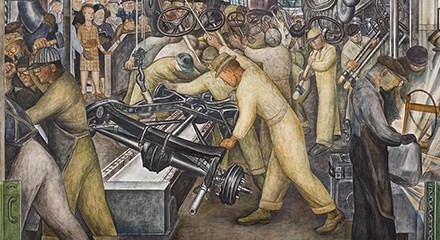
Alan Thornett, who died two weeks ago at the age of 89, had a long and mostly honourable career as a Trotskyist political leader. A shop steward in the Transport and General Workers’ Union (now part of Unite) at Morris’s Oxford Cowley Assembly Plant (successively British Motor Corporation and British Leyland) between the early 1960s and his victimisation in 1982, and deputy convenor for a substantial part of that time, he was briefly notorious as a result of being targeted in an employers’ and T&G bureaucrats’ witch-hunt in spring 1974, as a result of which he has received a Daily Telegraph obituary that largely reprises the witch-hunt.1
A ‘great British cars’ website, ‘AROnline’, has a very similar obituary, with the author and those commenting within the obituary blaming leftwing shop stewards for the collapse of the British car industry.2 One would imagine that the Ryder report on British Leyland had not already pointed out in 1975 that the company had been making losses and paying dividends out of capital for years. In my own time at Cowley Assembly (1976-78), every attempt to speed the lines up beyond 38 cars per hour to reach competitiveness with Ford Dagenham (44 per hour) failed due to the lines breaking down (not caused by sabotage). The British economy was already moving to the dominance of financial services crowding out industrial investment before Thatcher. Blaming Bolshie shop stewards was just a scam to cover up this underlying development.
The website of the social-imperialist Alliance for Workers’ Liberty offers a hatchet job from Sean Matgamna that displays his usual smear techniques against political opponents. We might be willing to believe that Thornett was at fault in splitting from Matgamna (and all the other sins of which Matgamna accuses him) if Matgamna and his co-thinkers had not played the same James P Cannon ‘smashing centrist obstacles’ games in their entry operation in the International Socialists in 1969-72, their short-lived fusion with Workers Power in 1975-76, and their short-lived collaboration with Labour Briefing in Socialist Organiser in 1979-80. Once three of your recent brides have drowned in the bath after you heavily insured their lives, we cease to be willing to believe in unfortunate accidents.
By their enemies shall you know them. I canvassed for Labour in east Oxford in the October 1974 general election (applying the line of the International Marxist Group, of which I was then a member), and encountered a number of people on the doorstep who did not intend to vote, but said that “if that Alan Thornett was standing, I would vote for him”. They showed better judgment than Matgamna.
There are better obituaries/reminiscences from Thornett’s comrades, Duncan Chapel, Tony Richardson and John Lister.3 And Thornett wrote about his experiences as a leftwing trade unionist in his 1987 book, From militancy to Marxism. Equally, though I knew Thornett and spoke with him from time to time, I was not personally close to him and cannot say that I know the details of his political history. It is, however, worth contributing some thoughts about his career as a Trotskyist political leader. (What follows is going to be the first part of a two-part article, for reasons merely of time. I have had difficulty in constructing what I have written so far.)
I flag as the first point that I am not writing about Thornett either as a trade union militant or as specifically a working class political leader. Either approach celebrates him by diminishing him. Thornett was at the lower age end of a generation that produced numerous highly competent, militant trade unionists and working class political leaders (of very diverse politics).
The capitalist class has largely, though not completely, succeeded in managing out of existence this working class cadre, by a combination of offshoring production and financialisation; drawing more of the children of the upper layers of the working class into further and higher education; persuading the workers’ movement and the left that ‘news management’ and the ‘news media’ could substitute for an independent working class press and media; and ‘lawyerisation’ of both trade unions and industrial relations, and local government, suppressing the democratic processes in which such a cadre can emerge.
There have been fewer British communist or Trotskyist political leaders, so we should take the ones we have had more seriously. Thornett in this context has the considerable merit of having resisted Gerry Healy’s turn to lunacy in 1974-75, and having broken with Matgamna, as the Matgamnaites’ social-imperialism became clear in the 1980s. The fact that Anti-Capitalist Resistance, of which he was a leader, has slid towards social-imperialism by way of supporting ‘humanitarian assistance’ in relation to Libya and Rojava in the early 2010s, and after 2022 arrived at the social-imperialist destination with calls to arm the US proxy regime in Ukraine, does not alter this historical merit.
Politics
Morris’s (by the 1950s, BMC’s) Cowley Assembly plant was unionised, very much against the will of management, by a group of militants with a communist core. Pressed Steel (later the Cowley Body Plant) had come first, in the 1930s.4 Alan Thornett started work at Cowley, aged 22, in 1959 - two years after the formal recognition agreement, and the same year that management victimised the T&G convenor, Frank Horsman (the union settled for him to be transferred to Pressed Steel).
In the 1938 Transitional programme, the Trotskyists wrote that “Trade unions, even the most powerful, embrace no more than 20% to 25% of the working class and, at that, predominantly the more skilled and better paid layers.” The sort of mass unionisation with closed shop agreements and shop-stewardism displayed in the unionisation of Cowley Assembly - and many other factories - reflected the politics of ‘full employment’ in Britain. This in turn reflected the politics of ‘containment’ of communism in the ‘cold war’ period between 1950 and around 1976: major concessions were made in order to prevent the spread of ‘communism’ into western Europe and Japan.
The resulting impression was one of the irresistible advance of socialism and of the working class: with the USSR at its core, many post-colonial regimes adopted extensive statisation and planning, and the strength of trade unions and welfare systems grew in the ‘advanced capitalist countries’.5
On the other side, it would probably not have happened without the local strength of communists. ‘Official’ communist and revolutionary activists formed the core of organising efforts, and Thornett’s books illustrate the complex tactics developed in order to win. In this context, it is unsurprising that Thornett rapidly joined the Communist Party after starting work at Cowley. The actual central leader of the unionisation, Bobby Fryer (in origin a Hungarian child refugee from Nazism), was more sceptical of the ‘official’ CPGB.6
In the mid-1960s a substantial part of the Communist Party group in Cowley Assembly T&G was won to the Socialist Labour League led by Gerry Healy. The SLL was not, as it later became under the name of the Workers Revolutionary Party, a crazy sect funded by money from Libya. Rather, it was the largest of the three major fragments of the 1944-48 Revolutionary Communist Party (mark I). Like the second largest, the International Socialists (now Socialist Workers Party), it had broken from a primary orientation to entry in the Labour Party to promoting a (broadly) mass-strikist orientation in the shop stewards’ movement. It was in a stronger position to do this because it had recruited in the late 1950s ex-Communist Party members who had broken with the CPGB over the 1956 Hungarian uprising.
I have misplaced my copy of From militancy to Marxism, and I cannot now find in the online sources any explanation of Thornett’s and his comrades’ decision to go over from the CPGB to the SLL. The date means that it was clearly not part of the post-1956 crisis of the CPGB. It seems more likely that the character of the Wilson government undermined the plausibility of the strategic line of The British road to socialism of a succession of increasingly leftwing Labour governments.
After all, Wilson had been the ‘left’ candidate in the 1963 Labour leadership election against Jim Callaghan and George Brown, having resigned from government over NHS charges in 1951 along with Nye Bevan. Far from ushering in a further period of left development, Wilson’s government was technocratic, and its ‘prices and incomes policy’ was mainly concerned with controlling strikes. In 1966 Wilson took this policy to the point of invoking a state of emergency and engaging in an anti-communist witch-hunt (which even Tory leader Edward Heath thought was implausible) against a seafarers’ strike.7
In contrast, the successes of the trade union movement during the ‘cold war’ period made the mass strike strategy promoted by the Trotskyists appear more plausible.
SLL
Winning the Cowley group was a big coup for the SLL, and Healy put serious personal attention into working with them. By 1971 Thornett had become secretary of the SLL’s All Trade Union Alliance (their imitation of the CP’s Liaison Committee for the Defence of Trade Unions) and a member of the SLL’s central committee.
Under the Heath government of 1970-74, the mass strike strategy was very much swimming with the tide. Though Heath defeated the postal workers in 1971, in 1972 he lost to the miners, and to a ‘general strike wave’ in defence of the Pentonville Five dockers imprisoned for defying Heath’s anti-union laws. There was a wave of strikes. The SLL slogan, ‘General strike to kick out the Tory government’, had real attractive power. The period ended in Heath imposing a three-day week in December 1973 and calling a general election in February 1974 on the question of ‘who rules’, expecting thereby to defeat a second miners’ strike.
In fact, Heath lost. Capital turned to its Labour ‘second eleven’: initially a minority government, and Heath at first wanted to try to assemble an anti-Labour coalition, but the ‘men in grey suits’ told Heath he must go. Heath’s anti-union laws were partially amended in the Trade Union and Labour Relations Act and Employment Protection Consolidation Act, carefully designed to shift power away from shop stewards and local branches to the full-time officials of trade unions; in particular, the provision of ‘industrial tribunals’ was to take victimisation cases away from local negotiation, while the check-off system of deduction of union dues from pay gave more control to the central union offices. Substantial wage rises were conceded, but immediately taken away by price rises.
This was the immediate context of the witch-hunt of Alan Thornett as the ‘Red Mole’ and, going along with it, the T&G bureaucracy splitting the powerful 5/55 branch to create a new 5/293 branch, and campaigning for ex-SLL renegade Reg Parsons to replace Bobby Fryer as convenor.
In substance, the mass-strikist perspective had until the early 1970s provided an effective strategic orientation to link militant trade unionism with a perspective of workers’ power and socialism. The local disputes could be seen as building up the framework of organisation and consciousness - this was especially true of secondary solidarity action.
Meanwhile, under Richard Nixon, the USA began the restructuring of its strategic management of the world economy and world politics, by taking the dollar off gold (August 15 1971) and the 1973 ‘oil price shock’, in which the US’s ally, Saudi Arabia, pushed sharp increases in oil prices; though this was in theory to ‘punish’ the US for support of Israel, it issued rapidly in the 1974 petrodollar agreement, under which Riyadh agreed to price oil only in dollars, while the money would be recycled into US treasury bonds.8 The effect was to turn low-grade endemic inflation and mild foreign exchange risks into much sharper inflation risks, while runs on the currency became more radical tools for disciplining the working class and the semi-colonies.
The lesson was rammed home in Britain with the high inflation of 1974-75 and the 1976 sterling crisis. Under these conditions the state was driven to sharper controls on trade unionism and on local government; while union members were faced with stagflation (unemployment growing along with inflation), the sort of guerrilla struggle of 1950s-60s shop-stewardism became less attractive.
The SLL (in November 1973 renamed as the WRP), however, clung to the general strike slogan. With the Tories gone, this was decreasingly plausible. But the WRP argued that a military coup was coming (there was, indeed, talk of a possible coup within the British state apparatus in 1974) and could be defeated by a general strike. Militants were told that they should for the present avoid confrontations in order to save money for the coming general strike. (The idea that saved money would be useful in a general strike against a military coup is fantastical; under such conditions the capitalists would drive hyperinflation and the strike committees would have to impose rationing or collapse.)
Against this insanity, Thornett and his co-thinkers went into opposition to Healy and were expelled from the WRP in December 1974, rapidly proceeding to create the Workers Socialist League, with the newspaper Socialist Press.
Influences
Robin Blick claimed in 1980 that he and others in the Bulletin group - especially Trotskyist veteran John Archer - were responsible for the political content of Thornett’s opposition document, ‘Correct the wrong positions of the party, return to the Transitional Programme’. This claim has been adopted by Bob Pitt in his pro-Labour history of Gerry Healy and by David North’s proprietary World Socialist Website/International Committee of the Fourth International.9 It is at best a half-truth. There is no reason to suppose that Blick and his co-thinkers were lying outright when they said they had discussions with Thornett and his co-thinkers in 1974 (I heard the same story personally from John Archer). But it is clear that there were other influences on the Thornett group.
The starting point is that in the mid-later 1960s the SLL was collaborating, in a very loose way, with the French group, the Organisation Communiste Internationaliste, led by Pierre Lambert. This collaboration claimed to be the continuity of the International Committee of the Fourth International that had been created in a split in the Fourth International (then, there was only one …) in 1953. In 1969-71 Healy organised a split with the OCI, the political basis of which remains unclear;10 the Healy side emphasised that the Lambertistes had downgraded the importance of dialectical materialism, and Healyites in the early 1970s could be encountered waving copies of Lenin’s notes on Hegel in Collected works volume 38. The insistence on ‘dialectical leaps’ and opposition to ‘empiricism’ and ‘impressionism’ that this focus emphasised supported the belief that Britain was about to encounter a revolutionary crisis, and that the SLL-WRP was about to break through on a mass scale as a result.
The launch of the WRP in November 1973 reflected this belief. But the belief itself was precisely - impressionistic. Healy and his co-thinkers were “dizzy with success” (to quote Stalin with heavy irony …): going from working in very small groups in the 1950s to organising meetings of thousands in the early 1970s - that must have seemed like being on the verge of mass politics. The phenomenon is not unique to Healy, since it affected Tony Cliff and his co-thinkers in 1976-77, Peter Taaffe and his co-thinkers in 1996-97, and Alan Woods and his co-thinkers in 2024; there are plenty of examples among Trotskyists elsewhere in the world.
The Bulletin comrades made up a small group of ex-Healyites and other Trotskyists who came together in opposition to the SLL’s grandiose launch of the WRP, linked up with the OCI’s international tendency (the Organising Committee for the Reconstruction of the Fourth International), and began publishing the Marxist Bulletin in early 1974, aiming it at what they expected to be dissent in the WRP.11 As I have said above, there is no reason to suppose they are lying, when they say that they had discussions with Thornett and his co-thinkers in 1974.
However, the Thornett group did not go to the Lambertistes in 1975. Among the several other influences on them, it seems to me, there has to be included the International Marxist Group’s Cowley cell, created in the IMG’s first round of ‘industrial colonisation’ in 1971. The shop stewards were defeated in the imposition of Measured Day Work in 1971, though they did obtain a ‘mutuality agreement’. The IMGers adopted Lutte Ouvrière’s tactic of putting out a factory bulletin, using cell members on the plant to write the stories from the plant, and outsider supporters to duplicate and hand out the bulletin.
They focussed strongly on ‘transitional demands’ - especially workers’ control (already in a sense present in the ‘mutuality agreement’) and in particular ‘open the books’: two IMG economists who later switched to the WSL, Bob Sutcliffe and John Harrison, did some work on exposing the falsity of management’s financial claims. By 1974, the IMG’s bulletin was very widely read; and one of the early things the WSL did after breaking free of Healy was to introduce a factory bulletin of the TGWU 5/293 branch, which effectively marginalised the IMGers’ bulletin.
Equally, the WSL (at least in Oxford) did not pursue the Lambertistes’ line on Israel-Palestine, and did not pursue the Lambertistes’ general practice of setting up fronts under their organisational control in competition with other fronts. Rather, they worked primarily through Oxford Trades Council and together with the rest of the Oxford far left in the usual solidarity campaigns, and so on. I think, therefore, that Thornett and his associates broke with Healy into an open engagement with the rest of the far left (including the ‘Pabloite’ IMG and the ‘state caps’), and were not particularly attracted to joining up with another Trot caudillo in the shape of Pierre Lambert.
WSL
That said, the WSL was a lopsided organisation and at the end of the day an unsustainable one. In Oxford, its membership proportional to population would have equated to a national party of around 40,000, up at the scale of the old CPGB. Outside Oxford, it consisted largely of small groups of fans.
Its political orientation was largely to urge people to be like the Oxford WSL: oriented to the working class and the trade unions; in the Labour Party, but not deeply concerned with the inner-party struggle or building broad left formations. The WSL did serious work attempting to unionise Blackwells’ bookshop and the local hotel trade. The Oxford Student Trade Union Liaison Committee it promoted in this context was a unitary local campaign group. It worked with the Oxford CPGB, the IMG and others in running a campaign for a ‘leave’ vote in the 1975 EEC referendum on an internationalist basis (both the CPGB district and the IMG branch were denounced by the national organisations for ultra-leftism); and in the anti-fascist campaigns.
Socialist Press, produced on a shoestring between 1975 and 1981, defended a broadly ‘anti-Pabloite’ Trotskyist political line with some serious arguments.12
But the advice to ‘be like the Oxford WSL’ was unrealistic in relation to the actual situation of the small groups of adherents outside Oxford, and also unrealistic in relation to its own historical origins: the core Cowley team had come from the CPGB to the SLL, not from a small group trying to do mass work directly in competition with the other left groups.
This difficulty resulted in the WSL being ‘raided’ by the Spartacists in 1978 and 1979 - a process that did not produce long-term gains for the Spartacists, but was demoralising for WSLers.
They were critical of the Parity Committee for the reconstruction of the Fourth International set up in October 1979, but attempted to engage with this short-lived lash-up between the Lambertistes and the Argentina-based Morenistas. The Parity Committee broke up in 1981; in the same year the WSL fused with the Matgamnaite Socialist Organiser. This was a choice that John Lister acknowledges as a mistake: it reflected the needs of WSLers outside Oxford, who were more deeply engaged in the Labour Party and needed a serious orientation and relations with other forces there. But it was still naive to hook up with Matgamna.
At the time of the fusion, the Matgamnaites were not, as they rather rapidly became, open Zionists and social-imperialists. But the problems emerged very rapidly. The South Atlantic war of 1982 produced an internal debate in which the Matgamnaites defended ‘Falklands self-determination’, and an opposition attached to the old WSL’s international co-thinkers of the Trotskyist International Liaison Committee adopted a ‘Victory to Argentina’ line, while Thornett and his immediate co-thinkers took an intermediate position. This led to the loss of a chunk of the former WSL-side base, weakening the position of Thornett and his co-thinkers in the fused WSL.13
By 1983-84, the Matgamna group was pushing hard its pro-Israel line, and Thornett and his immediate co-thinkers could not stomach the evolution and began to factionalise. The result was that the fused WSL NC voted in March 1984 to expel 35 members for “disruption”. The expelled group constituted themselves as the Socialist Group and began, from autumn 1984, to publish Socialist Viewpoint.14 They had clearly, as John Lister points out, suffered a severe setback by trusting to the Matgamnaites’ good faith. They were now to move to fusion, in 1987, with the ‘Pabloites’ of the International Group.
This fusion would produce less bureaucratic repression, but meant merely that the distinctive features of the Thornett group’s politics dissolved in the ‘lovely water’ of the Mandelite swamp.
-
www.telegraph.co.uk/obituaries/2026/10/16/alan-thornett-trotskyist-shop-steward-cowley-died-obituary.↩︎
-
Chapel: anticapitalistresistance.org/alan-thornett-1937-2026-a-working-class-leader-who-faced-the-apocalypse; Richardson: anticapitalistresistance.org/alan-thornett-key-militant-in-the-1960s-70s-80s-motor-industry/ (Oct 13); Lister: anticapitalistresistance.org/remembering-alan-thornett.↩︎
-
www.marxists.org/history/etol/writers/edwards/1979/xx/tu1934.html.↩︎
-
Not just the imperialist countries, and not all of them, since the USA did not accept a christian-democratic/social-democratic policy for itself.↩︎
-
Fryer’s origins: freizinger.co.uk/?page_id=28. Fryer sceptical of the CP: thornett.redmole.org/1981/the-real-record-of-the-communist-party-at-cowley.↩︎
-
K Thorpe, ‘The “Juggernaut method”: the 1966 state of emergency and the Wilson government’s response to the seamen’s strike’ Twentieth Century British History Vol 12 (2001), pp461-85.↩︎
-
chaipredict.com/resources/expiration-saudi-us-petrodollar-agreement.↩︎
-
Pitt: www.marxists.org/history/etol/writers/healy/pitt/Chap9.html; Northites: www.wsws.org/en/special/library/how-the-wrp-betrayed-trotskyism/06.html.↩︎
-
Parti-pris arguments at www.wsws.org/en/special/library/how-the-wrp-betrayed-trotskyism/04.html (Northites) and www.marxists.org/history/etol/writers/healy/pitt/Chap8.html (Pitt). There did seem from these accounts to be substantive political differences, especially that the Lambertistes were dual-defeatists in the 1967 Arab-Israeli war (the Healy wing sought Arab victory), and about the conduct of Guillermo Lora and the Bolivian Partido Obrero Revolucionario in the revolutionary crisis and military coup of 1970-71.↩︎
-
Wikipedia (en.wikipedia.org/wiki/Socialist_Labour_Group) is useful on the history.↩︎
-
Available at www.marxists.org/history/etol/newspape/socialist-press-uk/index.htm. It went weekly in February 1978.↩︎
-
socialistfight.com/wp-content/uploads/2019/10/whathappenedwsl-1.pdf. That the author is a sectarian means that the text has to be read with caution, but does not alter the utility of the information.↩︎
-
Linked at splitsandfusions.wordpress.com/2016/12/12/the-socialist-group-socialist-viewpoint.↩︎