
15.10.2026
Postcard from the future
A Godzilla El Niño could persist until at least early next year, bringing record temperatures along with more flooding and drought. But there is also a possibility, paradoxically, that it could trigger a deep freeze in Europe, writes Eddie Ford
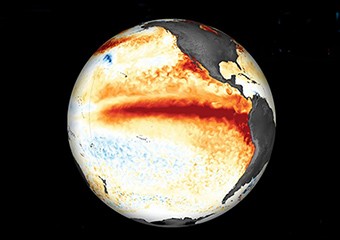
Officially known as the El Niño Southern Oscillation (ENSO), the El Niño event that is happening in the Pacific is reaching what scientists are calling “unprecedented levels” weeks before its expected peak in December. Likely this will be the strongest in living memory. This, of course, is piling extra heat into an atmosphere, where temperatures are already rising rapidly, meaning that 2027 is very probably going to blow away all previous records - becoming the hottest year we have ever known and in turn pushing extreme weather to new highs.
We can see this from spikes in the sea-surface temperature across the central-eastern equatorial Pacific, the region at the heart of El Niño.1 The preferred measure of most meteorologists uses a 30-year rolling average as a reference, therefore taking account of human-caused global heating, and this metric, known as the Niño 3.4 index, has increased markedly from an average +1.6°C above normal in June 2026 to +2.5°C above normal in August. But for the last quarter of this year, the seasonal average sea surface temperature is forecast to reach approximately +3.7°C around December - the highest since observations began - which would be stronger than the previous record of +2.6°C in November 2015-January 2016.
Any temperature rise above 2°C is officially called “very strong” - often dubbed a ‘super’ El Niño, while others have referred to the now strengthening El Niño as “Godzilla-level”. According to the latest seasonal guidance from the European Centre for Medium-Range Weather Forecasts - related to the Niño 3.4 index and based on it in “both relative and traditional modes” – El Niño could even get to a temperature of 4.0°C, and some “probabilistic models” are predicting values as high as 5°C.2 But, whatever forecast or model you use, El Niño is ratcheting up the climate crisis even further and obviously has alarming implications.
Supercharge
For example, very strong El Niño events like those in 1997-98 and 2015-16 were associated with hundreds of billions of dollars in damage globally - but what we are seeing now is “leaving those past ones in the dust”, according to climate scientist Zeke Hausfather, whose analysis was published by Carbon Brief.3 Another climate scientist described the El Niño event as a “huge redistribution of energy in the climate system”, making it dangerous precisely because it is unfolding on top of a much warmer, anthropogenically influenced climate system.4
Thus many places around the world will undergo heat extremes they have never experienced before, inevitably having an impact on health, food security and water stress. If we continue to burn fossil fuels in the same way, El Niño events will occur on an increasingly hotter baseline - making it much more difficult, of course, for communities to deal with the consequences, which are often completely devastating.
World Meteorological Organisation forecasts indicate “a near 100% likelihood” that El Niño will persist until at least February 2027.5 That figure is not being derived from one model: rather a scientific consensus across 13 national and international centres, from Washington to Tokyo to London to Pune, built on real-time exchange of ocean buoy, satellite and radiosonde data. It has to be stressed that no two El Niño events are ever the same: they vary wildly - each having its own pattern and ‘evolution’, which needs to be studied concretely.
Naturally, there is ongoing debate about the impact of global heating on the ENSO pattern itself, it being well understood that it typically brings a huge rise in temperatures, hence further amplifying the escalating climate crisis. But new research from climate researchers at the University of Michigan has strongly indicated that the reverse is also the case: human-caused global heating is making El Niño itself more intense when it does arrive.6 “Our findings suggest El Niño can supercharge global warming, but also global warming can supercharge El Niño,” says Julia Cole, who led the new study published in Science.7 “We are seeing a shift where El Niño doesn’t look like what it did prior to industrial times,” and that is very bad news indeed for those who have been badly impacted by the climate crisis and yet have done nothing to cause global warming themselves.
Basically, the research painstakingly analysed the composition of large boulder-like deposits of coral fossils found on the Galápagos Islands. These old corals date back to 1,000 years ago and contain chemical compositions that indicate what the sea surface temperature was like when they were alive. They are situated off the coast of mainland Ecuador right in the heart of the El Niño area, where surrounding waters heat up during such an event. While El Niños remained fairly stable for most of this long period, things started to change around the time the world started to industrialise in the late 19th century on a mass scale.
However, the process has become even more extreme over the past 40 years, with El Niños’ variability now around 37% higher than during pre-industrial times. Cole’s research team managed to rule out any random or naturally occurring reason for this switch, and she has expressed surprise at “how consistent” the data was - there was “just such a large, distinct difference” between what has been happening in the last 40 years and what happened in pre-industrial times. The logical deduction, if the research is broadly correct, is that really large weather events like the one that appears to be brewing right now in the tropical Pacific might become more common in the future - it is not a freak occurrence: rather an unwanted glimpse of the future.
Whatever the exact case, Godzilla or otherwise, El Niño is expected to cause widespread crop failures, with a Goldman Sachs analysis predicting that it could contribute to a 15.8% surge in global food commodity prices - which, of course, would have a knock-on effect worldwide, including for consumers in Europe, where it is predicted food prices could rise by 1.3% across the euro zone. Having said that, the full effect will take time because of how the cost of climate impact percolates through global food supplies, which could take until the second half of 2028 to be fully realised.
Then there is the chance that it could increase the danger of severe flooding and drought, wildfires and cyclones - not to mention civil war and military conflict - developing in countries already facing a “triple shock” from the energy crisis, El Niño and surging borrowing costs.8 The World Food Programme has warned that 50 million people are likely to be pushed into acute hunger.
In a sobering report by the Climate Impact Lab, it has been estimated that the extra heat from El Niño alone will cause the deaths of 450,000 people by February, from Nigeria and Indonesia to the USA.9 This figure is on top of the early fatalities resulting from global warming and many further deaths are expected from the droughts, wildfires and flooding that El Niños bring. Researchers from the CIL say the El Niño event is also a “postcard from our future”, pushing up temperatures to the level the climate crisis is projected to deliver in 20 years’ time.10 A major El Niño in 1877-78 led to more than 50 million deaths due to drought and famine, with India, Brazil and China severely affected, and “was arguably the worst environmental disaster to ever befall humanity”.11 What cannot be denied is that the ramifications from El Niño will be felt far away, increasing drought risk in a large swathe of the world, while increasing rainfall elsewhere. India has already experienced a 50% shortfall in essential monsoon rains this month, affecting crops, while in Sri Lanka reservoirs for drinking water are running dry.
Vortex
Generally in Europe, El Niño’s weather impacts tend to be much more indirect and less severe, increasing the chances of more unsettled conditions later in the year, such as a milder, wetter and windier autumn and early winter. But there is speculation that the supersized El Niño could actually, perhaps counterintuitively, trigger a ‘deep freeze’ in Europe.
The explanation lies in the fact that every year in winter, strong westerly winds circle around the pole high up in the stratosphere - which extends from an altitude of about 10-50 km above the Earth’s surface and is referred to as the stratospheric polar vortex (SPV), circulating around cold air high over the Arctic.12 However, following a peak in El Niño, the SPV can become weaker and thus can increase the likelihood of a Sudden Stratospheric Warming (SSW) event, which would subsequently increase the potential for cold weather.13 An SSW is an event in which temperatures rapidly increase (from -50°C to 0°C or more in just a couple of days) in the stratosphere and, as the cold air from high up in the stratosphere disperses, affects the shape of the jet stream, as the cold air sinks from the stratosphere into the troposphere.
Will this phenomenon affect a country like the UK, once famous for its mild climate?14 It is extremely difficult to predict, if not nearly impossible, as the links are unclear and the evidence is mixed. The so-called Big Freeze of 2009-10 was, at the time, the coldest winter in three decades - and, yes, it coincided with an El Niño. However, 2006-07 was also an El Niño winter and was unseasonably warm, and the supposed ‘Beast from the East’ in 201815 actually occurred during a La Niña year - effectively the opposite of El Niño. This means that, while El Niño is already having big impacts on global weather, and may influence the polar vortex later in winter, snow and ice in the UK is far from guaranteed. Fundamentally, weather is a chaotic system, so that small changes in initial conditions can lead to vastly different outcomes, making a weather forecaster’s job an arduous one.
But what we do know for sure is that governments do not want the masses to have access to the necessary information about what is really going on - it could breed discontent. After all, we recently discovered that the Keir Starmer government suppressed a report on the national security implications of the climate crisis by the Joint Intelligence Committee for being “too negative”. Similarly, the Intergovernmental Panel on Climate Change - which is meeting this week in Addis Ababa to discuss its seventh assessment report - is under pressure from some petro-states and major ‘developing countries’ to delay its publication.16 Led by Saudi Arabia and Russia, and including India and China, they are pressing for publication of the report to be pushed back to 2029, using the argument that this is “necessary” to allow developing countries to have “more input” into the scientific findings.
A blatant attempt to fiddle the figures, while human civilisation hurtles towards climate breakdown.
-
wmo.int/news/media-centre/sea-surface-temperatures-reflect-strengthening-el-nino.↩︎
-
theweather.com/news/trending/el-nino-2026-2027-could-reach-a-record-breaking-peak-here-s-when.html.↩︎
-
carbonbrief.org/analysis-super-el-nino-reaches-remarkable-all-time-record.↩︎
-
theguardian.com/environment/2026/sep/21/super-el-nino-temperature-record.↩︎
-
wmo.int/news/media-centre/sea-surface-temperatures-reflect-strengthening-el-nino.↩︎
-
theguardian.com/environment/2026/aug/27/el-nino-climate-patterns-fossil-fuels.↩︎
-
science.org/doi/10.1126/science.ady2660.↩︎
-
theguardian.com/business/2026/oct/11/developing-nations-triple-shock-energy-crisis-el-nino-borrowing-costs-un-warns.↩︎
-
impactlab.org/research/451000-at-risk.↩︎
-
theguardian.com/environment/2026/sep/23/el-nino-450000-extra-deaths-six-months.↩︎
-
https://archive.is/6WXhJ.↩︎
-
euronews.com/2026/10/09/el-nino-could-weaken-the-polar-vortex-does-a-scorching-summer-mean-a-freezing-winter.↩︎
-
Ibid.↩︎
-
bbc.co.uk/weather/articles/c6pqg9j7d2w7o.↩︎
-
en.wikipedia.org/wiki/2018_British_Isles_cold_wave.↩︎
-
www.theguardian.com/environment/2026/oct/13/ipcc-pressure-delay-publication-climate-report-ar7-cop33.↩︎