
24.09.2026
The few and the many
Mega-donations are not the only way to gain access and influence - there is also the role played by the media, think-tanks, schools, universities and charities. We need to build our own class institutions along with the necessary finances, argues Eddie Ford
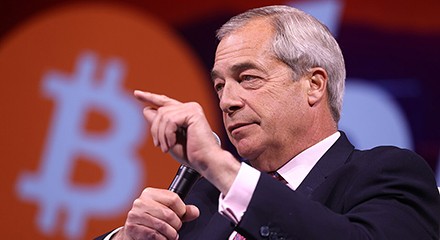
The staggering combined £72 million ‘gift’ given to Reform UK by crypto-billionaires, Ben Delo and Christopher Harborne, is the largest donation in British political history.1
Nigel Farage said he was “honoured and humbled” by the payments, Delo himself arguing that it merely “levels the playing field” - he wants the party to be able to “spend less time trying to raise funds to compete on equal terms and more time preparing for government”.2 Apparently, Reform is planning to use the money to hire about 400 campaign managers in target constituencies and is now on “election footing”. There is also talk of Reform TV.
Meanwhile, the Metropolitan Police has expanded its investigation into the party’s financing. This follows the recent Channel 4 sting exposing what seems to be senior party figures seeking illegal funding from a rich American doner.
Of course, to some extent, this is indicative of a wider trend in UK politics. Parties are increasingly funded by the rich and very rich - Delo and Harborne being just the most spectacular examples. Eg, an ‘exclusive’ by The Guardian reveals that a total of £179 million has been donated by wealthy individuals since 2019.3 Hence between 2001, when donation records began, and 2018 the total donated by individuals giving more than £1 million averaged £3.9 million a year. But between 2019 and 2025, that figure rose to £13.1 million a year! The example of supermarket tycoon David Sainsbury is cited. He gave £8 million to the Liberal Democrats in November 2019, but has now returned to the Labour fold. Indeed, you find that in some years, such as 2023, almost £7 out of every £10 in reported private donations to political parties came from rich people.
The response from Gordon Brown, the former prime minister, is not untypical when it comes to the liberal establishment. ‘We can stop the mega-rich buying access and influence’ declared the headline of his piece in The Guardian.4 For many, it was a ‘laugh out loud’ moment, because it suggested that the mega-rich buying influence and access began with these two crypto-billionaires. Anybody who knows anything about British politics can only but find that risible. What this is all about is not stopping the mega-rich buying influence and access, as if you could ever do that. Rather, Brown and company want to stop Reform, not the Labour Party, or the Liberal Democrats, let alone the Tory Party.
Agendas
Nigel Farage and Richard Tice are scoffing at the notion that these crypto-billionaires are buying access or influence within the party - what an absurd idea! You cannot help but laugh out loud once again. Clearly the likes of Delo and Harborne are not going to be deciding the entire Reform election manifesto - they precisely want to support what they already see as laudable about Reform.
However, when it comes to some fine-tuning, that is a different matter altogether, especially given the possibility at the next general election of some sort of Reform-Tory coalition. Then these guys would certainly get on the phone to a minister and expect a friendly reception - that is exactly the point of spending £36 million each - and, of course, they are not alone. There are plenty of other Chrises and Bens in the world, doing the same - that is the name of the game.
Anyway, Brown mentions in his article that last month he chaired the report of the Commission on the UK’s Future, which included recommendations on reforms to election financing, particularly a donations cap - referring to Andy Burnham’s “gut feeling” that it should be somewhere in the region of £500,000.5 Also to the fact that in September Stella Creasy and 63 other MPs backed an amendment to the Representation of the People bill - which was then withdrawn - limiting all donations annually to that figure, decreasing to £100,000 after one calendar year.
Our Gordon further looks around the world and reminds us that in December last year the UK and at least 59 other countries co-sponsored a UN resolution that urges states to consider “limitations on donations” to parties with a view to “combating corruption” - quoting figures that Canada caps donations to £930 annually, while France has a limit of £6,400 and £3,900 for presidential campaigns, and Italy’s cap is £85,600.
Then Brown presents some interesting figures, showing that outside a general election period in terms of day-to-day expenses, Labour and Conservative spending has recently been around £60 million and £55 million respectively - that, of course, shoots up in a general election period. While we do not know how the figures were arrived at, we can only quote Brown: before 2024 the total spend in election years was about £87 million. But in 2024 Labour’s expenditure ballooned to a record-breaking £103 million, while the Tories spent considerably less - £74 million.
Readers will be aware that the nature of Labour’s donations has changed in recent years: where it used to be the trade unions providing the bulk of Labour’s finances, now that is either equalled or even surpassed by private donations. Sounding a bit like Ben Delo, Brown assures us that what Labour donors simply wanted was an even playing field, as historically the Tories have always been richer. Well, come on, Gordon - pull the other one. The idea that only Reform’s mega-donors can buy access and influence, but not Labour’s private donors, is bullshite. All you need to do is listen to the most transactional leading trade union general secretary of the moment, Sharon Graham, and that is exactly the point she repeatedly makes. In spite of the unions handing over their substantial donations, we have nowhere near enough influence on Labour policy. In fact, she is threatening that, unless this is changed, Unite is going to spend its money elsewhere - which surely gives the game away. The idea that money does not get you access and buy influence is simply for the birds.
Adapt
Acting righteous, Gordon Brown says there is a huge difference - and there is - between some fantastically wealthy individuals donating $36 million and the likes of you and me donating a few quid through the trade union levy. That is true, but we are not talking about the influence of isolated trade union members. In reality, what is happening is that this influence and access is being collectivised and exerted by a general secretary or perhaps the union executive. Widening out the picture, we can see that through the incorporation of the trade union bureaucracy - and, of course, the incorporation of the Labour Party - the ruling class ultimately stabilises the capitalist system itself. In reality, the Labour Party was state-loyal right from its very beginning - there was no golden age of socialist politics, despite what some still seem to think.
Of course, this is not a situation that the ruling class wanted - but they can learn to live with it. From their perspective, they do not want something called the Labour Party or the trade unions involved in financing an alternative party of government - or making any sort of demands upon them. They would much rather have two completely bourgeois parties.
There has not, nor ever will be, an ‘even playing field’ under capitalism - have you ever listened to the supposedly ‘neutral’ BBC? And, historically, remember the BBC bias and bile during the 1926 General Strike, or during the 1984-85 Miners’ Great Strike, or any struggle that pits class against class. We all know what the BBC champions - the capitalist establishment. Nowadays it generally constitutes its liberal wing, as Nigel Farage constantly complains (although the capitalist right wing of the establishment is quite prepared to back Reform, Restore, etc). That may have nothing to do with directly financing of parties, but it unarguably helps to frame politics. Moreover, if you are mega-rich, you do not need to spend £36 million or whatever on directly donating - there are many other different ways to shape the agenda.
What about the ‘legacy media’. Rupert Murdoch and News Corp, the Telegraph, the Rothermeres, GB News, etc, exert huge influence. Less overt but no less important in many respects, there are the think tanks which come out with those ‘big ideas’. They are not just researching in some sort of antiseptic, neutral space: they each have their own agenda - like Bright Blue, the Adam Smith Institute, Policy Exchange and Think Labour. This is also where money can go to buy access and influence. Or what about bog-standard schools and their government-set mind-numbing curriculum and exam-passing culture. Of course, the elite have their schools and universities too, through them our future rulers are trained to rule. Charities, for that matter, can likewise play a definite political purpose. Nor should we forget the Church of England - the liberal establishment at prayer.
Then there is the constant factor of what Karl Marx called the dull compulsion of everyday life. Capitalism presents itself as ‘a fair day’s work for a fair day’s pay’ - equal exchange between worker and capitalist. Hey, one buys the other sells in the labour market. Marx, of course, showed that behind the ‘fair deal’ - and most workers instinctively know it - they are exploited. Nevertheless, there is always the apparent naturalism of capitalism.
Response
If you want a picture of a democracy that is ideal for the capitalist class, then it has to be a limited company - ‘one share, one vote’ (and if I’ve got a million shares and you’ve got just one, we know who wins the vote). That is the essence of ‘bourgeois democracy’.
What we had in the 19th century, needless to say, was the rise of those below, ie, the working class, and the subsequent response of the ruling class. At first they used naked oppression: crude censorship, bullets, batons and sabres. But that did not work. Persuading people to choose between Tweedledum and Tweedledee did. First between the Liberal and Tory parties, then between Labour and the Tories. Now, of course, it’s Labour, the Tories, Lib Dems, the Greens and the SNP and Plaid nats. So more Tweedles to choose between … but with the same result. Capitalism wins.
Communists do not propose a whole series of complex laws, or commissions, trying to work out how to prevent people from making mega political donations, or how to stop think tanks and charities from operating politically. That is a hopeless approach, akin to sticking your finger in the dyke. Rather, we need to build our own working class institutions, above all a mass political party that can outcompete the bourgeois and petty bourgeois parties when it comes to raising money and winning votes. We can be supremely confident here because we base ourselves on the working class: in Britain a clear, say, 70-80% majority. As Percy Bysshe Shelley wrote in his famous poem ‘The masque of anarchy’: “We are many - they are few”.
Yes, we need money. Newspapers, books, computers, TV stations, websites, offices, etc do not grow on trees. Yet, while we would not a reject a few mega-donations, fundamentally what we rely on is building a mass party of millions - the many.
-
lbc.co.uk/article/crypto-billionaire-donates-reform-5HjdhJq_2.↩︎
-
theguardian.com/politics/2026/sep/19/uk-politics-increasingly-funded-by-billionaires-as-mega-donations-surge.↩︎
-
theguardian.com/commentisfree/2026/sep/16/big-money-donations-mega-rich-access-influence-democracy-reform-gordon-brown.↩︎
-
labour.org.uk/updates/stories/a-new-britain-renewing-our-democracy-and-rebuilding-our-economy.↩︎