
27.08.2026
Free-wheeling dialectic
Readings from Bertolt Brecht, Darko Suvin, Bill McGuire, Jimmy Reid and Aeschylus. Tam Dean Burn reports on the CU culture sessions
Iwas pleased that the Weekly Worker editorial team chose to headline my preview of the culture programme for Communist University as ‘Nothing is fixed or finished’ (July 30).1 That is exactly the sort of dialectical ethos I had in mind and that we saw develop and grow over the week of August 8-15 at this year’s CU.
Our culture linchpins were Bertolt Brecht and Darko Suvin, upon whose Marxist intellects and experience we were readily able to free-wheel out sessions on a wide range of topics. Esther Leslie and I started with a launch of the ideas behind our Diderot Gesellschaft Movement (DGM), with Darko contributing on Zoom live from Italy.
His dear, departed comrade, Fredric Jameson, offered us much inspiration in the readings Esther and I gave from his book Brecht and method. As Darko said of it, “Brecht can be supremely useful to us if we wish to think through and do something about the present catastrophic state of the world; and what is useful is his method. This is Fredric Jameson’s thesis in his path‑breaking book.”
In it Jameson offers up so much of Brecht that fits what we are attempting:
I want to retain the connection between Brecht’s ‘usefulness’ for us today and a whole range of activities into which it might be expected to energise us … Brecht offers us a world in which practice is entertaining … so activity itself is also one of the features of knowledge and art, as those flow back into the useful … this is why a Brechtian conception of activity must today go hand in hand with a revival of the older pre-capitalist sense of time itself, of the change or flowing of all things; for it is the movement of this great river of time … that will slowly carry us downstream again to the moment of praxis …
This points towards Brecht’s understanding of the philosophy that could be very useful going forward, as climate catastrophe beckons. I also think there is a moonlight reflection of similar senses to what Camilla Power has been presenting in the Radical Anthropology Group with regard to time and capitalist control of it (more on comrade Camilla later).
Anyway it is all a beginning that might lead towards a ‘DGM manifesto’ developing through our activities and practice. CU offers such an opportunity for that and I will come back below to where we go next. And this is what Marx said about such developments: “Every metamorphosis is to some extent a swan song, to some extent the overture to a great new poem.”
At the next session we took Darko’s recent essay on the great solidarity song, ‘O bella ciao’, and divided sections of that between Esther and I, with elements of Sprechgesang (spoken song) thrown in. The singing worked fine, fitting the emblematic “song of death and ongoing joy”, as Darko bills it, and had our audience joining in the choruses of each version.2
When comrades Erin from Dundee and Janne from Utrecht joined us for the session titled ‘Hegelian alienation in Glasgow spirit and opium’, we really started to see how various fragments could be interlinked and collectivised. This sprang from a Substack essay entitled ‘Marx’s communism and the inspiration from Hegel’s “Anti-Christ”’ by Sally Mju - a young Marxist student from Vietnam.3
This passage from her essay shows why I saw possibilities for physical performance: “In Hegel, spirit or Geist is always in movement. It does not stand still. It passes through many shapes of consciousness. It divides itself, becomes alienated from itself, faces itself in strange forms, and slowly learns to recognise itself in what seems to be ‘not itself’.” Splitting passages from Sally’s essay between the four of us instantly made it all more performative, with us functioning more like a chorus in a play than delivering a lecture.
We then combined some of the discussion Sally and I had in the comments below her essay, and opened out into several other interconnected writings. These included the famous ‘Alienation’ speech made by CPGB Clydeside trade union leader Jimmy Reid when he took up the post of rector at Glasgow University in 19724, and lyrics from the album by Glasgow band The Tenementals, where a song entitled ‘Universal alienation’ sampled Reid’s speech and opening track ‘The owl of Minerva’.5
We found a further link from Dutch comrades at CU about a notorious speech by a far-right leader quoting the above renowned Hegel phrase on live television, whilst clearly under the influence of drugs! Drugs also feature in connection to both Glasgow having the highest rate of drug deaths in Europe and to Marx’s turning Hegel upright on alienation - as Sally outlines in her essay:
When Marx calls religion the ‘opium of the people’, he is not simply mocking religious people as stupid or blind. Before that, he writes that religious suffering is both the expression of real suffering and a protest against real suffering. Religion is ‘the sigh of the oppressed creature’. So for Marx the critique of religion is only the beginning. The real problem is to criticise the world that makes people need religion as comfort.
Gob-smacking
In the discussion afterwards Jack Conrad gave us his personal take on comrade Jimmy Reid as the most charismatic speaker promoting communism he had ever heard, even though he came from a different wing of the CPGB (whilst also, remarkably, becoming something of a celebrity, with appearances on the BBC Saturday night Parkinson chat show). Another connected element he outlined was that Reid was a committed Christian as well as a communist.
What was quite gob-smacking to us was that all this - plus sections of a brilliant folkloric poem by Erin Farley about the myths of the Glasgow river Clyde and class struggles there. such as the rent strikes during World War I - took just half an hour to deliver.
Discovering content that fitted each session’s theme was in process in the lead-up to CU and sometimes - as with the Jameson excerpts offering ideas towards a DGM manifesto - such discoveries were made in the spare hours during CU. Such a late addition was the very useful book, Tragedy of the commodity - oceans, fisheries and aquaculture, by Stefano B Longo, Rebecca Clausen and Brett Clark.
This exposure of how the Marxist metabolic rift theory applies to the sea fitted so well with our look at the subject through the prism of the poem, ‘The rime of the ancient mariner’, by Samuel Taylor Coleridge. This began as a play written by Johny Brown, in which I appeared as the mariner, performed in 2002. For the CU session Johny gave voice to the albatross shot by the mariner and then the bird exacting revenge by turning into a drone aimed at Burrough’s head. Such a dystopian take could perhaps fit in the future with Darko’s work on science fiction!
Another idea planted at CU was in regards to Darko’s translation and adaptation of Brecht’s Communist manifesto versification, which I performed in sections at the start of the morning sessions. We discussed how one thing that the poem does not contain is an awareness of the climate catastrophe that capitalism is unleashing. This is understandable, given Brecht was writing it around World War II, so Darko suggested we look at such writings on the subject by him and he will attempt to put them into the hexameter verse form used by Brecht and himself in the rest of the poem.6 Again we find solutions to challenges presented to us through our activity.
We will also now endeavour to make contact with the Tragedy of the commodity authors, operating in the field of radical sociology, to see if we can develop further work together. That would be an example of our DGM in action - working culturally with Marxist scientists.
The prime example of this at CU was the extended afternoon session we did on the last full day in cooperation with the Radical Anthropology Group, who have been regular CU participants over the years. This involved looking into the issues around the ancient Greek play, Prometheus bound, by Aeschylus. It had been brought to my attention by Darko through his essay, A long hope: the Prometheus counter-project.7 I have to confess that I had never come across the play in all my years as an actor, but have now seen how much it has meant to Marxists drawn to culture - not least the great man himself, who gave Prometheus the title, “patron saint of the philosophical canon”, in his early writings and employed his labour power (or use value?) in Capital itself.
In discussions with RAG stalwart Camilla Power I discovered a very different take on the Prometheus myth that binds him to the long patriarchal counterrevolution which usurped the female sex-strike solidarity that drove the original human revolution. This opens up a fascinating debate on whether Prometheus - like Jesus, another “menstrual male” symbol according to RAG - can still be considered a revolutionary figure despite being on the wrong side of history.
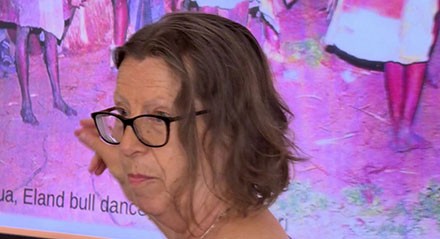
It was decided we should begin the session with an illustrated lecture on Origins and theft of fire by Camilla and then do a reading of the play with a full cast. That session felt like the highest achievement of our culture programme, because it brought unique beginnings of a debate into focus around such a cultural icon.
But that is not to take anything from the other sessions, including the dramatised readings of Bill McGuire’s geoengineering speculative fiction, The fix, and Darko’s poetry, including his incredible epic work, ‘Thus spake the muse - do not profit by the blood of your fellows’.
They all offer possibilities for further development and were certainly not fixed or finished on this outing. Next up for our DGM is the Historical Materialism conference in London on November 5-8, which has had me daydreaming of a Marxist mini-festival, featuring much of what was seeded at CU and with The Tenementals as our house band!
-
weeklyworker.co.uk/worker/1596/nothing-is-fixed-or-finished.↩︎
-
darkosuvin.com/2025/12/19/a-song-of-death-and-ongoing-joy-o-bella-ciao-2025-9800-words.↩︎
-
strengthinnumbersrecords.bandcamp.com/album/glasgow-a-history-volume-i-of-vi.↩︎
-
darkosuvin.com/wp-content/uploads/2021/06/ds-manifesto-transl.-1-19.pdf.↩︎
-
darkosuvin.com/wp-content/uploads/2023/12/1-prometheus-and-the-long-hope-7-23.pdf.↩︎