
12.11.2026
So much to choose from
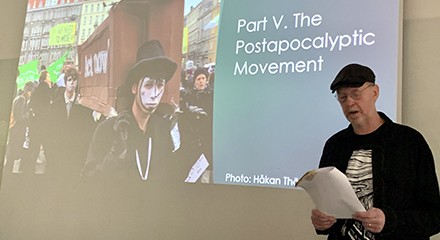
Tam Dean Burn followed the ‘Culture’ stream. Walter Benjamin was very much mentioned. But what particularly struck him was the presentation given by Håkan Thörn and Carl Cassegård on postapocalyptic environmentalism
The Historical Materialism conference in London began under a disgraceful dark cloud created by the Labour government that warranted this statement by the editorial board:
The decision of the UK government to deny Andreas Malm, a member of our editorial board, entrance to the United Kingdom, is shocking and disturbing. An internationally recognised academic, whose work has shaped the way the very question of climate change is discussed globally, is now facing the outrageous claim that his “presence in the UK is not considered to be conducive to the public good”.
The fact that he has repeatedly expressed his solidarity with the Palestinian people and has condemned the genocide in Gaza, in the same manner as millions of UK citizens in the past years, provides no ground for such a ban, unless the UK government has opted to assault the right to free speech and endorse censorship.
We unite our voice with all the voices that protest this outrageous decision and demand that Andreas Malm’s right to visit the UK is reinstated immediately.
But there was no way of stopping this quite extraordinary event, with hundreds of participants attending around 80 different sessions each day in a range of nine political streams - from ‘Marxism, culture and the arts’ to ‘Imperialism and anti-imperialism’ and ‘Workers and capital’ and much else besides.
To multiply the content even further, sessions were often then split between three or four different papers delivered under one banner over an hour and three quarters, with a question-and-answer period always included. I know some comrades, schooled in the Communist University approach of lengthier solo subjects and extended discussion, have criticised this approach, but it does allow for a large number of participants from many countries, who are often not experienced in presenting papers on public platforms.
This inevitably means that the quality of sessions can be variable and it is an enormous task in itself just working out which sessions to go for. It reminded me of the Edinburgh Festival Fringe, where, as a completely unique experience, you find an exhausting choice with some angst over what you will miss. But you are guaranteed to stumble over unexpected gems and many memorable political experiences, with Marx’s name mentioned more than any other. As I inevitably chose the ‘Culture’ stream to often paddle in, seeking like-minded comrades, Walter Benjamin was the other name that was often raised.
The most memorable session of the many I attended was the first on Saturday morning. Esther Leslie and I had once again made a live radio broadcast for the Bad Punk show on Resonance FM.com on the Friday night, which felt very special, not least because of the improvised musical score accompanying it (performed by Stuart Wilding, Skye McDade-Burn and the seasoned Band of Holy Joy team). The words of Bertolt Brecht and Rosa Luxemburg sat so well within that spontaneous sound design that it can somehow seem quite uncanny how well they fit together.
An added beauty is that the show is then immediately archived and available for playback on the Mixcloud site, so I was able to listen back to it, as I walked into the conference venue on Saturday morning, and could not be happier with what we had achieved in this world-premiere performance of Brecht’s versification of the Communist manifesto - with a counterpoint of Rosa’s engagement with nature from her prison-cell window.1
To then find a first-thing Saturday session entitled ‘Catastrophe: with and against including a first presentation of The post-apocalyptic manifesto’ sounded intriguing indeed. Presented by Håkan Thörn and Carl Cassegård, it was described thus:
Based on our book, Postapocalyptic environmentalism: the green movement in times of catastrophe (2022), we present a first draft of a pamphlet titled The postapocalyptic manifesto. The manifesto is structured in four parts.
The first part, ‘Against progress’, critiques the ideology of the hegemonic bloc that legitimises global capitalism through appeals to historical progress and claims of compatibility between economic growth and ecological sustainability. We argue that efforts to restore neoliberal globalism - or to promote a socialist version of green progress, such as the Green New Deal - will only accelerate the ongoing catastrophe, while failing to offer a postapocalyptic alternative for a just society on a liveable planet.
The second part, ‘Against apocalypticism’, critiques movements and cultural currents that oppose the hegemonic bloc by invoking the looming threat of an imminent global apocalypse. Such apocalypticism comes in the guise of sometimes diametrically opposed political movements, involving environmental movements calling for action to avert the apocalypse, as well as leftwing and rightwing accelerationists that mobilise to speed up developments that will ultimately bring about global apocalypse.
The third part, ‘The postapocalyptic condition’, diagnoses the present as postapocalyptic: the global apocalypse is no longer a future threat - it has already begun. We live amid an ongoing environmental catastrophe, which, combined with social, economic and cultural crises, exposes the catastrophic essence of western capitalist (un)civilisation.
Finally, the fourth and most important part, titled ‘Towards a postapocalyptic movement’, provides directions for future-oriented collective action, addressing the already emerging, but far from unified, global postapocalyptic socialist movement, which involves climate activism, indigenous anti-capitalist struggles, as well as sections of the transition movement and the movement for the rights of nature.
Like Marx and Brecht, it raises the spectre of communism and, like our show, adds the catastrophe being inflicted upon nature into the mix. It genuinely overwhelmed me with its power. It is now in the hands of Verso Books and hopefully will see publication soon - not least because we would love to explore what the two manifestos could offer together.
I was so pleased that we opened up contact with Håkan and Carl and they were hugely enthusiastic about our show, saying they had already passed it on to their comrades. This feels like exactly what the 2026 Historical Materialism conference and our efforts towards a Diderot Gesellschaft Movement (which Esther and I laid out in our Sunday session, attended by Håkan and Carl before they returned to Gothenburg) are all about. A great many more contacts were made and will be pursued over the coming days and weeks - along with much food for thought and avenues to explore.
To then have the day school built around the launch of Chris Knight and Jerome Lewis’s book, The revolutionary origins of language, happening two days later, felt incredibly fortuitous, to say the least, and I was still reeling from all that as I travelled back to Glasgow hours afterwards.
Finally, to have sandwiched between these two momentous Marxist experiences a meeting with the great radical comedian, Mark Thomas, as the first step towards a performance inspired by that book, and the importance of laughter that it displays, makes me chuckle with joy.
-
www.mixcloud.com/Resonance/bad-punk-6th-november-2026.↩︎