
30.07.2026
Oppose both imperialism and tyranny
Trump promises to mete out a beating. Saudi Arabia becomes directly involved. Pezeshkian urges Iranians to stand firm against the enemy. Yassamine Mather explains why the ceasefire could not hold
Predictably, the short lull in the war between the US and Iran has ended. Iran launched a missile attack against US forces in Jordan. The US and Saudi Arabia carried out strikes against Iran-aligned militias in Iraq and a US-owned tanker was hit off the Egyptian coast. Meanwhile, Donald Trump promises to “beat the fucking shit” out of the Islamic Republic, telling Fox News: “They’re going to get a beating.”
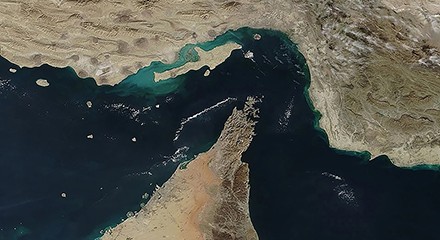
However, the central issue in dispute remains control of the passage through Hormuz. Iran has shown that its geographical position provides leverage far more effective than its nuclear programme, while the US and the gulf states reject any arrangement that would allow Tehran to impose unilateral control or compulsory charges on international shipping. The disagreement is no longer simply about whether Iran should have a role, but about how much authority it should exercise over each traffic lane and whether payments are voluntary service contributions or mandatory tolls.
Targets
Before the pause, the US had conducted 13 consecutive nights of attack. The early target list concentrated on coastal radar, missile batteries, naval installations, drone facilities and command-and-control systems. As the campaign continued, the range of reported targets broadened to include communications networks, bridges, tunnels, transport links, electricity installations and other infrastructure described by Washington as military or dual-use. Tehran argued that this widening campaign struck systems essential to civilian life and showed that the war was moving beyond narrowly defined military objectives.
Iran replied with missiles and drones aimed at American bases and associated facilities in Bahrain, Kuwait, Jordan and Iraq. Some claims of successful strikes have not been independently verified, and damage assessments remain contested. Nevertheless, the political logic of Iran’s response was clear. Tehran sought to demonstrate that Gulf countries could not host US forces, provide logistical support and permit operations from their territory, while claiming neutrality. In Iranian eyes, bases used by the US make the host state part of the architecture of the war.
The previous Memorandum of Understanding was unstable from the beginning. Even its name suggested a deliberately vague arrangement rather than anything approaching a final settlement. It tried to address immediate military risks and long-term political disputes without precisely defining either side’s obligations. Hormuz was the most visible ambiguity, but the same problem affected the nuclear programme, missile capabilities, sanctions, security guarantees, the sequencing of reciprocal steps and the consequences of alleged violations.
Such ambiguity may be useful when governments need to stop an immediate escalation without admitting defeat. It allows each side to present the same document differently to domestic audiences. But the advantage is temporary. Once implementation begins, incompatible interpretations become trigger points. Iran could argue that the understanding recognised its security role in the strait; the US could argue that it guaranteed unrestricted international passage.
The collapse of the MoU should therefore not be explained through simplistic stories about Iran’s irrational decision to suddenly abandon a workable peace, nor has it anything to do with factional differences within the Iranian regime. Washington appears to have concluded that the terms were too restrictive or insufficiently advantageous. Tehran concluded that compliance without enforceable guarantees would leave it exposed to renewed bombing and economic pressure. Each side tried to improve its position through force.
Defensive
The language used by Britain and the US has become increasingly strained. British ministers insist that the UK is not participating in the war, but supporting American “defensive” operations. But the distinction between defence and attack cannot be established simply by the label used in a ministerial statement. If US aircraft use British facilities, intelligence, logistics or protected airspace in operations that strike Iranian territory, Tehran will not regard Britain as detached from the conflict.
The same contradiction applies across the Gulf. Kuwait, Bahrain and other states may object that they are being attacked despite there being no formal declaration of war. Yet hosting US bases is not a politically neutral act, when those bases support military operations. This does not mean Iranian attacks are justified, nor that civilian populations should be made responsible for the decisions of their governments. It means only that the infrastructure of American power is regional, and war exposes the political meaning of that infrastructure.
The term ‘defensive’ performs an ideological task. It presents western military action as a response to aggression, even when it includes strikes deep inside another country, while describing retaliation by the targeted state as inherently offensive. Iran employs its own selective language, presenting all its actions as national defence and minimising the coercive effects of restricting international shipping.
As for Iran, the Strait of Hormuz has become more useful strategically to it than the nuclear programme. Nuclear capacity is surrounded by inspections, long technical timelines and the threat of ‘preventive’ attack. Hormuz is different. Iran’s coastline, missiles, naval forces and proximity to shipping routes allow it to affect energy markets almost instantly. Even partial disruption raises insurance costs, slows traffic and forces governments and companies to calculate the risk of escalation.
Tehran certainly fears that, if it restores normal passage without obtaining guarantees, the US will simply resume regime change operations, once the immediate pressure on oil markets has passed. From Iran’s perspective, surrendering control first would remove its strongest bargaining instrument, while leaving in place the US threat. That is why calls for Iran simply to ‘give in’ misunderstand the logic of the confrontation, regardless of one’s view of the Islamic Republic.
At the same time, Iran cannot use this weapon indefinitely without serious consequences. Regional economies suffer, but so does Iran. Neighbouring populations may initially blame the US, especially where American bases are unpopular, but prolonged disruption, unemployment, empty hotels, rising prices and attacks on infrastructure can shift opinion against Tehran. The belief that the peoples of the region will inevitably support Iran because their governments are allied with Washington is a dangerous illusion.
Global impact
The US-Iran conflict cannot be understood simply as an isolated quarrel between Washington and Tehran. It forms part of a broader struggle over the political order in the Middle East and, beyond that, the rivalry between the US and China. Iran matters in its own right, but it also occupies a strategic position in energy routes, relations with Russia and China, the politics of the Gulf and the future regional order sought by the US and Israel.
One objective of US pressure is to restrict the flow of discounted Iranian energy to China and reinforce American influence over the terms on which global trade is conducted. The US is seeking to demonstrate that it remains the hegemonic power capable of policing strategic routes. The war therefore carries a significance beyond the immediate Iranian state. It demonstrates whether Washington can use military and financial power to determine access to energy and discipline states connected to an emerging anti-American bloc.
None of this reduces every event to a direct US-China confrontation. Regional actors possess their own interests. Israel seeks to weaken Iran and reshape the regional balance; Gulf monarchies fear both Iranian power and the consequences of a another round of American-Israel warmongering; Oman attemps to play a mediating role; Saudi Arabia wants secure energy exports; and Iran’s rulers seek regime survival, regional influence and protection from attack. These interests intersect with global rivalry without being mechanically determined by it.
The war has also spread through related theatres. Houthi operations in and around the Red Sea create pressure on Saudi shipping and widen the danger to global trade. In addition we have Ukrainian claims of involvement in the Caspian adding another layer, although many specific claims require independent verification. What is certain is that, the longer the conflict continues, the more opportunities arise for separate wars and rivalries to become entangled.
China, Qatar, Pakistan, Egypt and Oman have all had reasons to encourage a pause. None want disruption of energy markets or a direct regional war. But mediation does not remove the underlying imbalance. The US can threaten destruction on a scale Iran cannot match. Iran can impose substantial costs, but it cannot equal American military capacity. This asymmetry shapes every negotiation.
Predictions that limited foreign strikes would automatically produce the collapse of the Islamic Republic have proved to be nonsense. Such claims underestimate the effects of nationalism, fear and wartime repression. A population may deeply oppose its government, while also rejecting a foreign military victory. Hostility to the regime and support for American bombing are not the same political position.
Foreign attack often strengthens the state in the short term. It allows the authorities to identify dissent with assistance to the enemy, restrict protest, intensify surveillance and demand ‘national unity’. People who would ordinarily mobilise against the government may hesitate, when demonstrations can be portrayed as weakening the country during war. Material hardship does not necessarily produce rebellion, especially where organisation is weak and repression is severe.
The Islamic Republic has long relied on crisis. External confrontation helps it justify internal coercion, while internal repression helps it manage the consequences of its foreign policy. This does not make the regime anti-imperialist or progressive. It remains a reactionary state, whose principal domestic enemy is its own population: workers, women, national minorities, political opponents and all those subjected to imprisonment and execution. Wartime conditions may strengthen rather than soften this machinery.
At the same time, explaining the war primarily as the result of Iranian irrationality, or reactionary obsession with ‘crisis’, obscures the history of US policy. At several points, including after 2001 and during the 2003 invasion of Iraq, Tehran offered cooperation to Washington. Those openings did not produce a stable accommodation. The US has repeatedly sought a settlement in which Iran is subordinated, contained or transformed. In fact Democrats and Republicans have never forgiven the Iranian people for overthrowing their stooge - the shah, Mohammad Reza Pahlavi - in 1979. The current war cannot be separated from the project for ‘revenge’.
The Islamic Republic’s rhetoric about Palestine should also be treated critically. Its support has often been selective, instrumental and subordinate to state interests. But exposing that hypocrisy does not justify an American or Israeli war, nor does it absolve the powers responsible for the destruction of Gaza and the wider regional crisis. Two reactionary forces can oppose one another without becoming political equivalents in power, responsibility or historical role.
False choice
The left can reject the false choice between supporting US victory and politically endorsing the Islamic Republic. Those sections of the so‑called Iranian left (only in exile) who argue against calling the US assault an ‘imperialist aggression’ do so because, in their limited imagination, if that was the case one would have to defend the Islamic regime. That is not the case. In Britain and the US, the first responsibility is to oppose one’s ‘own’ state: bombing strikes, the naval blockade, the system of bases, arms supplies and diplomatic manoeuvring. This is not because the Iranian government deserves support, but because workers in the imperialist states have a particular duty to oppose the power exercised in their name.
However, defeat for the American war aims would not automatically mean a victory for our side. Iran’s rulers could easily intensify repression, mobilise popular anger and attack its domestic enemies ever more aggressively. The left must therefore combine opposition to imperialist war with solidarity for independent working class, democratic, women’s and minority movements within Iran.
This requires more than predicting whether the regime will fall. The essential question is how people can organise from below under conditions of war. Immediate demands should include protection of civilian life, an end to executions and wartime repression, freedom for political prisoners, defence of wages and essential services, democratic control of emergency measures and opposition to ethnic or sectarian scapegoating. Longer-term organisation must aim to create a political force independent of both foreign intervention and the existing state.
The slogan of defeating the US has use only when connected to the agency of working people, not to the military success of a reactionary government. Likewise, opposition to the Islamic Republic has progressive content only when separated from monarchist restoration, external regime change, plans to dismantle Iran as a country and the fantasy that American bombs can deliver democracy. Any sort of viable revolutionary politics must treat both imperial domination and domestic dictatorship as enemies, while understanding that they are not identical forces.