
16.04.2026
End of something special
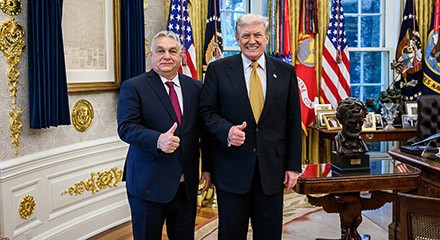
Viktor Orbán’s downfall is a blow to the Trumpist ‘fascist international’. But Péter Magyar is no liberal. He comes from the far right and remains on the far right, says Paul Demarty
Defeat for Viktor Orbán and his Fidesz party in the Hungarian general election is undeniably an event of global significance.
It was quite a defeat, as well. On a very impressive turnout, the Tisza (‘Respect and Freedom’) party of former Fidesz trooper Péter Magyar comprehensively smashed the incumbents, just scraping past the two-thirds majority line, which allows the new government broad leeway to tweak the constitution. It wrought havoc in many of Fidesz’s electoral heartlands.
Until this electoral cycle, Orbán had seemed one of the immovable objects of European politics. He was in power for 16 years, and in that time had shored up Hungarian society against challengers. Over time, the majority of the Hungarian media had conveniently fallen into the hands of his allies. The electoral system had been changed: a hybrid of first-past-the-post and proportional systems, designed to favour the incumbent. He seemed pretty comfortable, enjoying his role as a minor, but not inconsequential, statesman on the world stage. His description of Hungary as an “illiberal democracy” stuck, and proved attractive to many admirers internationally, especially on the post-liberal right.
Scandal
His downfall has a few explanations. Firstly, the Hungarian economy is stagnating. Orbán’s efforts to imitate the ‘Polish economic miracle’, and build up a substantial domestic economy, have largely failed. Hungary remains a kind of sweatshop for especially German capital, which he seduced by passing draconian labour laws. Attempts at endogenous development resulted largely in scandalous handouts to his mates. With the European economy in general on the skids, Hungary has been hit hard. Investment is stagnant, and unemployment is up.1
That corruption, and the general impunity of the Fidesz apparatchiks, has proven politically combustible on its own. Those outside the clientele networks have much to resent. Other kinds of scandals result from such cosy arrangements. One rather extended story in particular needs telling, since it is directly relevant, but also illustrative of the incestuousness of Orbánland. In 2019, the former director of a children’s home in Bicske, near Budapest, one János Vásárhelyi, was convicted of serial sexual abuse of boys in his care. His deputy, Endre Kónya, also received a stiff sentence, as he had blackmailed one of the victims into silence.
In 2024, a political scandal erupted when press reports revealed that Hungarian president Katalin Novák (a largely ceremonial role) had pardoned Kónya the year before. Further reports alleged that pressure from Zoltán Balog - a bishop in the Reformed Church, mentor to Novák and former Fidesz government minister - was decisive. Novák resigned in disgrace, as did justice minister Judit Varga. Varga’s recently divorced husband, another Orbánite operative, also resigned - but in disgust. His name was Péter Magyar. Small world, eh?
Beyond the economic woes, and the corruption and scandals, there is also the possibility that Orbån’s international politicking may have backfired. He has persistently undermined European efforts to back the Ukraine proxy war, but Hungarian nationalism has a distinctly anti-Russian flavour, as is common in the former Eastern bloc. His support for Romanian far-right leaders in their recent battles with local and European courts has also rankled, since there are old enmities over disputed borders there too. His close alignment with Donald Trump, meanwhile, may have cost him in the same way it has cost many other co-thinkers, as Trump’s comically colonial attitude to Europe has come to the fore.
There are more direct consequences, however: the EU has withheld post-Covid recovery funding, citing failures of democracy and the rule of law, but plainly in revenge for his obstinacy on Ukraine. The ailing Hungarian economy could badly do with the money, and Magyar has wisely promised to get it released.
Bogeyman
Though they are men of extremely different temperament, Orbán was an important forerunner of Trump. Fidesz is not in origin a far-right party, but a party on the European Christian Democratic model, emerging after the fall of Hungarian ‘goulash socialism’. Orbán was prime minister from 1998 to 2002, and he governed as such a party would be expected to, notably bringing Hungary into Nato.
It was a harder-edged figure who retook office in 2010, however, from the ailing Social Democrats (the neoliberal shell of the old ‘official communist’ ruling party). Under his rule, Hungary began to diverge from the standard-issue liberalism of EU politics. Fidesz promoted ‘traditional gender roles’, in a so-far-unsuccessful attempt to reverse population decline. The gay rights movement was steadily marginalised. When the Syrian migrant crisis of 2015 hit, Orbán led the charge against those urging a welcome.
This brought him admiration in many quarters on the European right, but also attracted attention on the American new right. Several well-known US pundits, like Rod Dreher and Gladden Pappin, showed up in Budapest and formed an outer circle of courtiers. Orbán set up the Matthias Corvinius Collegium (MCC), a conservative quasi-university, which later opened up a campus in Brussels, truly parking his tanks on the Eurocrat globo-homo lawn. MCC Brussels set itself up as a kind of watchdog on the EU, publishing exposés on the organisation’s funnelling of funds to pet NGOs in troublesome member-states, its interference in elections, its trans rights initiatives, and so forth.
In response, international liberal opinion sharply polarised against him. He became one of the great bogeymen of the day, the third name in the unholy trinity completed by Vladimir Putin and Donald Trump; and liberal opinion in our day could scarcely distinguish between them - three persons but one substance. He was talked of as an autocrat, though there were few signs of that early on the evening of April 12, when he graciously conceded defeat to Magyar. His position was never nearly as impregnable as Putin’s at the head of the FSB state; nor did he enjoy the kind of unchecked power of initiative yielded to Trump by decaying American ‘democracy’.
What is the programme of the new Magyar administration? Even a cursory familiarity with it should dampen the wild enthusiasm among western liberals for Orbán’s downfall. Magyar is no more enlightened on the matter of immigration than his old idol - indeed possibly less (he promises to cancel the work visas of south Asians that Orbán recruited to ameliorate his labour shortages). Though it predates his membership, Tisza is basically Magyar’s one-man band. Only he is allowed to speak for it. It is somehow a more centralised, personalist outfit than Fidesz. Assuming his objections to his old party are sincere (and why not?), they are primarily ones of honour - the stain of corruption and scandal must be expunged. (Judging by what we have seen so far, we expect truly dismal failure on this front, but hope springs eternal.)
On international policy, things are more interesting. He promises to mend fences with the Europeans, which is broadly popular with the national mood (given, as noted, the anti-Russian sentiment), and keen for more ‘European’ living standards. That will presumably remove Hungary as an obstacle to European support for Ukraine. Even here, however, he is pragmatic. Though he has been happy to have chants of “Russians go home” at his rallies, Magyar is anxious to deny he will put Russian gas imports at risk, which are essential for the Hungarian economy. It is plain that senior European figures consider him a man with whom one can do business, but the fine details may still bring frustration.
Euro right
Tacking closer to Europe, at a time of rather frosty transatlantic relations, means taking some distance from the US. This should not be difficult, really; Hungary is far more integrated into the European economy than it is with the US. American support for Orbán under Trump was real, up to JD Vance’s failed attempt to shore him up on the campaign trail, but the Americans have few real levers to stop Hungary from drifting away now.
The real cost is a symbolic one to the particular political project that found a home in both the Trump and Orbán regimes - what has been called the ‘far-right international’ or ‘fascist international’, a most peculiar phenomenon indeed. Following, as I have, gatherings like the National Conservatism conferences over the years, I have often been baffled by the fact that they can work at all. The America First crowd, and the Hungary First crowd, and so on - all getting together to celebrate their agreement on the concept ‘first’?
America’s habit of exporting its culture wars via squabbling camps of NGOs and internet influencers gave some sense to it; thus a Romanian bigot might also live in horror of ‘drag queen story hour’ coming to Bucharest, or a French reactionary might denounce ‘le wokisme’. But surely, I thought, this is just papering over the cracks. Now, with Trump revelling in his humiliations of subordinate powers, and Orbán defeated by another rightwing nationalist on partly nationalist grounds, perhaps my doubts are vindicated.
It is not necessarily a cause for cheer on the left, however. Rightwing politics may take a nationalist form, or alternatively a civilisational form. One can defend ‘the Fatherland’, or perhaps ‘the west’. The mistake of the NatCon crowd was to suppose you could do both without friction. Perhaps what emerges in the current situation, however, is a Europeanised right, dedicated to rearmament in depth and progressive detachment of its alliance structure from American tutelage. It is already visible, in embryo, in the opposition to Trump’s Iran war from the French National Rally and Alternative for Germany, among others.
Appearance
This would not be easy. Indeed, given the decisions made by the European elite this century, it is hardly clear whether it is even possible. However, even the appearance of multipolarity in global power (again, its reality remains doubtful, despite Chinese advances and American difficulties in the Middle East) puts it on the agenda. If the Gulf states could project power beyond their region, why not Europe? If the Canadian prime minister, of all people, is talking a big game about the opportunities for ‘middle powers’ in the post-American century, why not Europe?
In this scenario, Magyar’s victory could be the beginning not of Hungarian adjustment to ‘liberal’ European norms, but the reverse: a new continental militarism, to defend not ‘western’, but European civilisation from vulgar American power and Asiatic (including Russian) ‘barbarism’ alike. (One civilisation, really, is as good as another.) Where this leaves the EU as it exists is unclear, but it is quite possible to replace a bureaucracy’s governing ideology without much changing the bureaucracy. It would certainly be a better bet for the Germans, French and so forth than just trying to muddle on - if it is not too late.
Such a programme really would surely produce an international political coordination of rightwing elites - as neoliberalism did before it, and ‘national conservatism’ in the end did not. For the left, it would be a new source of danger - one which we, imprisoned as we are in our own separate national cages no less than the NatCons, are singularly unprepared to meet at present.
-
Michael Roberts has a useful summary of the economic angle on the election: see thenextrecession.wordpress.com/2026/04/11/hungary-the-end-of-the-orban-era.↩︎