
19.11.2026
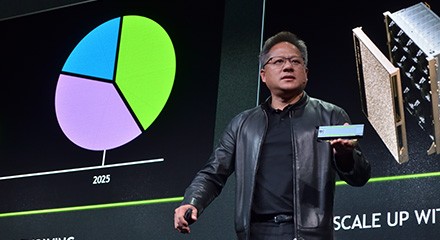
If loving you is Huang …
The underlying dynamic, of dividing the world into great-power blocs pending great-power war, has been drastically reinforced by - of all things - the sexual exploits of a middle-aged, leather-jacketed nerd. Harley Filben looks at Nvidia and its strategic importance
Jensen Huang’s downfall has it all. Sex, espionage, smuggling, high finance, geopolitical rivalry - the whole shebang.
It was the sex that, in the end, made this a scandal. In truth, the strange dealings of Nvidia - the world’s pre-eminent producer of specialised AI chips - with China-adjacent buyers have been bubbling away for some time. That Huang’s relationship with the chief executive of one of these buyers, the Singapore-based Megaspeed, had been sexual, and that she was perhaps a Chinese state asset all along, gave the story enough sauce to get off the business pages and into the headlines.
Little, really, is known about Alice Huang (or Huang Le, or Alice Wong, depending on your choice - for the sake of clarity, we will be on first-name terms with Jensen and Alice for the rest of this article). She is said to have been a Chinese state TV presenter, although long enough ago that no actual footage of her under the bright lights has emerged (the western media has nonetheless confirmed it to the best of its ability).
Her later entrepreneurial career - in partnership with her husband, Kang Wei - veered into the AI silicon business a few years ago, turning a nondescript, Singapore-based mobile gaming company into Megaspeed, a data centre builder (or ‘neocloud’, as they are called nowadays). Kang, it seems, is a bit of a dodgy geezer, having been fined by the Chinese government for securities fraud. He seems to have expressed no displeasure at his wife’s wandering affections, and it was he who introduced the two Huangs to begin with.
Smugglers
On the face of it, Megaspeed’s business is straightforward. It builds data centres, buys chips from Nvidia and rents the capacity to other firms, as cloud providers always do. The slight wrinkle in this is that the buyers are mostly Chinese, and China is not supposed to have access to state-of-the-art Nvidia chips under US export controls. But the data centres are all in south-east Asian countries outside China. This is a technically legal workaround, and there are stories of Chinese technicians ferrying hard drives full of AI training data in and out of these places.
But apparently they went further. A closer look at this firm reveals a rats’ nest of holding companies, and it is alleged that around $5 billion of its stock of AI chips ultimately made it, via a few steps of corporate prestidigitation, into the mainland. Some other estimates put the overall total of such smuggling operations, including by other Nvidia partner companies, much higher, accounting for as much as 20% of Nvidia’s stupendous annual revenues.
If anything like that is true, the more straightforward versions of the ‘honeypot’ narrative are put in question. Jensen may or may not be as patriotic an American as he sometimes claims, but at the end of the day he is a capitalist. Chinese firms want this stuff. Their money spends. Alice might perhaps have answered some deep need in this man’s soul for love; regardless, she certainly answered the deep need in this man’s soul for a back way into the Chinese AI silicon market.
The Chinese state may, in fact, not want this sort of thing going on: there is at least some kind of protectionism at work here, and probably the ruling party would prefer domestic firms to use Huawei’s chips and focus on improving those to catch up with Nvidia. There is no reason to suppose they could not catch up, after all, with state support.
Indeed, the exact relationship of Alice with the Chinese state is disputed heavily. The Ministry of State Security (MSS) in Beijing denies she is any kind of asset (though they would say that) - according to The Washington Post, suspicions on this point originate not with the CIA, but with China-hawk factions within the wider US State Department. They may, nevertheless, be true: it seems from coverage that these suspicions are not new, at least, and have factored into internal decision-making in the American state core, and not merely been trotted out as a way to get up a ‘yellow peril’ angle this week.
In any case, if the MSS had learned of this tryst (as surely it must have done), and the business arrangements associated with it, it would have been guilty of rank incompetence not to cultivate at least some kind of relationship with this woman. Nvidia’s strategic importance in the technology world today is enormous, and therefore great value would have been attached to Jensen’s pillow talk. It is worth mentioning, in this respect, that Nvidia and its hyperscaler customers - Microsoft, Amazon Web Services and the like - are neck-deep in military and intelligence contracts, and by that token their senior leaders must be treated, for practical purposes, as American state assets to at least that extent. It is all in the game.
So there are two significant matters arising: one, of the effect all this is likely to have on the AI bubble; and another, of its indications for the future course of the ‘new cold war’ between the US and China.
On the first point, it must be said at the outset that Jensen’s sexual adventures could not have come at a worse time. A significant subplot of the American midterm elections was simply how despised the AI industry has proven to be among the American citizenry. The concrete physical reality of the AI boom is the expansion of data centres, which - in their new AI-optimised format - are vast, loud, ugly things, whose power consumption has a meaningful impact on local electricity bills in the midst of a spike in energy prices.
Data centres
Put that all together, and we have the political result of the midterms - candidates, like Texas governor-elect Gina Hinojosa, who promised to slow down such developments, were rewarded, and 40 out of 41 ballot measures concerning data centres were won by the anti-data-centre side.
Even if the buildout can be got back on track, the problem remains that it is all hideously expensive. The buildout is largely debt-financed, and debt is getting expensive, with high inflation and therefore, by the robotic Jackson Hole orthodoxy of the Fed, rising interest rates as well. Already, neoclouds like CoreWeave and Nscale are under extreme pressure. The question is merely who else will get pulled into the drain with them, and when.
Now, to take out large speculative loans, one is usually in need of collateral and guarantors. Under Jensen Huang, Nvidia has controversially set itself up as a guarantor in many of these deals, which thereby become circular: Nvidia backs a loan, and the money from the loan gets spent on its hardware. So long as the music has not yet stopped, this makes good business sense. Yet it is a source of considerable counterparty risk, and Huang has faced some dissent internally on this point. One of his antagonists, according to scuttlebutt in the Financial Times, The Wall Street Journal and so on, is erstwhile chief financial officer Colette Kress - who now replaces him as CEO.
The wider AI industry is in a blind panic about this. Nvidia’s action as effectively lender of last resort has been essential. Venture capitalists flatly deny the ‘Chinese asset’ angle (uniting themselves for the moment with online tankies, who seem almost to suppose that China does not have spies at all), taking Jensen to have been offloaded by some malicious action of the US deep state. They astroturf petitions to bring him back. Anything to keep the wheels turning long enough for them to sell on to the greater fool.
Jensen is on manoeuvres to get his old job back, and he has backing from one Donald Trump. “Jensen obviously has two things going on. He has a family situation which is a rough deal. What he wants to do is sell chips,” he lamented, almost wistfully. Just let the poor man sell his chips! But, as of this writing, the Nvidia board denies there is any possibility of a return. We shall see. The cult of the CEO-overman runs deep in Silicon Valley.
The reality is that the ultimate consumers of all these AI chips - once they are installed in data centres - are not terribly diverse. We are talking above all else about the two central frontier labs in the American AI scene: OpenAI and Anthropic. OpenAI is plainly ailing; its initial public offering is delayed and delayed, and in the meantime it must raise more money from investors to keep operations going, and has to keep revising down the valuation of the company in order to do so. We are not yet in, but approaching, the dreaded territory of the ‘down round’: the need to raise investment at a lower valuation than the last time around, which usually serves as an unwelcome reality check in the industry.
Anthropic, meanwhile, remains on course for IPO in the coming weeks. Yet it notably had to revise its S-1 form (the formal prospectus filed with the Securities and Exchange Commission) with somewhat less attractive growth numbers, and its target valuation seems to bounce around day by day between $1.2 and $1.5 trillion (but what’s a few hundred billion dollars between friends?). The top end of this range is already a drastic downgrade from earlier projections of $2 trillion or more. Dario Amodei has taken to producing bizarre videos, where he promises to cure cancer and all mental illness (and, no doubt, bunions, haemorrhoids and ennui). The cure for male stupidity of the Jensen Huang type, alas, continues to elude him.
Great-power politics
The more serious aspect of this whole story is the state politics. Whether or not - as the venture capitalist ideologues suppose - this has all been got up by the American security services deliberately, it has been ably exploited by the China hawks. The American state apparently turned a blind eye to the circumvention of its export controls, and the responsible parties blame each other (treasury secretary Scott Bessent openly throwing commerce secretary Howard Lutnick to the wolves). It will not, we take it, be allowed to happen again.
In any case, as already mentioned, it is not at all clear that the Chinese are happy with this smuggling operation either. They want domestic capability, under the control of the state. It is assumed that the state of the art in China in terms of AI chips is three or four years behind the best Nvidia has to offer and, under such constraints, Chinese AI operations have had considerable success doing more with less, relying (it warms my old coder’s soul) on ingenious programming rather than brute-force compute buildout to make up the difference. But they have already caught up with the US in many other high-tech applications, and there is no reason to suppose that, in a few years, Huawei server boards won’t be roughly as good as the ones coming out of Nvidia.
Regardless, it seems that this scandal’s long-term significance will be the decisive severing of a crucial economic tie between the US and China, even if it had been kept going - as appears to be the case - through subterfuge. The underlying dynamic, of the dividing the world into great-power blocs pending great-power war, has been drastically reinforced by - of all things - the sexual exploits of a middle-aged, leather-jacketed nerd.
It will be a fine case study for historiographers to argue about later, relitigating the perennial contradiction between structure and agency, necessity and contingency, in human affairs. That is, if there are any historiographers left to make their case, when the Americans and Chinese are done with their feud.