
24.09.2026
Politics of apolitical culture
Saying sorry over Gaza and pleasing no-one. Behind Ed Sheeran’s unconvincing apologies there lies a complex network of commercial interests, political pressures and institutional power, writes Carl Collins
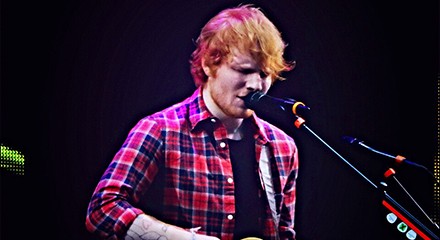
Ed Sheeran began his ‘Loop Tour’ in Auckland, New Zealand, in January and it is scheduled to conclude in Mexico City in December. The rapper, Macklemore, was, of course, one of the support acts for the tour’s September performances at the MetLife Stadium in New Jersey.
While performing as the opening act, Macklemore told the audience that he had come to publicise “two words that are very near and dear to my heart: ‘Free Palestine’.”1 He repeated the phrase, prompting the crowd to join in with the chant. It is worth noting that he also explicitly reassured his “Jewish brothers and sisters” that criticism of Israel was not criticism of Jewish people, and framed his comments as part of a wider appeal for peace, mentioning Lebanon, Cuba, Congo, Sudan and even people “living in fear” of US immigration authorities.2 He then performed ‘Hind’s Hall’ - his protest song inspired by student demonstrations against Israel’s war in Gaza and the killing of five-year-old Hind Rajab in 2024. At the following night’s performance, he referred to events in Gaza as a genocide.
Anti-Israel
This prompted the Israeli-American Council to launch a petition demanding his removal from the tour. Another pop star, Pink, who has millions of followers on social media and is Jewish herself, shared a meme which accused Macklemore of “ambushing” the audience with “anti-Israel propaganda”.3
Robert Kraft, the billionaire owner of the Gillette Stadium, barred Macklemore from a future appearance at his venue, criticising the artist’s comments as “deeply offensive and hurtful to the Jewish community”.4 Macklemore alleged that Kraft also organised other stadium venue owners to pressure Sheeran into dropping him or risk having performances cancelled. When stadium owners did just that, Sheeran buckled. His backing band and other support acts subsequently withdrew in solidarity with Macklemore.
Clearly feeling the pressure from the backlash, in the first show since Macklemore’s cancellation, Sheeran apologised and described the situation in Gaza as “unjustifiable”. The apology was heavily scripted and cringingly read from an autocue, along with tears - undoubtedly highlighting the legal and commercial sensitivities which have developed in the evolving situation.
It has been pointed out that Sheeran has in the past expressed ‘political’ positions on subjects such as the EU referendum, apparent support for Jeremy Corbyn and Ukraine. However, he has insisted that his shows are not intended to be political forums and that he had never wanted to be an “activist musician”.5 Instead he assures us that he had just inadvertently found himself caught up in an argument about freedom of speech and Gaza.
However the desire to be ‘apolitical’ is in itself socially and politically meaningful. In a period of war, mass displacement and intense political conflict, choosing not to address those issues, especially when given such a public platform, establishes a relationship of sorts to them: not making any political statements or taking any action can itself be viewed as a political choice or necessity.
Hegemony operates not merely by censorship of particular ideas, but by establishing the boundaries of what appears normal, reasonable and commercially viable. When someone says that they are ‘apolitical’, or that they do not have an opinion on important social and political questions such as war, what that tells us is that: (a) they unconsciously just repeat or acquiesce with the ideas and politics of the society that surrounds them, accepting and being shaped by what the hegemonic powers establish as being the ‘common sense’ of the day; or (b) they are lying.
Sheeran may claim to be an apolitical artist, but art is political.
Around a stadium performance sits an enormous structure of promoters, venue owners, sponsors, contractors, audiences, commercial relationships, reputations, capital and geopolitical actors. The apparent freedom of the artist is mediated by all of these things. The entertainment industry presents itself as a marketplace, where artists sell their particular commodity, audiences buy tickets and everyone is free to choose. But the market is not neutral.
If venue owners, such as, in this instance, Robert Kraft, who as an orthodox Jew and outspoken supporter of Israel, has a vested interest in the narratives at play in the cultural sphere, can collectively determine that a particular political intervention makes an artist unacceptable, market mechanisms themselves can regulate political expression. This need not be overt, formal state censorship. It can operate subtly in the shaping of ‘common sense’ and ‘acceptability’, through weapons such as, in this case, economic coercion (ie, threatening Sheeran with a cancellation of the tour, and thereby access to the means through which culture reaches an audience).
Political art
The reverse proposition is equally important, in that explicitly ‘political’ art is not automatically ‘superior’. Love songs, comedies, fantasies, stories about friendship, landscapes or personal experiences have a perfectly legitimate place in culture. The Marxist observation is not that every artist must write about, say, direct class struggle, but instead a recognition that every artist operates within particular social conditions.
The hegemonic powers are able to clamp down on those explicitly political artists that do emerge. Pete Seeger, the late popular singer of protest music, who was explicitly connected to organised labour, civil rights and peace, was blacklisted during the McCarthy period. And his later clashes with television executives over his attempt to perform ‘Waist-deep in the Big Muddy’ on The Smothers Brothers comedy hour in the form he wanted6 demonstrated that, while popular culture can be a vehicle for political ideas, the ability to use it in that way is conditioned by the institutions through which culture reaches an audience.
In addition to overt censorship and subtle coercion, capitalism has another weapon: the commodification of ‘political’ art. A protest song, if popular enough, can become just another product. A ‘radical’ musician can be transformed into just another brand. Symbols of rebellion can be printed on merchandise. A song about inequality can even become background music at a rightwing political event.
Take Bruce Springsteen’s ‘Born in the USA’ - a song about a working class Vietnam veteran who returns home to find no economic opportunities, an indifferent government, and a life trapped by systemic neglect. This was used by Ronald Reagan’s 1984 presidential election campaign as a jingoistic celebratory anthem because of its booming, triumphant chorus - subtly, but deliberately, omitting the verses about institutional betrayal.7 Or Woody Guthrie’s ‘This land is your land’ - now frequently treated as an uncomplicated patriotic anthem, despite having been written partly in response to the sentimental nationalism of ‘God bless America’.8 Guthrie’s politics were rooted in the experiences of working people, migrants and the poor. However, as the song travelled through American culture, some of its sharper social criticism was gradually detached from the context in which it was written. A cultural industry under capitalism can absorb political ideas, detach them from their original context and sell them back to us as entertainment.
More recently, Kneecap, the Belfast hip-hop group, have made Irish republicanism, the Irish language and opposition to British rule central to their artistic identity. Their politics are not merely an external statement attached to their music: they are part of its language, subject matter and public persona. Their conflicts with political institutions and the latter’s attempts to restrict their performances have become part of the group’s story.9 Yet it must be recognised that their political identity has also contributed to their commercial visibility.
Controversy generates publicity; the political persona becomes part of the product; audiences consume not just songs, but the experience of seeing a controversial group. This does not mean that their politics are insincere, nor does commercial success invalidate political art. But it does demonstrate a contradiction at the heart of commodified culture: an artist can appear to challenge the dominant order, while simultaneously becoming a commodity within it.
Ultimately, a Marxist approach must avoid two equally crude positions. The first is that commercially successful art is necessarily reactionary and therefore worthless; the second is that explicitly revolutionary art is automatically good and politically useful.
Music value
Macklemore’s politics do not make his music artistically valuable by definition, just as Sheeran’s commercial success does not make his work artistically worthless. For what it is worth, I think both of these artists are poor-quality. But we still have to recognise the political and cultural significance of what is going on around them.
We should be capable of separating artists from their work without pretending that artists exist outside society. Think of Lenin’s admiration for Tolstoy, whom he regarded as an important artist, while simultaneously subjecting his political and philosophical ideas to severe criticism.10 The value of a work cannot simply be determined by whether its creator has the ‘correct’ political opinions.
People can enjoy music made by deeply unpleasant or politically objectionable individuals (for instance, I happen to like Morrissey’s music, despite him having shifted significantly to a rightwing, nationalist outlook - away from the anti-establishment, countercultural icon he once was). The history of popular culture is full of such contradictions. Personal enjoyment of a work does not require political agreement with its creator. At the same time, we should not fall into the opposite error and imagine that art exists in a social vacuum.
The culture industry can absorb rebellion and the entertainment industry can subsequently sell it as culture, while staying alert to the chance of any sort of rebellion creating an actual institutional cost. That is not unique to this dispute; it is a general contradiction of commodified culture. Macklemore’s political identity is also commodified. Sheeran’s enormous commercial success depends upon a different relationship between artist, audience and institution. Yet both operate within the same cultural economy. The apparent neutrality of culture is therefore itself socially organised.
The real lesson of this story is not that musicians should all become political activists or that political artists should be treated as automatically virtuous. It is that art exists within society. Art is produced under capitalism, circulated through capitalist institutions and consumed by people whose lives are shaped by class, politics and history. Sometimes artists explicitly confront those conditions. Sometimes they retreat into the personal. Sometimes their work is appropriated, commodified or stripped of its original meaning.
-
www.theguardian.com/music/2026/sep/15/ed-sheeran-response-macklemore-free-palestine-comment.↩︎
-
www.rollingstone.com/music/music-news/pink-responds-backlash-macklemore-palestine-post-1235625662.↩︎
-
www.nytimes.com/athletic/7595049/2026/09/14/macklemore-robert-kraft-ed-sheeran-tour-palestine-comments.↩︎
-
pitchfork.com/story/ed-sheeran-clarifies-gaza-stance-again-blames-venues-for-kicking-macklemore-off-tour.↩︎
-
www.hollywoodreporter.com/tv/tv-news/smothers-brothers-comedy-hour-oral-history-1060153.↩︎
-
medium.com/@adamjohnrobertson/counterculture-co-opted-4a8edfcfcefd.↩︎
-
www.kennedy-center.org/education/resources-for-educators/classroom-resources/media-and-interactives/media/music/story-behind-the-song/the-story-behind-the-song/this-land-is-your-land.↩︎
-
See A McShane, ‘Saying it loud and clear’ Weekly Worker May 15 2025: weeklyworker.co.uk/worker/1538/saying-it-loud-and-clear.↩︎