
17.09.2026
Demand the whole package
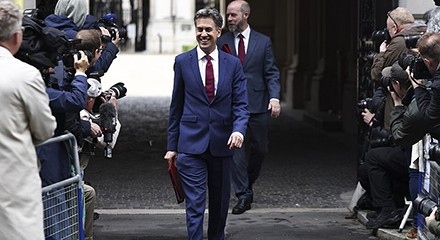
Ed Miliband has given an inch. Even though it is a token, we should be encouraged and take renewed strength. Yassamine Mather calls for full sanctions, boycotts and strikes
On its own terms, there is nothing wrong with Ed Miliband’s announcement of a ban on imports from Israel’s settlements in the occupied West Bank. They are illegal under international law; their expansion is a mechanism of dispossession, accompanied by organised violence against the indigenous Palestinian population. Any policy that stops British capital from profiting from this process is something that should have been done long ago.
But the sudden moral awakening in Whitehall should be treated with the suspicion it deserves - after all, Miliband is a long time supporter of Labour Friends of Israel, a committed Zionist, who expresses gratitude for the state of Israel for allowing his grandmother to settle there. He visited the country as a young man and recounts with joy picking oranges on the Nachshonim kibbutz (established on land seized in the 1948 Arab-Israel war). No, the important issues are why this sanction announcement happened when it did, and what effect it will have.
For three years Gaza has been subjected to collective punishment on a scale that has no recent parallel. Miliband now tells parliament that this is “a stain on the conscience of the world and of this country too”. Then there is the settler terrorism on the West Bank and the Israeli government ministers urging them on.
None of this was unknown. It was not an information gap that kept the mouth’s of Labour’s front bench firmly shut for years: it was a political calculation about international relations and the global pecking order. Tory and Labour governments have striven not to upset Washington and its Israeli attack dog by raising awkward questions like ethnic cleansing and genocide.
Yet, Miliband went further on September 8 than any previous British minister, describing settlers carrying out what he now calls “ethnic cleansing” and announcing sanctions on companies and individuals financing illegal West Bank settlement construction, infrastructure and advertising. Note that France, Ireland, Spain, Denmark, Finland, Norway, Poland, Portugal and Canada are all taking similar action.
These rhetorical shifts doubtless reflect a certain distancing from Donald Trump’s USA which has claimed Greenland and sanctioned friend and foe alike, not least Canada. Now Canada is set to become some sort of associate member of the European Union (a first). So maybe big geostrategic realignments are in the offing.
Interestingly, Trump has so far been quiet when it comes to Israel, and JD Vance has even said that the US must not be “subservient” to Israel. Benjamin Netanyahu must surely be worried.
Legitimate
However, though the Labour government will restrict trade with the illegal settlements, it has explicitly reassured Israel that ordinary commercial relations will continue undisturbed. Miliband also went out of his way to denounce the boycott, divestment and sanctions movement and to insist that the measures target the Israeli government, not the Israeli economy. Settlement activity can therefore be condemned without questioning the wider relationship with Israel.
Of course, this distinction - ‘bad’ settlements versus a fundamentally legitimate Israeli state - cannot survive serious scrutiny. Who garrisons the settlements? Who arms, trains and directs the military that enforces the occupation? Who builds the road network and checkpoint infrastructure, and administers the permit regime that make settlement expansion physically possible? The settlements are not a rogue excess produced by a few fanatical colonists: they are a state project, financed and defended by the same Israeli state apparatus that Miliband treats as a normal trading partner.
Settler-colonialism in the West Bank is inherent to Zionism, tying together the military, the land-registry bureaucracy, the banking system and a settler population that functions, in effect, as an armed frontier of Israeli capital accumulation. Separating ‘illegal settlements’ from ‘legitimate Israel’ therefore performs a specific ideological function for the British state: Whitehall can sanction the most visible and least defensible symptom of occupation, while leaving intact the commercial, military and strategic relationship with the state that produces and defends it.
Statistics confirm the limited material scope. UK-Israel trade in goods and services totalled around £6 billion in 2025; an estimated £38 million of goods were imported from the occupied territories that year. The measures proposed touch only a fraction of Britain’s economic relationship with Israel, allowing ministers to demonstrate movement without disturbing the wider relationship.
Nowhere is the hypocrisy more evident than with the arms exports. In September 2024 the foreign office suspended roughly 30 of Britain’s 350 or so extant arms licences to Israel, citing a “clear risk” that equipment could facilitate serious breaches of international humanitarian law. But the suspension explicitly excluded components for the F-35 programme - though primarily an American project, this fifth generation fighter plane contains British parts. Israel’s airforce regularly uses its F-35s to missile and bomb Gaza. The legal challenge over that carve-out mounted by Palestinian human rights group Al-Haq failed: in November 2025 the Court of Appeal ruled that the government could exclude F-35 parts, even though doing so violated Britain’s own arms-licensing criteria.1
A joint investigation by the Palestinian Youth Movement, Workers for a Free Palestine and Progressive International, cross-referencing UK export records against Israeli customs data, found that shipments of weapons-related goods - including F-35 components, munitions and armoured-vehicle parts - continued after the 2024 suspension, and in some categories increased. Whatever the precise accounting of individual consignments, the larger point is clear: Britain has drawn a narrow line around some exports, while protecting a weapons relationship of greater strategic significance.
This is why the argument cannot stop with wine, fruit or other settlement produce. Such sales are marginal, compared with the supply chains that equip the military enforcing the west Bank occupation and conducting operations in Gaza. Weapons help sustain the very system that the settlement ban claims to oppose. Banning farm goods, while continuing to supply military components, is therefore not a “good first step” towards confronting the underlying relationship, unless it is accompanied by pressure to end the arms trade itself. Otherwise the government gains the appearance of taking ethical action, while preserving the profitable and strategic core.
Two-state fiction
Miliband frames all of this as a defence of the two-state solution - the organising fiction of western Middle East policy for three decades. Every condemnation of settlement expansion is issued in the name of protecting a Palestinian state that has never been permitted to exist and whose material preconditions have been dismantled piece by piece: land confiscated, communities fragmented by roads and military zones, populations displaced, and after each new stage of colonisation, a fresh western statement reaffirming commitment to the ever receding two-state horizon.
Whatever the Palestinian Authority says, the two-state phrase has never served as code for self-determination. It serves as a diplomatic alibi - allowing western governments to express concern without breaking with Isreal’s expansionism, apartheid racism and permanent warmongering. Defending the two-state phrase lets a Labour foreign secretary sound like a critic of occupation while leaving the Israeli state, the arms trade and the alliance structure that sustain occupation undisturbed.
Miliband’s language - “the unlawfulness of the occupation should be reflected in the economic relationships we choose to have” - gestures in the direction of the International Court of Justice’s July 2024 advisory opinion without following its logic. The ICJ found Israel’s presence in the occupied territories unlawful and said the occupation must end as rapidly as possible. It went further: it held that third states have a duty not to treat that presence as legal and not to render aid or assistance that helps maintain it.
That is a stronger standard than anything on offer from Whitehall. If the occupation is unlawful in the sense described by the ICJ, the obligations that follow do not stop at the municipal boundary of the settlements. A policy that recognises the illegality of the occupation, but continues relationships that materially assist its enforcement, is centred on an obvious contradiction.
There is a deeper problem here than Miliband’s selective outrage. It is one that the whole framework of western ‘ethical’ diplomacy - sanctions here, licences suspended there, an import ban dressed up as a defence of the two-state solution - cannot in principle solve. These policies treat the conflict as discrete abuses that can be corrected administratively, when the underlying structure is regional and strategic.
Moshé Machover and the Matzpen tradition made the essential point half a century ago: Zionism is not simply a national movement that happened to collide with an existing population. It developed, and continues to function, as a colonial-settler project structurally dependent on the sponsorship of an external imperialist power - first Britain, then France, then the United States - because this particular settler-colonial project displacing an indigenous population cannot sustain itself on its own social base. It survives by making itself indispensable as a garrison state: a regional enforcer of imperialist interests in exchange for the arms, capital and diplomatic cover that keep the structure standing.
The close US-Israel relationship is therefore not incidental. It is the key element in the Israeli state’s capacity to maintain the existing order. This is exactly why a diplomatic fix confined to the import policies of individual western states, or even to Israel-Palestine as an isolated bilateral dispute, does nothing to change the actual system of repression. You cannot dismantle a garrison-state relationship one settlement-goods tariff line at a time, when the system being defended spans arms manufacturing, intelligence-sharing, capital flows and a wider imperial alliance. Comrade Machover’s argument is that the resolution of the conflict cannot come from partition, diplomacy between national leaderships or moral pressure on any single western sponsor.2 It requires revolutionary transformation across the region: the overthrow of reactionary Arab regimes that have served as junior partners in the same imperialist order, alongside the de-Zionisation of Israeli society, opening the way to a voluntary socialist federation, in which Jewish Israelis and Arabs, including Palestinians, could exist without one people’s national existence being predicated on the dispossession of the other.
That is a long-term strategic horizon, not a policy recommendation for tomorrow’s parliamentary order paper. But Miliband has given an inch and we must demand a mile. His is a token gesture, but it is also a concession, a tribute to the massive and sustained pro-Palestine movement seen here and across the world.
By-election
To state the obvious, the government did not take the decision in order to avoid a defeat in the Holborn and St Pancras by-election on October 8. However, it is, in part, an attempt to win back Muslim and left voters who deserted the Labour Party in droves at the last general election and saw four pro-Palestine MPs elected for the first time and Jeremy Corbyn re-elected. In many other constituencies pro-Palestine independents were in second place. So Segal Abdi Wali might seem like the perfect Labour candidate in Holborn and St Pancras - except, of course, she is exactly aligned with Andy Burnham and Ed Miliband, including when it comes to Israel-Palestine. She has steadfastly refused to sign the Palestine Solidarity Campaign demand for BDS.
Either way, the mass demonstrations must be sustained and made even bigger. The next pro-Palestine demonstration in London will therefore be particularly important (October 10, Thames Embankment). Naturally, we should be demanding a complete ban on arms sales and no exemptions for F-35s. Something that we can enforce from below. That means industrial action, especially at ports and airports. More than that, no goods going to or from Israel should be handled. We must demand more. Obviously the ban on Palestine Action must be immediately ended and the Prevention of Terrorism Act rescinded. All pro-Palestine political prisoners must be freed. Above all, the whole BDS package - as unanimously agreed by the TUC congress in Brighton - must be enforced.
Of course, that will not bring Israel to its knees. Only the class struggle for socialism in Israel and crucially the wider Middle East can do that. But it would send a powerful message and help tilt the balance of forces internationally and here in Britain.
-
aoav.org.uk/2025/court-of-appeal-rejects-al-haqs-challenge-over-uk-arms-exports-to-israel-aoav-comments.↩︎
-
Note especially comrade Machover’s Israelis and Palestinians: conflict and resolution Chicago 2012.↩︎