
23.07.2026
Most profitable yet
Crass commercialisation, a source of huge FIFA revenues, crude political interference by Donald Trump, but also moments of pure football joy. Carl Collins weighs up the pros and cons
When the song, ‘Three lions’, entered the charts in May 1996, the line “30 years of hurt” captured the frustration for England fans since the 1966 World Cup victory. The song became the soundtrack of a generation and is still played widely today.
More time has now passed since the release of ‘Three lions’ than had passed between England’s 1966 victory and the song’s release. The anthem that once looked back on 30 years of waiting has itself become a relic of an even longer era - one in which football and the society around it have continued to be transformed by commercialisation, inequality and the capitalist corruption of the beautiful game.
England’s campaign at the 2026 World Cup ended with a third-place finish. Although it was their best performance since lifting the trophy in 1966, representing progress in footballing terms, the familiar sense of unfinished business remains. The “hurt” immortalised in ‘Three lions’ has not disappeared: it has merely been extended into a seventh decade. For all the talent available to the England squad, and despite another deep run into the tournament, the ultimate prize once again proved elusive.
Disappointing
Elsewhere, Scotland endured a disappointing tournament from a footballing perspective, failing to make a significant impact on the pitch. Yet Scottish supporters won widespread admiration off it. Their good humour, friendliness and enthusiastic embrace of host communities earned praise across the United States and the world. In an age when football is increasingly marketed as a corporate entertainment product, the warmth and solidarity displayed by ordinary supporters remains a reminder that it is the fans, not the governing bodies, politicians or sponsors who give the game its soul.
One of the biggest talking points before a ball had even been kicked was the expansion of the tournament to 48 teams. Many critics rightly saw the move as another attempt by FIFA to maximise broadcasting revenues, sponsorship opportunities and commercial income by simply creating more matches. Those concerns remain valid. Every expansion of a sporting competition is viewed first through the prism of profit. Indeed FIFA’s revenues were boosted by a cool $11 billion, what with ticket sales, broadcasting rights and advertising - the most profitable yet.
Yet the enlarged format produced genuine footballing stories that would otherwise never have happened. For example, Cape Verde, making history by reaching the tournament for the first time, captured the attention of the world - not just football fans. Their remarkable run included holding this year’s winners, Spain, to a 0-0 draw in their opening game. They also took defending champions and this year’s runner-up, Argentina, to extra time in the round of 32 before narrowly losing 3-2. At the centre of that story was, of course, the 40-year-old goalkeeper, Vozinha, whose outstanding performances symbolised what makes international football compelling. Such moments remind us that football’s genuine riches are not measured in advertising and television contracts, but in the dreams of fans, particularly in smaller nations competing on the world stage.
Ironically, Cape Verde’s success nearly scuppered FIFA’s carefully managed tournament structure. The governing body had gone to considerable lengths to protect the leading commercial attractions: Argentina, England, France and Spain. Those teams were effectively granted privileged status by being placed into separate quarters of the draw, ensuring they could not eliminate one another before the semi-finals. On paper this was presented as a competitive balancing measure. In reality, it was about safeguarding television audiences and commercial value by maximising the chances of as many as possible of football’s biggest brands progressing in the tournament.
As events unfolded, the four highest-ranked teams all reached the semi-finals anyway. But the process itself illustrated FIFA’s willingness to manipulate tournament structures in pursuit of commercial objectives. Even so, the decision to switch Argentina into Group J and move France into Group I ensured the two highest-ranked nations, Argentina and Spain, could not meet until the final. Had the groups remained in their original positions, England would have faced France in the semi-finals, while Argentina met Spain. Instead, FIFA reshaped the pathway to preserve the possibility of what it evidently considered the ideal final.
For working class supporters, the greatest barriers were not found in the draw, but in the cost of attending the tournament itself. Travelling across the vast distances of the United States, Canada and Mexico required flights, internal transport and accommodation beyond the reach of many ordinary fans. Those fortunate enough to secure tickets often found themselves spending thousands of pounds to follow their team.
Sky high prices
Ticket prices themselves became the subject of official scrutiny. FIFA was in fact subpoenaed by the attorney general of New York and New Jersey as part of an investigation into ticket pricing and seat allocations. The fact that football’s governing body found itself under legal examination during its own flagship tournament says much about the priorities that increasingly dominate the modern game. That said, we can expect nothing to come of this.
Supporters also faced restrictions that bordered on the absurd. Tournament organisers initially considered prohibiting spectators from bringing their own water bottles into stadiums, despite many matches taking place in intense heat. Only after significant criticism was the proposal reversed. The episode reflected a familiar pattern: supporters are viewed less as participants in a shared sporting occasion than as captive consumers, whose every need presents another opportunity for making money.
That same commercial logic was visible on the pitch through the widespread use of ‘hydration breaks’. While in some cases extreme temperatures undoubtedly required measures to protect players, the scheduling and presentation of these interruptions revealed another purpose: they provided ready-made advertising windows for broadcasters and sponsors, creating opportunities to monetise the game in addition to the official break at half time. The ‘welfare’ measures served as much resented cover.
Given the financial incentives involved, it seems highly likely that hydration breaks, or similarly packaged commercial interruptions, will become a permanent feature, at least in international and continental competitions. Football has already absorbed ever more advertising into its fabric, from digital pitch-side boards to sponsored time-keeping and endless branding opportunities. Every pause in play now risks becoming another commodity to be sold.
The tournament also demonstrated once again that claims of keeping politics out of sport remain highly selective. FIFA has long insisted that football should remain separate from political disputes, yet that principle is regularly abandoned, whenever powerful states intervene.
One of the clearest examples came in the controversy surrounding Iranian players and support staff, never mind supporters, who faced significant difficulties obtaining visas to attend matches. Restrictions placed on the team, such as being required to travel in and out the US on match days, were deliberate attempts by the global hegemon to hobble their chances of any success and FIFA did nothing to protect the integrity of the game. For ordinary Iranian fans, following their national team became impossible - not because of footballing reasons, but because of geopolitical realities. While FIFA frequently speaks about inclusion and unity, it possesses remarkably little influence, when those principles collide with the policies of powerful governments.
Just as outrageous was the intervention by Donald Trump following US player Folarin Balogun’s red card, personally calling FIFA president Gianni Infantino to overturn the subsequent punishment. Such decisions might appear unprecedented, but football has seen similar episodes before. Cristiano Ronaldo benefited from disciplinary action being suspended in order to play in this World Cup. And in another FIFA competition Lionel Messi’s Inter Miami were effectively awarded a place at the 2025 FIFA Club World Cup without progressing through a predetermined qualification pathway. Rules, it appears, often become surprisingly flexible when the commercial value of particular individuals or teams are considered sufficiently great, or interventions are made by the ‘right people’.
Donald barges in
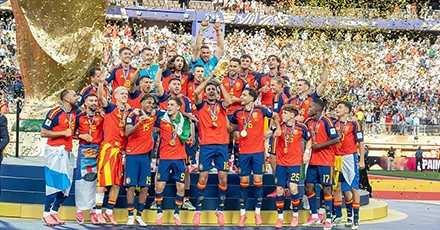
Trump’s involvement did not end there. Having previously overshadowed Chelsea’s FIFA Club World Cup celebrations by inserting himself into the trophy presentation (and, of course, revelling in the award of the hastily created, sycophantic FIFA ‘Peace Prize’), he was handed another prominent ceremonial role during this World Cup. He presented the winning trophy to Spain, despite not having attended any of the 100 or so games before the final. He also presented rings to the winners - something taken from the US National Football League’s Super Bowl.
None of this interference should surprise us. Sport has never existed outside society. Under capitalism, football reflects the contradictions of the economic system that surrounds it. The enormous wealth generated by the game is concentrated in the hands of governing bodies, broadcasters, sponsors, owners and corporate partners, while the supporters who create its atmosphere and cultural significance are asked to pay ever more for the privilege of participating.
This trend extends well beyond the World Cup. Domestic supporters can expect further increases in season ticket prices, replica shirts, subscription packages and matchday costs. Every successful commercial innovation introduced on football’s biggest stage soon finds its way into domestic leagues. Whether through dynamic ticket pricing, expanded sponsorship opportunities or further broadcasting changes, the burden invariably falls upon ordinary supporters.
Yet football will continue to endure, precisely because it belongs, culturally if not economically, to the working class. The passion that filled stadiums, the friendships formed across borders and the unforgettable stories produced by nations like Cape Verde remain stronger than the corporate structures attempting to package and monetise them. For now anyway.
While FIFA may own tournaments, it does not own the emotions they inspire. It is the job of the left to recognise this and show it can appeal to the masses who enjoy the game by organising opposition to its commercialisation and linking it to the wider political and economic struggles.
As long as football remains organised according to the priorities of profit rather than the interests of supporters, the struggle over the future of the game will continue. The World Cup demonstrated both the enduring beauty of football and the accelerating commercialisation threatening to suffocate it. It is a contradiction unlikely to disappear any time soon.