
09.07.2026
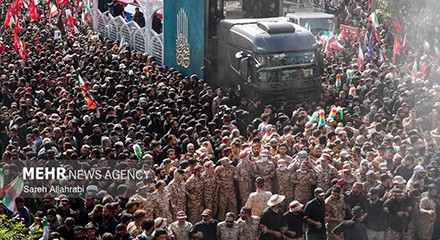
Funeral in Mashhad
The late Ali Khamenei is being transformed into a potent symbol. But, with his son and successor completely absent, continued sanctions and an on-off war, factional rivalries above may become more acute. Meanwhile, those below experience continued repression and worsening conditions. Yassamine Mather reports
Four months after supreme leader Ali Khamenei was killed at the outset of the US-Israeli war, the Iranian government has organised a mammoth funeral in his honour: beginning in Tehran on July 3-4, the carefully choreographed procession headed first to Qom, then Najaf and Karbala in Iraq, before finally returning to Iran and interment, on July 9, in Mashhad’s Iman Riza Shrine.
The 86-year old Khamenei was targeted on February 28, the first day of the war. The US-Israeli military strike also killed members of his family, including his wife, and badly injured his son, and now successor, Mojtaba Khamenei. He must have recognised the danger, but took no special measures to protect himself. Becoming a martyr would have been a welcome prospect.
Ali Khamenei ruled Iran for 37 years with a style defined by ideological rigidity, hostility towards western powers and deep suspicion of anyone who opposed his version of the Islamic Republic. Before his assassination he had faced some of the largest anti-government protests in the history of the state. His government responded, as so often before, with brute force. Yet his death has allowed the Islamic Republic to present him as a unifying symbol. In this sense, his death may have made him more useful to the regime than if he had continued to live.
Many Iranians now willingly repeat the claim that he was the architect of Iran’s military strategy in the US-Israeli war. Yet while there is no doubt that he played a crucial role in creating unity between the regime’s rival factions, I remain somewhat sceptical about claims that he was a superb military thinker. However, the funeral is designed precisely to elevate him into whatever now serves the regime.
Certainly the funeral has seen a huge popular mobilisation. Some 15 million have turned out. And the political message is clear: Iran is undefeated, it wants to move away from the focus on bomb damage and peace talks and unite the population around avenging its martyred leader. Day after day Iranian television, radio and newspapers have focused almost entirely on the funeral. Tribute songs, documentaries, clerical speeches and religious programmes about Khamenei’s life.
“We must stand up and scream for our nation’s blood, so the whole world knows that the proud people of Iran will not stay quiet when they are bullied, and we will not forget the blood of our leader,” wrote Mohammad Bagher Ghalibaf, the head of parliament, in a state media message on July 2. Ghalibaf, who is also leading Iran’s current talks with the US, called the funeral a historic achievement that would show the spirit of the Iranian people. The contradiction is striking: the same leadership that is negotiating retreat abroad is staging defiance at home.
The chosen dates were full of deliberate symbolism. Khamenei’s body was displayed to the public on the same day the US celebrated its 250th Independence Day. Another major day coincides with an important Shia religious holiday. The funeral is taking place during Muharram, the month when Shia Muslims focus intensely on sorrow, betrayal, sacrifice and martyrdom - especially the 7th-century death of Imam Hussein, from whom Khamenei claimed descent.
Iran has handled only two funerals of comparable size before: Ayatollah Khomeini’s in 1989 and Qassem Soleimani’s in 2020. Both descended into chaos, with deadly crowd crushes. During Khomeini’s funeral, grieving crowds even tore the burial cloth from his coffin, forcing the authorities to rescue the body by helicopter. That history has made security and crowd control essential. Protecting Khamenei’s body, controlling millions of mourners, hosting foreign delegations and coordinating ceremonies across five cities in two countries required a logistical operation larger than anything Iran has previously attempted, especially after a major war and months of unrest.
The first public viewing began at 6am local time on Saturday inside a giant mosque complex in Tehran. Firefighters installed more than 6,000 water sprayers above the crowd to keep people cool in the July heat. Tehran’s main airports were closed during the funeral, and the government has declared national holidays in the cities through which the coffin travelled.
Tehran, a city of around 17 million people, experienced its largest traffic control plan ever. Private cars were banned from the funeral route, hundreds of parking areas were opened, mobile bakeries and emergency services deployed, and the government asked ordinary citizens to open their homes to visitors.
Taking Khamenei’s body into Iraq carries a deliberate political and religious message. It shows that Iran sees itself as a Shia power whose authority extends beyond national borders. Khamenei’s followers - Shias who consider him ‘Marjae Taghlid’ (a religious guide who should be imitated), live not only in Iran, but also in Iraq, Pakistan, Lebanon, Bahrain and elsewhere. The Iraqi processions are therefore meant to present the funeral as an international event rather than merely an Iranian one.
Government officials have claimed that some 900 foreign reporters covered the event. Iranian state media placed great emphasis on the foreign leaders and representatives who attended. In reality, aside from the leaders of Georgia and Pakistan, as well as Russia’s deputy security chief, few major international figures came. Western countries were not invited.
During the first day, the regime chose carefully selected Quranic verses to suit the different foreign delegations. They appeared to signal how the regime viewed each country or movement: loyalty and steadfastness for Hamas and Hezbollah, martyrdom for Iraq’s Hashd al-Shaabi, divine victory for Palestinian Islamic Jihad and Qatar’s neutrality framed as dependence on god. There were also similar supportive, or critical Quranic messages, for China, Saudi Arabia, Turkey, Pakistan and Egypt
The biggest question hanging over the event was the absence of Mojtaba Khamenei. Government officials try to present him as fully recovered and actively involved in running the country, including the current negotiations with the US. Yet there are obvious doubts about his health, his authority and who is really running the government. His absence from a small private funeral for his own wife earlier this week increased speculation.
The Iranian military pointedly warned enemies not to ‘make any mistakes’ during the funeral. The foreign minister has also said that Iran would immediately retaliate against any renewed threat to its leaders. This warning followed the Israeli defence minister’s public statement that Mojtaba Khamenei was next on Israel’s target list. The funeral is therefore not only an act of mourning: it is also a theatre of deterrence, succession, anxiety and unresolved power struggles.
Despite the government’s effort to turn the funeral into a display of unity, strength and loyalty, many ordinary citizens appear indifferent or exhausted. One Tehran resident bitterly complained that they could not even buy petrol because the lines were too long.
But the Islamic Republic remains in place. The government still functions, the security and military institutions are active, and the regime’s legal framework has not changed. At the same time, recent developments have fuelled speculation about shifts in the style of governance, the role of the leadership, the decision-making process and the distribution of power within the political structure. The central question is no longer simply whether the regime has survived. It is whether the Islamic Republic remains a system with a single centre of decision-making, or whether it has become a constellation of competing power centres.
The first reality revealed by the war and Khamenei’s death was not the fragility of the Islamic Republic, but the durability of the class state he helped consolidate. The constitution, the doctrine of Velayat-e Faqih, the Guardian Council, the network of appointed and elected institutions and above all the military-security apparatus, particularly the Islamic Revolutionary Guard Corps, have continued to function. This demonstrates that the Islamic Republic was never reducible to the rule of one man: it is a historically formed apparatus of class domination - clerical, military, bureaucratic and capitalist at once.
The regime is therefore not merely an ideological dictatorship: it is a capitalist state shaped by sanctions, militarisation, privatisation, corruption and the systematic subordination of the working class. Its ideological language is religious; but its social content is class rule.
Life and times
During the 1960s and 1970s, the young Ali Khamenei operated primarily as a ground-level activist, underground organiser and regional operative within the anti-Shah religious opposition. He was first arrested in Birjand for propagating anti-regime messages from the pulpit, and later that year for helping organise demonstrations around the June 1963 ‘15 Khordad’ uprising.
In 1964, Khamenei cut short his advanced seminary studies in Qom and returned to the city of his birth, Mashhad, to care for his ailing father. In Mashhad, he taught Islamic classes and lectured on the Quran and the Nahj al-Balagha. His approach was explicitly political: he used religious exegesis to criticise social and political conditions under the monarchy. These lectures became popular among university students and revolutionary youth.
Khamenei’s rhetoric reflected broader anti-imperialist currents of the 1960s and 1970s. Influenced by figures such as Jalal Al-e-Ahmad and Ali Shariati, his circles fused traditional religious opposition with third-worldist, anti-western and anti-colonial critiques. By 1967, surveillance by the Savak secret police forced him to move his classes into clandestine gatherings in mosques and private homes.
As opposition to the monarchy shifted towards armed resistance in the early 1970s, Savak targeted intellectual and clerical figures who provided an ideological foundation for radicalised youth. Between 1963 and 1975, Khamenei was arrested six times. His most testing time perhaps occurred in 1975 when he was confined to the Joint Anti-Sabotage Committee prison in Tehran. He spent months under harsh interrogation and in solitary confinement.
After his release, the Shah’s regime banned him from teaching or preaching. When he continued with underground networking activity, Savak arrested him again in late 1976 and sentenced him to three years of internal exile. That exile was cut short in late 1978, as Pahlavi began losing control amid nationwide strikes and mass demonstrations. Released ahead of schedule, Khamenei returned to Mashhad to help direct local revolutionary committees. Recognising his record as an organiser who had remained inside the country through repression, he was appointed to the underground Council of the Islamic Revolution, as the monarchy was collapsing in early 1979.
Khamenei is often portrayed by Israeli and western media as an illiterate old mullah. In fact he was an unusually committed reader, whose interests went well beyond religious texts. He presented reading as spiritually essential and had read large multi-volume works in his spare moments. His literary tastes were broad. He reportedly admired Russian classics, including Sholokhov, Tolstoy, and Chekhov. He was also an admirer of French writers such as Victor Hugo, Alexandre Dumas and Romain Rolland, and had read and cited English-language writers such as Jane Austen, John Steinbeck and Harriet Beecher Stowe. Persian poetry was another major interest, especially that of Allama Iqbal. He was a friend and admirer of Iran’s well known contemporary poet, Shafiee Kadkani, until 1979. However, the two fell out after the Islamic revolution.
His non-fiction reading focused heavily on politics, history, science and revolution. He often used western critical works to support arguments about negative US cultural and political influence. He was also interested in the history of science and the transfer of knowledge between Islamic and European civilisations, using such themes to encourage Iranian scientific self-confidence. A major part of his reading was devoted to Iran-Iraq War memoirs and revolutionary history. He frequently wrote commendations for war memoirs and treated revolutionary novels and histories as case studies in how revolutions unfold.
There is a story, which someone recently told me, that captures the contradiction of his political life. In early 1970s, Khamenei was reportedly in a house in Tehran, when Masoud Ahmadzadeh, a well-known Marxist and founding member of the Fedayeen anti-shah guerrillas, arrived while on the run. It was raining, and Ahmadzadeh took refuge in the house for a couple of hours before continuing his escape. Khamenei later pointed to the wet patch on the floor left by Ahmadzadeh’s soaked clothes and praised him, saying that the ground he had touched should be valued. Yet decades later, Khamenei presided over a regime that executed thousands of Marxists, presumably because their opposition to the Islamic Republic was treated as part of a ‘fitna’ (plot or conspiracy). The revolutionary who could once admire the courage of a Marxist militant became the dictator of a state that crushed Marxists, workers and dissidents of every kind.
Contrary to the claims of bourgeois commentators, often echoed by sections of the Iranian left, the central problem with Khamenei was not his opposition to what he called the “arrogance of the west”. Nor was it his hostility towards the US or Israel. The fundamental contradiction lay in his failure to recognise that meaningful opposition to western domination requires fighting capitalism itself. Although he never employed the term, ‘imperialism’, preferring an Islamic vocabulary of resistance, genuine anti-imperialism cannot be separated from opposition to capitalist social relations and private ownership of the means of production.
In practice, Khamenei combined rhetorical denunciations of western domination with policies that facilitated the almost complete privatisation of previously nationalised industries. He endorsed the neoliberal economic programmes pursued by successive governments, including subsidy removal, affecting the poor, in pursuit of reforms broadly consistent with international financial institutions such as the International Monetary Fund and World Bank. These policies, not rhetoric, generated deepening poverty, entrenched corruption, widening inequality and growing domestic opposition.
Hegemony
The regime’s continuity should not be confused with stability. The exclusion of parliament from major political decisions, including negotiations with the US and the signing of the war-pause memorandum of understanding, shows a further hollowing out of formal institutions. While the legal architecture remains in place, power has moved more openly towards unelected institutions: the Supreme National Security Council, the IRGC, intelligence bodies and offices where military, clerical and capitalist interests converge.
The same dynamic is visible in foreign policy. The Islamic Republic’s approach towards the US and its regional proxy forces remains embedded in a strategic framework developed over decades. This framework is tied to the regime’s material interests: regional leverage, military-security expansion, sanctions-based accumulation, smuggling networks, reconstruction contracts, arms flows and the political economy of the IRGC.
What is often called Iran’s ‘Axis of Resistance’ has always been more pragmatic than purely ideological. It combines religious solidarity with political calculation. It has functioned as a regional security strategy, a means of projecting power and a mechanism through which sections of the Iranian ruling class, especially the military-security bourgeoisie, expand their influence and resources.
The post-war crisis, economic exhaustion, growing domestic anger and weakening of Tehran-backed forces have caused the regime to engage in talks with Washington. But this was not a principled transformation of foreign policy: it was a tactical retreat under pressure, aimed at preserving the state, stabilising the ruling bloc and preventing the crisis from becoming revolutionary.
This is evident in the written message attributed to Mojtaba Khamenei regarding negotiations with the US. Like his father, he attempted to preserve ideological purity, while avoiding direct political responsibility. This is the familiar language of Bonapartist manoeuvre: retreat while declaring resistance, compromise while staging defiance, preservation of the state while denying the scale of its problems. The regime bends tactically only in order to defend the strategic foundations of its rule.
The same applies to the economy. There is no serious break from the existing model. State and quasi-state institutions remain dominant, the IRGC’s economic empire remains intact and policy-making remains trapped in crisis management. The regime does not seek emancipation from dependency, poverty, inflation, unemployment or corruption: it seeks only to manage these contradictions in ways that preserve capital accumulation for the ruling bloc. There is no reform project here: only the reorganisation of exploitation under permanent crisis.
While the regime has shown tactical flexibility abroad, it has shown little meaningful flexibility at home. Domestic repression remains the central pillar of its survival. Reports of continued arrests, rising death sentences and intensified crackdowns show that the machinery of coercion remains fully operational.
The regime’s greatest fear is not merely foreign pressure: it is the political entrance of workers, women, youth, oppressed nationalities, teachers, pensioners, students and the urban poor as an organised social force. For this reason, the Islamic Republic can tolerate factional quarrels within the ruling elite more easily than independent organisation from below. Repression is therefore not a temporary policy: it is the concentrated expression of the state’s class character.
Under Ali Khamenei, speeches, televised appearances, crisis interventions, religious ceremonies and direct ideological messaging were part of the regime’s mechanism of domination. He did not simply rule administratively: he constantly reproduced the ideological authority of the state.
Even in the Iranian year 1404 (beginning in March 2025), when wartime and security conditions limited his public presence, Khamenei delivered at least 39 speeches and televised messages. His authority was produced through repetition, visibility and command. Mojtaba Khamenei, by contrast, has remained unseen and unheard. His supporters chant, “To protect the nation, obey the leader’s command”, yet the leader who is supposed to issue the final command remains politically absent.
What exists in his place are numerous written statements - abstract, defensive and bureaucratic. These statements invoke cohesion, preservation of the regime, resistance and security, but they do not present a coherent project of rule. They do not generate hegemony, mobilise society or resolve the contradictions of the ruling bloc.
This is not simply a communications problem: it is a crisis of political authority. Mojtaba Khamenei may have effectively inherited the office, but he has not yet inherited the ideological and institutional authority that allowed his father to discipline the regime’s competing forces.
In this vacuum, conflicts within the hardline camp can become more visible, prolonged and difficult to contain. Disputes over negotiations with the US, wartime management and political positioning have spilled into Muharram eulogies, televised debates and factional attacks.
These conflicts do not yet amount to a full crisis, but they indicate that the old mechanism of elite discipline has weakened. The ruling bloc remains united against the masses, but it is increasingly divided over tactics, authority and responsibility for crisis management. This is a classic contradiction of authoritarian capitalist rule. When accumulation is stable and repression effective, elite conflicts can be managed behind closed doors. Under conditions of war, sanctions, social discontent and economic dislocation, factional competition becomes harder to contain. The Islamic Republic remains intact, but its internal contradictions are becoming harder to conceal beneath slogans of unity, resistance and obedience.
In recent months, appointed military and security bodies have become increasingly important. Decision-making remains concentrated at the top, but the process of announcing, justifying and implementing decisions now runs more openly through coercive institutions. The government, the Supreme National Security Council and military structures, such as the Khatam al-Anbiya (‘Seal of the Prophets’) headquarters, have played a more visible role not only in executing decisions, but also in defending them.
Masoud Pezeshkian’s remarks about the vote of Supreme National Security Council members, including military officials, in favour of signing the memorandum with the US, along with Amir-Hossein Sabeti’s comments on Saeed Jalili’s opposition, reveal new alignments and fissures within the ruling bloc.
The Supreme National Security Council still formally operates under the leader’s supervision. In practice, however, it has become one of the decisive centres of security and foreign policy. This does not mean that power has been transferred to one single institution: rather, it indicates a shift in the internal balance of the ruling bloc, with the military-security bourgeoisie gaining greater practical weight.
Selective repression
Some changes are visible in the social sphere, but they should not be mistaken for liberalisation. On issues such as the wearing of the hijab, lifestyle and certain everyday restrictions, there appears to be a relative reduction in confrontation, compared with previous periods. But repression against dissidents, labour activists, women organisers, students, ethnic minorities, political prisoners and defendants in security cases has continued.
This contradiction is better understood as selective repression. The regime may reduce direct confrontation in areas where coercion risks provoking mass anger, while intensifying pressure against activity that could become organised political opposition. In other words, it may loosen control over appearance, while tightening control over class struggle.
Taken together, the evidence points neither to imminent collapse nor to simple continuity. What is emerging is a recomposition of authoritarian capitalist rule. The core structures of the Islamic Republic remain intact. Its strategic policies remain largely unchanged. Its military-security institutions remain powerful. Its economic model remains dominated by state, quasi-state and military-linked capital. And its rule continues to be based on repression.
But the form of command is changing. The regime appears to be moving away from a model centred on the personal authority of Ali Khamenei towards a more fragmented, militarised and security-mediated form of ‘collective’ authoritarian rule. The central question is whether this arrangement can stabilise. Mojtaba Khamenei has inherited the office, but not the authority. He has inherited the machinery, but not the hegemonic capacity to unify the ruling bloc and impose discipline on its factions.
This fragile balance depends on the current post-war situation. A renewed military confrontation, a new security crisis or another wave of mass protests could rapidly destabilise the emerging arrangement. But the deeper contradiction lies below the surface of elite politics. The Islamic Republic faces not only a succession problem, but a crisis of social reproduction. It presides over a society marked by inflation, unemployment, unpaid wages, ecological collapse, gender oppression, national oppression, privatisation, corruption and the systematic degradation of working class life.
Its rulers can reorganise power from above, but they cannot abolish the antagonism between state and society, capital and labour, the military-clerical ruling bloc and the exploited majority. The future of the Islamic Republic will therefore not be decided only by palace manoeuvres, factional alignments or security councils: it will also be shaped by the capacity of workers, women, youth, oppressed nationalities, teachers, pensioners, students and the urban poor to transform scattered anger into organised political power.