
09.07.2026
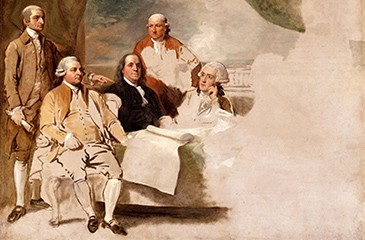
Celebrating the defiled republic
Two hundred and fifty years after the declaration of independence, America still awaits democracy. Only a third revolution can achieve that, argues Paul Demarty
There is an apocryphal story that, on July 4 1776, King George III wrote in his diary: “Nothing important happened today”.
This story is certainly false. That most wayward of kings did not even keep a diary; and, if he had, he would not have heard of the declaration of independence by the 13 British colonies in America that would, ultimately, become the United States, until weeks later, given the speed of communication at the time.
Nonetheless, he might not have been wholly unjust in recording these events so dismissively at that time. The American war of independence had many more years to run. It was not until 1783 that the British finally conceded defeat; direct engagements in the war tended to favour the British. George Washington’s genius was for strategic retreat. It is not the kind of genius typically rewarded in the folk mythology of national birth, but it told in the end.
The question of the first American revolution is a troubling one for Marxists. On the plus side, it was the first indication of the vulnerability of the British empire in its very heartlands. No colonial population in its whole extent, at the beginning of the 1770s, was so very British; yet the tyrannical measures following on merely from membership of that empire drove the American gentry into revolt. Governments at home were exasperated: how did the restive American colonies propose to defend themselves without the British army and navy? And how should the latter be deployed without proper funding, necessarily through taxation? Yet the Americans spurned the aid available, and were driven in the end to an independent form of oligarchic republican rule.
Yet even the shift to republicanism, of any sort, is complicated by the ends to which such republicanism was directed. The states were settler colonies. They expanded to the west, in turn displacing the native peoples. The latter, indeed, tended to favour the British in the war. The British preferred a slower pace of westward expansion; the colonies were champing at the bit to obtain new territory and move the frontier beyond the Great Lakes. What is at issue, in other words, is the independence of a settler colony. A settler colony that really did undertake a revolution, which placed the American bourgeoisie in control of the old colonial territories; but one whose relentless march would come at the expense of the native peoples, sometimes in near-open genocidal form.
Where do we place our emphasis: on the fight for freedom, or the fight to dominate? In truth, the two cannot be separated. That is not a reason to reject the revolution, such as it is; to suppose it to have merely been a fake. It is to understand its irreducible moral limits. Something, indeed, was unleashed on that day in 1776, something of decisive importance. The notion of republican self-government returned to the sphere of possibility of the great powers, in ways that would be telling, especially in France a few years later. Yet the American revolution has always been dogged by who it did not include: the Amerindians and the African slave populations, above all. Much later on, Karl Marx famously wrote that a nation which oppresses another can never itself be free. Besides Ireland, he may well have had the contradictory American experience in mind too.
Great idea
Much depends on getting the interpretation of these events right; but we may as well start by looking at the celebrations themselves.
America’s 250th anniversary was presided over by its 47th president - a man whose ability to represent the ‘distinct American genius’ is, to put it mildly, contested. His great idea was to turn the governmental district of Washington DC into “the great American state fair” - a strange facsimile of those provincial celebrations of above all agricultural production. The idea of the yeoman farmer was, after all, central to the Jeffersonian vision of American democracy - a great society of property-owners never far from direct work on the land. Yet even out in the states themselves, these fairs have become caricatures of themselves; the national version was a caricature of the caricature.
Few enough people turned up, in the first place; those who did had the usual range of diverting activities to attend. There was a faux-revival tent, where you could listen to Christian rock and perhaps be baptised there and then. Military planes thundered overhead in formation. There was a heatwave on, and dozens were hospitalised as a result of heat exhaustion. An apocalyptic storm delayed Trump’s big speech; when it came, it was the usual fusillade of self-congratulation and score settling.
He had already made a big speech at Mount Rushmore, denouncing the evil rise in the US of “communism” (it is unclear whether he meant the Democrats or specifically the Democratic Socialists of America, who recently scored a number of victories in Democratic primaries) and implying state action against it. In theory, a revolutionary anniversary of this sort - something like a royal wedding this side of the pond - is supposed to be a unifying event. That message seemed to have gotten through to DSA New York mayor Zohran Mamdani, who made the sort of cautious but ultimately triumphant patriotic speech that one might have expected from a Barack Obama. It even got through to the pope - an American, of course, whose message of congratulation covered much the same ground.
For Trump, the national mythos is simply irrelevant. He has never engaged in the default set of hypocritical national obeisances. His contempt for the dead and wounded of America’s wars is legendary - he prefers winners, people who ‘do not die’. Instead, America is to be interpreted through his own person. The American experiment is a success, because it produced the amazing genius, Donald J Trump!
In a certain respect, it is worth taking this seriously. In Trump’s first term, liberals would often react to a new horror with the stock phrase, ‘This is not who we are’. At the very peak of the woke wave, when American history was viewed by such people as only a tissue of white-supremacist violence, that phrase fell out of use. After all, isn’t this exactly who ‘we’ are? Trump is a racist huckster selling shallow nationalism to a mass base of marks he clearly despises. What could be more American?
Even the obviously criminal aspects of the Trump enterprise - the naked self-dealing, the crypto scams, the bribes - have the smell of authentic nationhood to them. As Raymond Chandler put it in The long goodbye: “We’re a big, rough, rich, wild people and crime is the price we pay for it - and organised crime is the price we pay for organisation.” Corruption is a recurring problem in American politics, from the effective ownership of the state by the antebellum cotton barons to the flunkies of the Grant administration, through the robber-baron era to Warren Harding’s Ohio boys, and then to the profligate thievery of Richard Nixon’s entourage. Defenders of Trump today point to the hiring by the Ukrainian corporation, Burisma, of Joe Biden’s crackhead son to a no-show job in a naked act of influence-peddling - and, in a sense, they are right to do so.
These defects in political culture have always stood athwart the content of the national myth: that America is the world’s first and most stubbornly enduring democracy. As such, it has taken on a special role, merely as a proof that such a thing is possible. “Our popular government has often been called an experiment”, Abraham Lincoln told Congress on the first independence day of the civil war. He understood the conflict then underway as a decisive test of that experiment - not only for Americans, but all peoples. He was right; but it was not to be the last. The test of the last century of American society has been of the democratic ideal, only ever realised very imperfectly in its governing institutions, coexisting with the administration of a world empire. The Trump era merely makes that moral danger explicit.
First revolution
Back to the beginning, then, and to a different empire. The British empire was in a state of semi-continuous war with France, which lasted throughout the 18th century and then until the final defeat of Napoleon. French Canada bordered directly with the American colonies; disputes over how to pay for the required defence dogged those colonies for decades. The Brits employed ‘carrot and stick’: as the 1770s rolled around, the emphasis shifted to the stick, and the American gentry began to chafe badly against new taxes they had no say in. ‘No taxation without representation’ is the famous summary of these objections.
When the British attempted to disarm American dissidents in 1775, the situation rapidly fell into full-scale war. Though overwhelmingly dominant in military strength, the British were successfully resisted with guerrilla tactics and canny diplomacy with the governments of France and Spain. The American territory was already vast: patriot forces could retreat at will into the deep country. Independence was declared in 1776, and achieved finally in the peace treaties of 1783.
What emerged from the war was a decentralised continental confederation, which rapidly proved entirely inadequate for governance. The crisis came in 1786, when the economic dislocation caused by the war triggered a general uprising of plebians and small farmers in Massachusetts - the Shays rebellion. This could only be put down by effective suspension of the articles of confederation in order to raise troops, and in turn produced the convention that agreed the US constitution, more or less as we know it today. It created a federal government with distinct legislative, executive and judicial branches that were - crucially - capable of coercing the individual states. As part of the political struggle to do so, popular elements imposed the amendments known today as the bill of rights, of free speech, the right to bear arms and form militias, the right to avoid self-incrimination and arbitrary search and seizure, and so on.
There remained, of course, two major matters to be resolved. The first was the limited geographical extent of the new-born United States, and the pertinent fact that the ‘virgin lands’ yet to be seized were populated. The second was an internal population - that of the slave labourers on the plantations, especially in the south. A shining democratic exemplar to the world ought not, presumably, to indulge in extensive ethnic cleansing and genocide to extend its territory; and it really, really ought not to treat some class of persons as, literally, the property of another class.
There was, sadly, little enough opposition to the first of these crimes, and the settlement of what is now the continental United States proceeded in fits and starts until the early 1900s, to the great disadvantage of the native peoples - a great civilisation reduced, by way of coercion, trickery and mass murder, to a few reservations. By expanding in this bloody-handed way, America bought itself a measure of social peace - the development of capitalism back east had a safety valve, as surplus populations could “go west, young man”, in Horace Greeley’s words.
Second revolution
Slavery was not so easily dealt with. The cotton produced by the slave plantations fed the mills of northern England; the profits were extraordinary. But it was labour-intensive and land-intensive work. The slave trade per se was illegalised by the British - the only people who could really carry it out. New slaves had to be bred from old ones, like prize horses put out to stud. Interference with this reproductive process was a real threat to the planter class. Meanwhile, land hunger drove the US to squalid wars of conquest like, most spectacularly, the 1848 Mexican-American War, which brought territories from Texas to Alta California into the union.
The interests of the planters were opposed, first of all, by a small, but growing, mass movement of abolitionists, largely religiously-inspired, for whom slavery was a gross national sin, on account of which America could expect severe divine retribution. The abolitionists remained marginal until the dominance of the slavocracy began to retard the economic development of the north. There emerged a parallel movement of free-soilers, dedicated to spreading a system of free labour in the states and especially in the territories yet to become states.
The conflict over the legality of slavery in these new territories turned violent, with the ‘bleeding Kansas’ conflict - a low-level civil war in that territory between rival slave-state and free-state governments and their associated bandit gangs. The free-soilers formed a political party, the Republicans, and the resulting political crisis led, in short order, to full-scale civil war when the south refused to accept the presidency of the Republican, Lincoln, in 1861. While the military goals were initially limited to restoring the full union of the states, by 1863 the immediate end of slavery was in sight.
This was now, in the proper sense, a revolutionary war - the second American revolution. The American polity that emerged was very different. The federal government was far stronger in relation to the states. There was now a unified fiat currency and a central bank, long resisted by Jacksonian Democrats. The pressure of war-needs revolutionised the forces of production in industries from arms to textiles. And, finally untethered from the backward planter class, the great era of railroad construction could begin. The constitution gained three new amendments, which authorised the federal government to intervene against the states in favour of the rights of ordinary citizens (or, as the case may be, against them).
Nothing useful can be said about 1776 that does not include the protracted struggle of this whole history -at least the difficult and, in the case of the suppression of the slaveholders’ revolt, extremely bloody process by which the real enduring constitutional settlement of the US was reached. That, of course, complicates the more simple-hearted reactions to the 250th anniversary.
As an example: writing in Compact, James Vaughn - a founding member of Platypus - offers 1776 as a breakthrough for the distinctively modern form of freedom, associated with the rise of the bourgeoisie. He takes 1776 as the declaration of independence of the new world from the old, and this is the new world of bourgeois freedom, the freedom of self-creation, the recognition that fulfilment is the product of social rather than divine laws, and the subordination of the state to social life - “that modern, bourgeois freedom should be given full scope to develop on its own terms, and that the state should be the servant of society, not its master”.1
The obvious objection to this is that this bourgeois freedom, of absolute self-creation, was an abortion even in revolutionary America. The society of self-creating bourgeois gentry proved unable even to suppress the Shays rebellion (a rabble of small farmers and revolutionary war veterans) without a military coup, later ratified in constitutional law. If Vaughn had been around for that rebellion, and had kept a diary, one can well imagine him marking the day in the same words as the pseudo-George III.
Even that settlement proved unsustainable until the conclusion of the civil war. It is notable that Vaughn cites above all in his list of bourgeois freedoms “the rights of the society of free labour, of universal social cooperation based on the free exchange of labour and its products”, but he does not even mention the basis of American prosperity on categorically unfree labour in the slave societies of the south. To read his article, one could almost be forgiven for thinking there was never slavery in the United States at all. The native peoples, notably, are also entirely absent.
Vaughn is nonetheless right to insist that the founding documents of the American republic proved an indispensable resource for those who sought to rectify tyranny, including the tyranny of chattel slavery. When the great abolitionist preacher, William Lloyd Garrison, publicly burned a copy of the US constitution in 1854, to protest the denial of its provisions to black Americans, he paid that text a backhanded compliment. There was something important in there, precisely, that was being betrayed, entailing its immolation.
Third revolution
And so, to the text itself of the 1776 declaration:
We hold these truths to be self-evident, that all men are created equal, that they are endowed by their Creator with certain unalienable Rights, that among these are Life, Liberty and the pursuit of Happiness.
That to secure these rights, Governments are instituted among Men, deriving their just powers from the consent of the governed,
That whenever any Form of Government becomes destructive of these ends, it is the Right of the People to alter or to abolish it, and to institute new Government, laying its foundation on such principles and organising its powers in such form, as to them shall seem most likely to effect their Safety and Happiness.
On display in these famous words are both the genius and the fatal flaws of the document. The genius is, above all, the audacity - a statement of uncompromising egalitarianism (that the equal creation of men is self-evident - if only!), and the enshrinement of the right of revolution. This, after all, might seem a contradiction in terms. A right of revolution could never actually exist in any particular constitutional arrangement. The appeal is to a higher order - in the text, a religious order, a reference to absolute human ends, but one that might well be reinterpreted - and has been reinterpreted - in terms of human reason.
Yet that higher order must always meet grubby reality. That absolute equality never extended to the natives, described in the declaration as “the merciless Indian Savages, whose known rule of warfare is an undistinguished destruction of all ages, sexes and conditions”. The question of the equality of the slaves, as noted, dragged on until its bloody conclusion in 1865 - and indeed afterwards, with the defeat of reconstruction and the institution of segregation and Jim Crow.
The civil war, of course, also called into question the right of revolution. It was just that right, after all, invoked by the southern secessionists, who supposed a free-soil Republican government to “alter or abolish” their accustomed rights. The Union disdained this exercise of the right of revolution, as well they might. Yet they could only do so by departing from the text: the interests of the class of planters - their life, liberty, etc - could not be suffered to dictate American history any longer.
The class character of American ‘democracy’ is not a mere Marxist obsession. In fact it goes back to the very origins. Thomas Jefferson supposed, as previously noted, that the yeoman farmer could provide a stable social base for such a political regime. The free-soilers had their own one, a fluid class alliance of labour, homesteader and the petty bourgeoisie against the decadent pseudo-aristocrats of the southern planters. That alliance, in the end, was obliterated by the northern capitalist robber-barons (an attempt was made to recreate it with the People’s Party - the original populists - which likewise foundered). Its condition of possibility was always the expanding frontier, the possibility of the homestead. The closure of the frontier made America a lot more like Europe - sharply polarised between capitalist and proletarian, with a smaller and politically ambiguous petty-proprietor class between them.
That leaves the working class movement itself - never as powerful in the United States as it was in Europe. Yet its separation from property, in the US like everywhere else, makes it a meaningful contender to realise the total egalitarianism of the declaration. Property itself is tyranny - that much is obvious from Jefferson and Hamilton, through the slavocracy and the robber barons, to the openly corrupt extraction regime of Trump 2.0.
If the workers’ movement meets the goal of realising the best of the democratic spirit of 1776, however, it will have little enough use for the Heath-Robinson machinery of the US constitution. Its checks and balances are mechanisms precisely in favour of property, and from there in favour of tyranny and corruption. That there are indispensable gains in it that have never been put better, at least in English - the robust defence of freedom of speech, of religion, of the right and duty to bear arms, of protection from self-incrimination and arbitrary arrest - cannot be denied, but these elements are in contradiction with the overall design.
The ‘separation of powers’, always rickety, could never survive America’s transition to become the global hegemon. Power has bled out of the legislature, the most roughly democratic of the three branches - into the executive, which controls both the vast military forces assembled over the last century, and the judiciary, which ensures capitalist control of the political process, in favour of the financial oligarchy produced by global primacy.
American politics has always had two souls: democratic and oligarchic. But they cannot co-exist forever. If substantive democracy is ever to reign, a third American revolution must be put on the agenda.