
30.04.2026
Banking on perfect safety
Forty years ago the Chernobyl disaster happened. Eddie Ford argues that nuclear power remains inherently unsafe, incredibly expensive and is tied inextricably to weapons of mass destruction
The anniversary of the Chernobyl disaster should always remind us of the inherent dangers of nuclear power. Yet there are those who want us, obscenely, to view it as a source of ‘clean’ or even ‘green’ power - such as the British government, which wants to build yet more nuclear power plants, including small modular reactors (SMRs), or ‘mini reactors’, the first ones on Anglesey.1
The April 26 1986 explosion at Chernobyl in Ukraine was the worst nuclear accident to date, causing the immediate death of dozens of people and numerous, often fatal, health problems since. Western reporters who covered the accident were understandably kept well away from the site. Nevertheless, when they were given the once‑over with geigercounters they were told to go and thoroughly wash and shower and incinerate all of their clothes - so radioactive were they. Also showing the long-term danger to human health, a vast exclusion zone was established - something like the size of Cyprus, which is staggering.
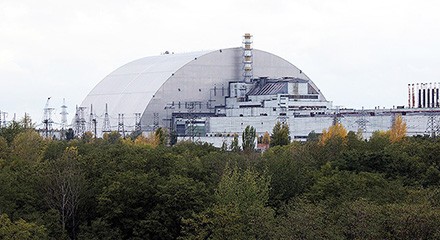
Rising above the site now is the New Safe Confinement - an incredible Heath Robinson-type affair, it is the largest steel structure ever built. Taller than the Statue of Liberty, it weighs more than the Eiffel Tower and is wider than the Colosseum - its arch curving overhead like a giant aircraft hangar.2 Put in place in 2016, costing some £1.85 billion, NSC was funded by 45 countries. Its purpose? To shield the world from what lies beneath. Under its vast roof there lies the original sarcophagus - a grey concrete tomb erected in the immediate aftermath of the accident to cover the ruins of the exploded reactor No4.
Some argue that the Fukushima disaster of 2011 - the only other ‘level 7 category’ event apart from Chernobyl, as defined by the International Atomic Energy Agency3 - was actually worse, because the coastal location of the plant allowed radioactive waste to flow directly into the Pacific and thereby travel around the world. But Chernobyl is generally considered to be on a bigger scale due to its pluming smoke and catastrophic release of intense radiation.
Compromised
According to Ukrainian officials and western experts, a full repair is now required within four years - a project that is estimated to cost up to £432 million - otherwise the NSC’s 100-year lifespan cannot be guaranteed. Unsurprisingly, Ukraine’s government has not yet found the money.
This is something that should be given extra urgency by the fact that a Russian drone struck the north-west face of the arch on February 14 2025. Firefighters arrived within minutes, but sealing within the roof had caught alight and kept smouldering. For three whole weeks, teams desperately cut more than 300 holes into the outer wall to reach the hotspots with water hoses.
When the fires were finally out, it was discovered that the strike had destroyed two key systems. The confinement function, affecting the NSC’s ability to contain any radioactive release from the sarcophagus, had been compromised - and so too had the humidity control system, which keeps the structure from corroding, and puts the arch itself at risk of failing. With its main functions deeply compromised, should the sarcophagus now collapse, it would certainly release another cloud of radioactive particles into the air with few, if any, safeguards.
In other words, another Chernobyl disaster is one Russian strike away, as obviously the feat of engineering covering the sarcophagus was never meant to protect it against drone attacks, let alone ballistic missiles.4 Indeed, rather than being an isolated incident, that February 2025 drone strike was merely the worst to date of an evolving pattern of increased Russian and Ukrainian near-miss attacks on NPPs and associated storage facilities.
We now know that a flawed reactor design - combined with a series of human errors - caused reactor No4 to explode. It was an explosion that released 400 times more radioactive material than the Hiroshima atomic bomb, affecting swathes of Europe, as the radioactive particles drifted westwards according to the prevailing wind. This included Wales, where heavy rain in April and May 1986 drenched higher ground with alarming quantities of radioactive caesium and iodine. The authorities imposed a blanket ban on the sale of milk, spreading panic.5 There is also a profound suspicion that children in Wales were affected too. People from that school generation have since died from unusual or aggressive cancers and at a relatively young age.6
At the Chernobyl plant itself, two operators were killed instantly, while 28 firemen and emergency workers died due to radiation within three months.7 About 116,000 were evacuated. According to the World Health Organisation, 240,000 recovery workers were called upon in 1986 and 1987 alone to deal with the consequences. Certainly, no-one can question the heroism of the first responders. With very little protection firefighters entered the stricken plant. They would have known that they were going to die, either from the flames or the radiation.
Tragedy
Many people view Chernobyl as a contributing factor to the fall of the Soviet Union five years later. For example, Ukrainian historian Serhii Plokhy argues in his 2018 book, Chernobyl: history of a tragedy (much of the information contained within appearing in English for the first time), that the disaster helped forge a “modern Ukrainian national consciousness” by exposing the failures of the Soviet system: a moment of rupture.8
The Chernobyl explosion was first announced not in the USSR, but in Sweden. Scientists registered a big spike in radiation levels coming from the east. At first, by bureaucratic instinct, the Soviet authorities did not let any news out - deciding against reporting the accident for almost four days, and then merely releasing a vague two-sentence announcement. Three weeks later, Mikhail Gorbachev - after initially describing western reports of the catastrophe as “malicious lies” - finally made a public statement, as criticism mounted, disclosing the scale and detail of the disaster. So much for his newfound policy of glasnost (openness).
Now we are dealing with the Ukraine war, a war with nuclear power plants - either still functioning or under shutdown. In terms of the disputed areas in Ukraine, that includes Europe’s biggest nuclear power plant - Zaporizhzhia in south-eastern Ukraine, which is among the 10 largest in the world and under Russian control since 2022.9 Are these NPPs safe? Well, all you can say is they are as ‘safe’ as Chernobyl. Doubtlessly they have built extra security measures since 1986, but in reality nuclear power is inherently unsafe - especially in a zone of military conflict.
The left as a whole does not buy into nuclear power any more, but amongst an older generation there were many - especially among the pro-Soviet left - that bought into nuclear power and its big lie of boundless cheap energy. Remember, Britain was the first country to have a civilian nuclear power plant: Calder Hall, which began feeding electricity into the grid in 1956. Then in February 1966, it was announced that the first prototype fast breeder reactor in the UK would be constructed in Dounreay, Scotland.
This was going to be a new dawn for Britain, we were told at the time, with electricity that was going to be so abundant they would not even bother billing it! Nuclear power was presented by some as the ‘technology of the future’. In reality, though, the electricity generated from these NPPs was hellishly expensive (and remains so). But what it hid, of course, was Britain’s post-World War II attempt to be the ‘third power’ alongside the US and USSR. Having its own nukes being an essential requirement.
But America put a stop to all that malarkey, and what we now have is still nuclear power - but Britain patently does not have any independent nuclear capability, illustrating its real standing in the world. Its American‑designed nuclear weapons are ‘dual‑key’, meaning that Britain would need the say-so of the US administration before firing off a nuclear missile from one of its four Trident subs.
Nuclear weapons
Nonetheless, successive governments have relentlessly pursued nuclear power, despite the huge costs involved and the evident dangers. Why? The answer is not hard to find: “Maintaining nuclear weapons status, or having the option of going for nuclear weapons status, provides the most likely explanation” - at least according to Phil Johnstone and Andy Stirling, both of Sussex University.10
But still there are a few on the left who hang on to the idea that nuclear power represents the future. It is, after all, not a fossil fuel, and something is needed to fill the inevitable gaps when it comes to solar and wind (sometimes the sun does not shine, sometimes the wind does not blow).11 Advocates tout its relative safety too. The number of deaths caused by nuclear power is nothing compared to coal (either in terms of mining accidents or diseases associated with the digging and burning of coal). Hence, we are told that nuclear is “not particularly dangerous”. Well, yes, but only if things do not go wrong either through a technical failure, human error or a crazy act of war.
In actual fact, nuclear power requires a talent pool of physicists, engineers and technicians, along with a chain of companies capable of supplying the necessary components - and, in turn, the nuclear weapons industry rests on that same talent pool and same supply chain. In other words, peaceful nuclear power is an oxymoron. As for the notion that it is “not particularly dangerous”, what can you say on the 40th anniversary of the Chernobyl disaster?
-
theguardian.com/news/ng-interactive/2026/apr/25/chornobyl-power-plant-at-risk-amid-russia-war-ukraine.↩︎
-
en.wikipedia.org/wiki/International_Nuclear_and_Radiological_Event_Scale.↩︎
-
pembrokeshire-herald.com/137120/special-feature-did-chernobyl-affect-children-in-wales.↩︎
-
amazon.co.uk/Chernobyl-History-Tragedy-Serhii-Plokhy/dp/0141988355.↩︎
-
theconversation.com/all-at-sea-making-sense-of-the-uks-muddled-nuclear-policy-48553.↩︎
-
E Jacobs ‘Nature’s gift to humanity?’ Weekly Worker August 22 2024: weeklyworker.co.uk/worker/1503/natures-gift-to-humanity. We were even told that we ought to “embrace” nuclear energy if we want to “set our species on a path to an abundant life for all”.↩︎