
23.04.2026
He didn’t want to know
Claimed ignorance of Peter Mandelson’s security rating tells us a great deal about the inner workings of the state. But, says Paul Demarty, we should be demanding full access. Publish everything and ‘security’ be damned
There was much amusement earlier this year when Peter Mandelson - still for now ‘Baron Mandelson of Foy’ - was photographed urinating in the street in Notting Hill.
He had been enjoying a no-doubt well-refreshed visit to the home of former Tory chancellor George Osborne, where the two presumably compared notes on turning this country into a barely habitable hellscape of vape stores and homeless encampments. The BBC reported last week that Kensington and Chelsea council intended to issue a £300 penalty notice to Mandelson, but were not entirely sure what address to send it to. In the end, the Royal Borough will get off lightly, whether or not they manage to collect the cash, for Mandelson seems far more intent on pissing on the career of the prime minister! And, while the rain in time washed his Notting Hill ejecta out to the Thames super-sewer, not even a monsoon could clean the stains off poor old Sir Keir Starmer.
A quick recap: with the UK faced with the need for a new US ambassador (with Donald Trump already in a bad mood, thanks to Labour apparatchiks’ worthless assistance to the Kamala Harris campaign), one name rapidly floated to the top of the list - that of Mandy. He had a good relationship with the president; he had a good relationship with numerous other dictators and princelings for that matter, and therefore had a good line in grovelling sycophancy. He was well-connected in the business world, which counts for a lot in sucking up to Trump. He was perfect, albeit perhaps a little unreliable.
He was also, it is fair to say, pretty well plugged into Starmer’s circle. Morgan McSweeney, Starmer’s then chief of staff and Svengali, was a protege of Mandelson’s. He was also close to the residual Blairites in the parliamentary party, of course, like Wes Streeting. It was a match made in heaven. He was duly appointed, without much controversy (or any more than could be expected, given Mandelson’s scandal-prone political history).
Alas, Trump had brought one troublesome promise into the White House with him: to release the ‘Epstein files’, even if nobody could really work out what these files actually were. When he got cold feet, Democrats in Congress, along with a few true believers in the GOP, forced significant releases of Jeffrey Epstein-related documents held by the department of justice. These provided, firstly, evidence that Mandelson had offered support to Epstein after his conviction for solicitation in 2008, leading to his sacking as ambassador.
Then, in February, prima facie evidence emerged that, when he had been brought back into the cabinet by nemesis Gordon Brown, Mandelson had leaked private government documents to the sex-pest financier at the height of the 2008 crisis; and also that he may have received financial gifts. He was sacked and, soon after, arrested for questioning. No charges have yet been filed - and, of course, he denies everything.
All of this was very embarrassing for Starmer, who made various statements to the effect that he was shocked that Mandelson had lied about the extent of his Epstein ties. Various people were thrown under the bus, including McSweeney.
The latest scandal is that it turns out that Mandelson failed his security screening comprehensively. Yet he was still appointed. How can this have happened? Once again, Starmer is shocked - I’m sorry, “staggered”, to use the exact word he has been repeating for days like a malfunctioning wind-up doll - to discover this. Why wasn’t he told? He is quite insistent that he was, indeed, not told. Various leaks from the government have striven to buttress this account of events. The sacrificial victim this time is Olly Robbins, the permanent private secretary at the foreign office, who apparently disregarded the security concerns and approved the appointment.
Spectacle
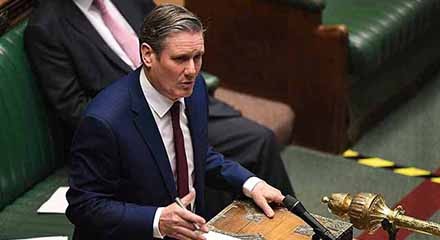
All of which set up a great spectacle for the Commons this week, where Starmer and Robbins alike got to push their respective versions of events. On April 20, Starmer more or less rehashed his previous talking points, and was curiously let off the hook by the opposition; Diane Abbott asked some pointed questions, and Zarah Sultana got herself suspended from the house for calling Starmer a barefaced liar to his face.
More interesting was Robbins, who was clearly narked at having been made the fall guy. His story was already a popular hypothesis, shared (for what it’s worth) by ourselves: the government, clearly, wanted Mandelson for the job. They made that extremely clear to the civil servants concerned, and it was up to the civil servants to work through the procedures. The procedures allowed overruling the security check, and ‘working towards the Führer’, and they took the decision they believed would save them the most hassle. Robbins claimed that he had not seen the vetting report - only been briefed on it. Perhaps true, perhaps a deflection of his own.
If this is true, then Sultana was morally correct, but technically wrong. Business was conducted in a way that Starmer could not, literally, be caught in a lie; his moral compromises were conveniently outsourced. It is hard not to feel for Robbins, all told. When the revived Epstein scandal took out Mandelson, the civil servants were left exposed; after all, this sort of informal, nudge-wink decision-making is designed to help shit roll downhill (or, perhaps, piss!). It is very common in the business world for just that reason.
So we do not take Starmer at his word here. Suppose, however, we did. It is not an uninteresting argument. The government leaks are quite insistent that all this security vetting is an internal prerogative of the civil service (indeed, even Robbins claims not to have seen this report). Various names have been floated as blockers of the essential information: Robbins, of course, but also Antonia Romeo and Catherine Little (cabinet secretary and cabinet office permanent secretary respectively), who knew about all this weeks ago.
They had been brought into action during the February crisis, after parliament demanded the release of all information related to Mandelson’s appointment - except that prejudicial to ‘national security’. Their delays, according to The Guardian, relate to this:
A government source insisted Little “did not sit on the information”, but was involved in a complex process and was trying to establish the risks in sharing highly sensitive information, including with the prime minister. The source added that Little informed Romeo of her plan to establish those risks. Romeo, the government source said, was supportive of the plan. That process appears to have taken weeks, with as many as a dozen officials and lawyers aware of Mandelson’s vetting failure. Starmer’s statement would suggest he was not formally notified by any of them until a few days ago.1
Now, there are very good reasons for scepticism, when it comes to anonymous ‘government sources’, but, in line with our thought experiment, let us assume this is all true. The striking conclusion is that, even with his job possibly on the line, even after parliament demands access to this information (the sensitive stuff, after all, was just supposed to go to the intelligence and security committee), apparently the prime minister has no right to know about any of it. Huh?
The drama of Starmer’s troubles, and the salacious character of the Epstein scandal, draws the headlines. Yet between the discreet smoothing of Mandelson’s appointment and this year’s crisis management, a picture of something more fundamentally important emerges - the structure of the British state (indeed perhaps of bourgeois states in general), and the essential role played within it of controlling the flow of information. Parliament is supposed to be sovereign (or at least the king in parliament), yet it is frozen out apparently by the obscure machinations of the Sir Humphreys, and indeed the Dame Humphreys.
Bureaucracy remains
Governments come and go; the permanent bureaucracy, including the civil service, but also the military and security state (also involved here), remains. It too has its governing ideology and perceived purpose, which changes - but more slowly, tectonically. It is this permanent layer that makes the state effective as a bulwark for capital against challengers.
It is, ironically, the right - the party of order - that has led the charge of late against this permanent caste of officials. In America, this was strikingly illustrated by Elon Musk’s campaign of terror last year in the short-lived ‘department of government efficiency’; public servants were a perceived risk to the plans of Musk and his ilk for openly corrupt raiding of taxpayers’ money. Yet he was hardly first on the scene. Numerous figures on the American far right, such as Steve Bannon and Curtis Yarvin, have long demanded an all-out assault on the ‘administrative state’. British rightists, notably former Boris Johnson consigliere Dominic Cummings, have made much the same case on this side of the Atlantic.
Democracy
These people have tended to frighten the left into defence, however qualified, of the public servants concerned. Yet it is worth thinking about why the rightwing attacks always seem to fail. Governments of the right, even more than governments of the capitalist ‘left’ (‘neoliberalised’ social democracy and so forth), require impunity to be effective. Impunity is assured, above all, by the united front of the state apparatus and its control of information like the failed security vetting of Mandelson.
For Marxists, the proper proximate aim is the politicisation of state business, its being put into question in the full glare of publicity: the exact opposite, in other words, of the mission of the civil service. We do not favour permanent bureaucracy, civil or military, but the supremacy of democratic bodies. A mature socialist society would not have a career civil service at all, but accountable officials, upon whose work the utmost transparency is imposed. Though today the ‘revolving door’ between government and private industry is a mechanism of legalised corruption, we should in fact aspire to ordinary people rotating in and out of direct economic activity and political-administrative roles - something only possible with the total subordination of the economic to the political. Every cook can govern - and should.
We are far from this, of course, but it does suggest that our immediate demands should not be over-focused on Starmer, as pathetic a figure as he is, but on how this sausage was made. Release this vetting report! To hell with ‘national security’ - we will be the judge of what is prejudicial to ‘British interests’, such as they are. Any such revelations will not be politically actionable for the left in the short term, of course (unless we count the Greens). But it will be educational.
The Epstein scandal has had a rather ambiguous effect on political consciousness, spreading all too widely a credulous conspiratorial mindset. It has, however, had the virtue of being deeply destabilising, and forcing into the open the sorts of squalid arrangements that are, in reality, all too characteristic of political power under capitalism. So far as we are able, we should exploit this opportunity.
Meanwhile, Starmer struggles for survival. His future may be safer than it appears: nobody is likely to move on him before the expected drubbing in the May elections, and even then, there is the tricky question of who to replace him with. The non-stop disasters of this parliament have soiled most of the likely candidates; Starmer succeeded in keeping Andy Burnham out of the Commons (probably at the cost of Labour failing to win Gorton and Denton). Perhaps May 7 will be such a nightmare that they will offload him anyway - time will tell.
To find a replacement without the stink of Mandelson on them, the PLP will have its work cut out.