
16.04.2026
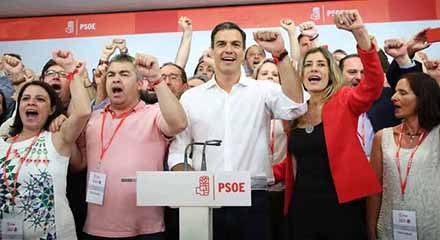
Combat social democracy
Donald Trump hates the Spanish government with a passion. That suits the Spanish government and has brought forth much praise from invertebrate peaceniks and goopy liberals, says Paul Davies
Spain’s prime minister, Pedro Sánchez, has attracted much attention recently. After all, he has dared to do what most, if not all, of Europe’s political leaders did not do: to publicly, clearly and unambiguously criticise Donald Trump and his administration’s war with Iran. A “disaster”, “unjust” and “bad for the world”, Sánchez said a few days after the US began its bombing campaign. He used this to justify Spain not permitting US warships to dock at Rota, or its planes to land at Morón.
Of course, Sánchez’s position of ‘no a la guerra’ (‘no to war’) has provoked torrents of verbal abuse and all kinds of threats from the US president. Clearly the Spanish government has rattled Trump: “Spain has been terrible,” he said during a White House press conference on March 3. The country was “very uncooperative”. He even threatened to “cut off all trade … and all dealings” with it. However, Madrid remains resolute.
It is worth bearing in mind that this position is consistent with its stance towards the Middle East in general - something else that, unsurprisingly, has not exactly gone down well with Donald Trump or Benjamin Netanyahu. Indeed, Spain’s political relationship with Israel has been frosty since the start of its Gaza genocide. In October 2025, the Spanish parliament, the Cortes Generales, introduced an embargo on armament exports to and many imports from Israel, particularly from its illegal West Bank settlements. The government also banned military transit destined for the Zionist state from any part of its sovereign territory.
For inveterate peaceniks and goopy liberals, the position Spain’s coalition government has taken is commendable - Sánchez and his Socialist Workers Party of Spain (PSOE) are supported by Sumar, the Eurocommunist soft left, as junior partners. With the growing popularity of neo-Franscoist parties such as Vox and SALF and the general rise of the far right in Europe, Spain’s government appears to be holding out against the tide.
Is this something for the left to celebrate? Something to emulate? The likes of Jeremy Corbyn, Zarah Sultana and Zack Polanski are certainly within this frame. So is Owen Jones of The Guardian: he lauds the Spanish government for its “progressive” stance on international issues, Gaza in particular.
Principles
So why has Sánchez chosen to defy the American empire? After all, despite his party’s socialist name, politically it is usually described by bourgeois journalists as ‘centre-left’. In other words, both the PSOE and Sumar are committed to running capitalism … albeit supposedly in the interests of ordinary Spanish people.
Recent opinion polls for the next Spanish general election, due in May 2027, show the PSOE trailing behind the mainstream conservative People’s Party (PP).1 A consistent picture since PSOE established its coalition after the 2023 general election. Corruption charges have not helped. The same goes for sexual harassment allegations within the PSOE. The country also faces an acute housing shortage along with skyrocketing rents.
Indeed December’s regional election in Extremadura - in Spain’s west - were disastrous. In what is traditionally a leftwing stronghold, the PSOE lost 10 of its 28 seats. Vox leapt from five to 11 and is now in coalition with the PP. A not dissimilar outcome was also seen in February with Aragon: big gains for Vox, big losses for PSOE, and Unidas Podemos disappearing entirely from the regional parliament.
However, Sánchez is a canny political operator. He successfully tamed soft-left formations such as Podemos and Sumar, he bought off Catalan separatism by securing an amnesty law, and has adopted what has been called a pro-migrant stance. His plan to grant legal status to 500,000 undocumented migrants has caused a storm on the right, but allows him to present the PSOE as both a champion of human rights … and the means to sustain Spain’s relatively buoyant economic growth.
With that record in mind, Sánchez’s stance on Gaza and the war in Iran may be another calculated move to save his skin. Polls show nearly 90% of the country believe Israel is committing genocide in Gaza and around 68% of the population support him against Trump. His position certainly stands out in stark contrast to that of Alberto Núñez, PP’s president, and Vox, of course: both initially backed Trump’s Iran war and are now finding it necessary to backtrack somewhat. So, on Iran, Sánchez has his two main opponents on the ropes. Whether or not that saves him at the next general election is another matter entirely.
Influences
Of course, the Spanish premier’s perspectives and political manoeuvres are not only being influenced by opinion polls: forces within his coalition government also shape his politics. Namely Sumar and its various components. Such components include Izquierda Unida, of which the ‘official’ Communist Party of Spain is the principal organiser, plus various fragmented and disjointed parties, including the reinvented Republican Left.
Initially holding 31 seats in the Cortes Generales, Sumar’s fraction was reduced to 26 in 2024, when Podemos and its five deputies withdrew following a spat over speaking rights. But, given that Sánchez depends on Sumar to maintain his government, he wants to keep them on side. On the other hand, Sumar depends on the PSOE. If the Sánchez government falls, Sumar could easily face parliamentary oblivion.
So Sumar gets not a few crumbs from the table. Sumar’s Yolanda Díaz, a PCE member who serves as second deputy prime minister and minister of labour, boasts of strengthening abortion rights and establishing a relatively significant rise in the minimum wage. Sumar also claims responsibility for successfully reducing the maximum statutory working week to 37.5 hours with no salary reduction. Such titbits are considered great achievements by many on the left - well, those who have abandoned any serious commitment to socialism. There is also pseudo-internationalist posturing. Much to her delight, Díaz is banned from entering Israel because of her statements objecting to genocide and ethnic cleansing. And then there remains Podemos. Despite finding itself on the opposition benches, it claims prime responsibility for steering Sánchez into granting legal status to the 500,000 undocumented migrants.
Of course, despite various media outlets attributing the positions of the Spanish government to Sánchez’s ‘socialist’ convictions, there is nothing remotely socialist about the government or Sánchez. The PSOE has a name which dates back to 1879, true. But in reality the modern PSOE is the invention of the CIA, which engineered Spain’s ‘transition to democracy’ and entry into Nato following Franco’s death. Ideologically, therefore, it has long been committed to Atlanticism and rightwing social democracy.
What marks Sánchez out is not his ‘socialism’, rather it is his ‘combat social democracy’. Instead of adapting to the far right, like Sir Keir’s government, he adopts an aggressively rhetorical stance against the likes of Vox. Inevitably this is extended to Trump. A risky game, but it might just pay off. We shall see.
So-called left
Depending on the parliamentary arithmetic, Sánchez can reach out to the left rather than seeking a rapprochement with PP in some grand ‘traffic light’ coalition (as in Germany). But there can be no hiding the opportunist swamp that passes for the left. Far from refusing, as a matter of basic principle, to participate in what is a capitalist government, coalitionism is assumed, taken for granted. That way, so it is argued, comes influence and “making a difference”.
In February, four largish leftwing organisations - Sumar, IU, Comuns and Más Madrid - agreed an electoral alliance that will fight under the sadly appropriately gradualist slogan, Un paso al frente (‘One foot forward’). Given that the main components are Sumar and Podemos it was not a surprise that the whole alliance is a top-down affair.
Despite originally opting to remain independent, Podemos has thrown in its lot with the alliance. For Podemos this effectively represents its road back to governmental benches and fat ministerial salaries. The first test will be the May 17 elections in Andalucía. Here, the alliance will wrap itself within another alliance, Por Andalucía.
Who will lead the election list remains to be seen and, not surprisingly, appears to be a bone of contention. Podemos still thinks it is the big beast on the left, while Sumar and Díaz believe they are on a roll with their ministerial portfolios and swollen body of staffers and hangers on. The PCE certainly views itself as the “backbone” and “cohesive force” within the alliance.2 Podemos are considered fractious and irresponsible.
However, what Por Andalucía will be specifically campaigning upon remains unclear. As with the nationally focused Un paso al frente, much emphasis appears to be placed on a campaign to prevent the steady growth of Vox rather than the promotion of a transformative agenda. Hence, Podemos is banging the drum for ‘bread and butter’ issues: the severe housing crisis, its worsening health service and low wages.3
From nothing, nothing will come.