
09.04.2026
Back to reality
Artemis II and the new space race do not represent a great leap in human progress, argues Paul Demarty.Instead what we have is a criminal refusal to take responsibility for the dire conditions here on Earth
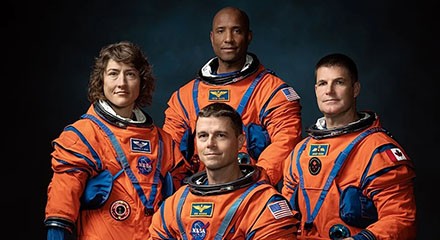
As I write, the Artemis II mission has entered lunar orbit, and is on course to reach the greatest distance from Earth ever achieved by a crewed space flight.
The news has been received with general good cheer. It is, after all, a welcome distraction from the worsening bloodshed of America’s assault on Iran, and the looming economic dislocation attendant on the war. Presumably, something like that is part of the point - not specifically the current war, of course, but there is a clear attempt to recapture the optimism of the Apollo programme and its successes, above all the landing of Apollo 11 on the lunar surface in 1969.
As John F Kennedy famously put it in his speech at Rice University in Texas, in 1962,
We choose to go to the moon in this decade and do the other things, not because they are easy, but because they are hard, because that goal will serve to organise and measure the best of our energies and skills, because that challenge is one that we are willing to accept, one we are unwilling to postpone, and one which we intend to win, and the others, too.
Whatever else it was - and it was many other things, not all so salutary - the Apollo programme was an attempt at a grand nation-building project, using the cutting edge of rocketry, computer engineering and aeronautics to go, as the Star trek slogan would later have it, where no man has gone before. In that respect, it was very American. The frontier had been closed at the beginning of the century, but here was a new frontier, glowing temptingly at us on clear nights. The moon landing, when it came, was a genuine mass cultural moment, registered in the fascination of generations of children with toy spacecraft, the resurgence of popular science fiction and science writing, and even the multiplication of new clichés (‘It’s not rocket science …’).
The Artemis programme is the faltering attempt of several presidencies to recreate that great achievement - with, of course, the benefit of technology, the likes of which the Nasa of the 1960s could only dream about. (The Apollo 11 guidance computer, a justly legendary technical accomplishment, would be hard-pushed to power a modern television remote, never mind a smartphone.) Begun in 2005 by George W Bush, tinkered with by Barack Obama, relaunched in Donald Trump’s first term, soft-pedalled by Joe Biden, and now just about tolerated by the cost-cutting Trump 2.0 regime, Artemis puts human beings - at great length - once more in the neighbourhood where Neil Armstrong set foot over 50 years ago.
Pointless
Despite the media hype, there is a certain pointlessness to the whole exercise, which is difficult to suppress entirely. The truth is that, from a strictly scientific point of view, the exercise is worthless. Earlier crewed space missions at least yielded data about the effects of zero gravity on the human body. How much is there left to learn, really, about that, after countless intervening missions and above all the various space stations? The four crew members of Artemis II will achieve nothing that could not have been done more efficiently, cheaply and safely with an unmanned craft, except social media posts about how stoked they are to be in space. A computer, after all, would not be troubled, as the Artemis crew were a few days ago, by a malfunctioning toilet.
Presumably the Nasa boffins are quite aware of this, and so we must look elsewhere for explanations. The first, as noted, is the idea of recreating a great historic achievement of the American state - of recent presidents, Trump has shown no small interest in all this. He is very keen to ensure the next moon landing takes place while he is still in office. Trump is a man who likes to put a shiny item on his CV, hence his resentment at being denied the Nobel Peace Prize. Crewed space missions, in the terms of evolutionary biology, are ‘costly displays’, like the ungainly tail of the peacock. We do these things, remember, because they are hard.
The second explanation is the vulgar matter of military competition. Indeed, the Apollo programme itself is hardly dissociable from the cold war, the endless angst over the supposed ‘missile gap’ and other Strangelovian obsessions. Now, of course, the great rival is further east. China has its own space programme, and its own plans to go to the moon; for Beijing, of course, it would be the first time - and a grand coming-out party.
The outworking of this is presumably a new wave of militarisation of the Earth’s near space. Much has already been done here - most notably the rival networks of spy and communications satellites. Military dominance of space has been an American objective since at least the 1980s, with Ronald Reagan’s ill-fated Space Defence Initiative (better known as ‘Star Wars’), and was then a major sticking point in nuclear negotiations with the Soviets. There is no kidding around now, and one expects the US and its new peer rival to play for keeps.
Finally, there is the question, once more, of ‘opening the frontier’. The original remit of the Constellation programme in 2005 - which became, eventually, Artemis - included a crewed mission to Mars by 2030. As of now, plans still include a permanent moon base, to begin construction in 2028. In this respect, the US government seems to be on a similar wavelength to the science-fiction-poisoned billionaire, Elon Musk, whose SpaceX company is an important contractor for the programme.
One can put a positive, Promethean spin on the dream of - as Musk likes to put it - making humanity into a multi-planetary species. If it could be achieved, after all, this would be an enormous symbolic change in the dignity of species, next to which the exertions of Apollo and Sputnik would be mere child’s play. It is a suitable goal for anyone whose ambitions are untroubled by realism.
There is, however, a less sunny interpretation. The Pilgrim Fathers crossed the Atlantic, after all, because they found Britain inhospitable under the tyranny of the Stuart kings (who were happy, for their part, to remove these troublemakers to a place where they could be more easily managed). The colonisation of Mars, likewise, could serve as an escape route from the crowded, war-torn, environmentally-threatened ‘Spaceship Earth’. In this aspect, Musk’s grand plans look rather like the discreet efforts of fellow American billionaires to buy up land as far away as possible - New Zealand is popular - to build impregnable compounds and bunkers, for when the shit really hits the fan.
Bad conscience
Since the colonisation of Mars is a ludicrously unachievable goal, it is appropriate perhaps to refer to a work of science fiction to illustrate a more profound problem with this outlook. Kim Stanley Robinson’s magnificent Mars trilogy is a hard-SF story of an international team of scientists set to work creating a Mars colony, in which endeavour they face innumerable technical obstacles, pitilessly described by Robinson. The biggest problem, however, is that they bring with them - precisely - humanity, Earth’s problems, Earth’s rancorous politics, and above all Earth’s ruthless corporate interests, because of which things get rather sticky.
There is a basic philosophical misunderstanding here. It is a hard-won insight, from Giambattista Vico to Karl Marx and even Martin Heidegger, that all human life starts in medias res - in the foaming rapids of natural and human history. This calls forth the hope that there is some way to wipe the slate clean, to start again from zero. But this hope is futile. Even to have the hope is to be marked irrevocably by history. Paradoxically, this hope’s very futility causes its scope to expand: we need not only a new planet, but new bodies (as Musk has put it, referencing the initial procedures of a computer operating system as it starts, humanity is perhaps merely a “bootloader” for artificial intelligence).
This despairing Prometheanism finds occasional echo on the left, in the form of transhumanism and momentary fads like ‘luxury space communism’. Though leftist futurists no doubt do not share Musk’s reprehensible opinions on gender, race and the justice of his own vast fortune, they undertake the same flight from reality.
Manifesto
There was a movement in hard-SF not long ago called ‘mundane’, complete with its own manifesto - the gist of which is that faster-than-light travel is impossible, and authors committed to the genre should refocus on the no-less-fascinating potential of the future of our own planet, or perhaps its immediate neighbourhood. In a similar way, I think it is correct for Marxism to be ‘mundane’. The revolution will be made, if it is to be made, by the agency of our fellow humans, our friends and neighbours, our distant comrades, or people very much like them, on this blue planet of ours. We seek the liberation of humanity, not liberation from humanity.
Our destiny, then, lies not in the stars, or even on Mars, but on Earth. The problems before us here are severe, of course, but they cannot be solved by science fictional daydreams. They require, instead, global coordination of economic activity, the destruction of rival powers’ vast apparatuses of death, and the healing of the metabolic rift between humanity and non-human nature. These are tasks for political transformation, not in the first instance for technological progress, important as that is: it is social relations that, in the end, determine the uses to which technology shall be put.
This should not entail a parochial attitude to the extra-terrestrial. Humankind’s hunger for new discoveries about our solar system, galaxy and universe is quite salutary. Exploration of space should continue, with these aims in mind. And who knows? Perhaps, when every belly is reliably fed on our own planet and nuclear arsenals are no more than an anxious memory, we can put a few brave souls in a tin can and launch them towards the moon or Mars. It would be, for world communism, just what it is for capitalist society today - a flex, a ‘because we can’ move. Sometimes that is reason enough.
Under present conditions, however, one can only deplore the waste and the hubris. Artemis II is a flight from Earth, but also a flight from the capitalist world’s bad conscience.