
26.02.2026
Sticking plaster budgets
We want a democracy for the people that works through the people. Tam Dean Burn reports on the ‘people’s budget’ initiative proposed by Your Party councillors in Glasgow
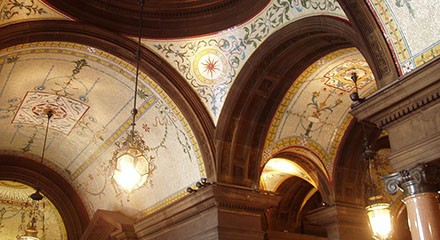
In the most important Glasgow City Council meeting of the year on February 24, the YP councillor for Govan, comrade Dan Hutchison, moved a motion on council spending for the next year. This was presented as a “people’s budget” and was no small achievement, as any proposed budget must pass strict legal scrutiny in order to be deemed fit for purpose. Such a task proved beyond Reform councillors, for example, who were therefore notable by their absence. So a party that hardly exists yet in anything but (daft) name has, in the hallowed grandeur of Glasgow’s City Chambers, proposed how to run Scotland’s largest city.
Comrade Hutchison and two other former Green councillors, Seonad Hoy and Leòdhas Massie, defected to YP back in the heady days leading up to Zarah Sultana’s sold-out rally in my neighbourhood of Maryhill in late October 2025. Since then the councillors have been meeting regularly with Glasgow YP activists and trade unionists to formulate the budget presented this morning.
Understandably, given the timescale, it could not be a genuine “people’s budget”, but afterwards comrade Hutchison stated that they were looking forward to beginning work on next year’s budget right away. This needs to be an exercise in local democracy - reaching into communities across Glasgow for connections and ideas that reflect the city’s needs. I suggest this could be a far more fruitful engagement with communities than the rush job of superficiality that a May Holyrood election campaign will likely be (if it happens at all). An acceptance of this reality is becoming more apparent by the day in statements from leading figures in YP Scotland.
Of course, a focus on such a budget campaign could appear to be a futile exercise, as there is no chance of such a budget passing, with a solid Scottish National Party-Green majority proposal also on the table. But it does make excellent propaganda. We can demonstrate that a Your Party council budget can offer genuine and radical alternatives to the pro-capitalist party offerings: for example, instigating research into how a four-day working week with no loss of pay can be introduced for all local authority employees in Glasgow.
This follows on from the experience and advice of South Cambridgeshire council, which made such an arrangement permanent for staff after a trial period. Shamefully, Labour minister Steve Reed criticised the scheme, throwing baseless accusations against it. But it is now looking like Reed will be the next member of Starmer’s cabinet to exit after the debacle over the cancelling of the now forthcoming English council elections.
The Glasgow YP council budget claims to fulfil the mandate given at the recent Scottish conference for members in positions of such authority to insist on the principle of only tabling or supporting ‘no cuts’ budgets and other such measures. This is clearly an area that needs debating and fleshing out - just what does that mean and should it be a principle? For example (and I may be off the mark here), doesn’t the council tax increase of 5% proposed in the budget mean a cut in working class living standards? And shouldn’t our councillors be demanding an end to the council tax and indeed adopting the slogan, ‘No tax on the working class’?
This is where we could get into debate about whether we should be taking part at all in the anti-democratic charades that pass for local governance. The answer is, of course, yes. But not because we think that with clever accounting, eg, borrowing from next year’s budget, everything will be fine and dandy. It is widely recognised that councils, and not only in Scotland, are run by appointed officers rather than elected councillors, with senior executives on exorbitant salaries and facing little scrutiny. It is hardly surprising that voter turnout is so low across council elections, reflecting apathy and little hope for change.
Moreover, if councils behave in a manner that is deemed to be irresponsible, the government can intervene directly, using section 15 of the Local Government Act 1999. External commissioners take over decision-making from elected councillors in specific areas (eg, finance) or in terms of overall governance.
So our councillors need to combine using elections to spread socialist ideas and build party organisation with what might be called ‘legislative propaganda’. This helps ready minds for mass mobilisations and demonstrations, not just locally but, crucially, nationally in Scotland and across the whole of the UK. Hence, rightly, the YP Glasgow budget demands a clampdown on landlords and states the need to bring housing stock back under control of the local authority. Not because YP can deliver. But because YP wants the population to look beyond the ‘official’ SNP-Green document, which, even in its own words, relies on a “sticking plaster” of a year’s borrowing contingent to deal with the homelessness crisis ushered into Glasgow by Starmer’s Labour policy of clamping down on the accommodation needs of asylum-seekers.
Meanwhile, the Glasgow Labour group proposes a budget with draconian cuts, hiding behind a lower council tax rise, which it knows should not be put into effect. The SNP-Green budget is hiding its cuts for the present, but, as comrade Hutchison states about the relationship between both SNP governing bodies, “I think if a government, in their own election year, isn’t even going to provide enough money for councils to run, then what are they going to do after the election?”
Indeed it does not bode well for future years and makes it all the more important that Your Party gets its act together in defence of working class communities and their services.
We should look at the bigger, even bleaker picture, as represented by the eminent climate scientist, Bill McGuire, who said in the Weekly Worker: “If we are to prevent the very worst that climate breakdown can bring, then an enlightened programme of action has to be enacted by a different form of government that works for the people through the people.”1
Later Bill stated: “Most likely then, we are going to need to plan, at a local scale, how we might best cope, as society and the economy crumble - at the level of town, village, street … block of flats even. Today would be a good time to start. When tomorrow comes, it may well be too late.”2
We too favour a radical redistribution of power downwards to the local level. Britain is extraordinarily over-centralised. As our Draft programme states, when it comes to local democracy: “Service provision, planning, tax raising, law enforcement and funding allocation to be radically devolved downwards as far as possible and appropriate: to ward, borough, city and county levels” (section 3.1.1).
But, and this needs emphasising, we also recognise that power needs to be democratised at all levels in society - regional, national, continental and global. Necessarily that means democratising what is called the economy. Without society - the collective producers - taking over the economy, beginning with the commanding heights, we cannot have a form of government that really works “for the people, through the people”.
-
‘Going beyond protest politics’, February 19: weeklyworker.co.uk/worker/1573/going-beyond-protest-politics.↩︎
-
billmcguire.substack.com/p/tomorrow-will-not-be-like-today.↩︎