
26.02.2026
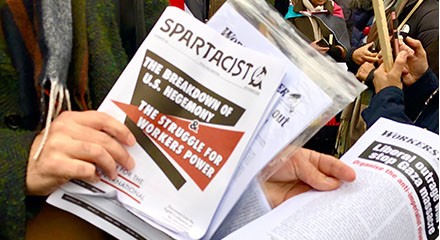
Beware of Sparts bearing gifts
We have a common view that open polemics, as sharp as may be necessary, are essential to any lasting, any worthwhile unity. However, there are those who object. Mike Macnair replies to Vincent David of the Spartacist League
Comrade Vincent David’s letter (‘Unpack the crap’ February 191) raises issues that are important enough to be worth discussing at more length than just an exchange of letters. This article, therefore, tries to take the argument to a little more depth. A reply to this article from the Spartacist League comrades would be welcome if it, also, developed the arguments in more depth.
The core of the political difference is the meaning of ‘proletarianisation’ and, conversely, comrade David’s argument that: “One of the biggest problems of the socialist movement today is that it is totally divorced from the working class.” This argument is a partial, but overstated, truth: the far left is not “totally divorced”, but it is marginal in the working class; because it is generally politically marginal. The Spartacists’ proposal for this problem is, however, a quack remedy.
Before getting down to this, there are a couple of other issues posed by comrade Vincent’s letter that are, in fact, equally important. These are the relationship of the question of unity to open polemic; and the relevance of “digging up examples from 50 years ago”.
Comrade David complains that in my February 12 letter, ‘Spart Cannonism’,2 I have “written a quite demagogic letter”, where “Macnair still feels the need to pillory [the Spartacists’ defeated ‘proletarianisation proposal’] as crap” and that:
The merger of the RCO and the Spartacist League of Australia is a massive win for the communist movement there and beyond. After years of talking about communist unity in the pages of the Weekly Worker, this merger is actually the first real achievement of this perspective. So we are puzzled as to why comrade Macnair wrote a letter (again) essentially bashing the Sparts by digging up examples from 50 years ago.
All of these comments contain two elements. The first is objections to the tone of my writing, as excessively sharp - and, conversely, failing to celebrate sufficiently the unity of the Revolutionary Communist Organisation and the SLA as a “massive win” and so on. The second is objections to my discussing now the Spartacists’ practices of the 1970s to early 1980s.
Official optimism
The claim that “The merger of the RCO and the Spartacist League of Australia is a massive win for the communist movement there and beyond” is a classic piece of self-deceiving ‘official optimism’. The RCO and the SLA are both seriously small organisations. Their fusion is a potentially positive development; but whether it will give rise to a ‘snowball effect’ has yet to be seen.
I personally encountered similar talking-up of the historic significance of agreements among small groups from Nahuel Moreno, Pierre Lambert and Fausto Amador in the context of the split in the Unified Secretariat of the Fourth International in autumn 1979. The agreements (which I did not join) proved to produce no more than a fairly short-lived international bloc (the ‘Parity Committee for the Reconstruction of the Fourth International’). In the 1990s I was involved in discussions with Cliff Slaughter plus his co-thinkers and Michel Varga (Balázs Nagy); these showed Varga playing the same game of overstating the significance of our discussions in the hope of getting rapid agreement without careful thought.
The Spartacist League (Britain) was founded as a result of a 1978 split from the Oxford-based Workers Socialist League, led by Alan Thornett, which then fused with the London Spartacist Group to form the Spartacist League/Britain. The first issue of the new Spartacist Britain paper (April 1978) commented:
This fusion is one of the largest and most important in the 15-year history of the Spartacist tendency. The new organisation already has close on 50 members and a presence both in London and the Midlands. By its comprehensive Leninist programme and clear internationalist perspectives the SL/B is exercising a strong attraction on remaining dissident elements inside the WSL. The same will soon prove true as well toward the numerous small centrist organisations, which will find in the Spartacist League a solidly programmatically based unity - in striking contrast to the short-lived, politically promiscuous unnatural couplings which pass for fusions in the highly fragmented British Trotskyoid milieu.
Triumphalism of the same sort appeared in Spartacist Britain for June 1981, reporting the effects of the decision of the International Spartacist Tendency to pull its entry fractions and those they had won in the past months out of the USFI sections in Britain (International Marxist Group), France and Germany.3 But it was fairly short-lived; many of those won from the WSL and IMG (as, also, others) rapidly came to identify the IST as a personal cult round James Robertson (1928-2019).4
It is not quite clear to me where this tendency to ‘official optimism’ among Trotskyist caudillos like Moreno, Lambert, Varga, Robertson - and James P Cannon; and Ted Grant and Alan Woods - came from. It is radically inconsistent with Trotsky’s repeated insistence that (for example) in 1932, “the proletarian revolution requires the truth, and only the truth”, since “There is nothing so precarious as sympathies that are based on legends and fiction. There is no depending on people who require fabrications for their sympathies.”5 Or in 1937, against celebrating the POUM (Partido Obrero de Unificación Marxista - Workers Party of Marxist Unification), which had a stronger claim to be a “massive win for the communist movement” than any modern far-left regroupment (until you looked at the details):
Do not tell me that the workers of the POUM fight heroically, etc. I know it as well as others do. But it is precisely their battle and their sacrifice that forces us to tell the truth and nothing but the truth. Down with diplomacy, flirtation and equivocation. One must know how to tell the bitterest truth when the fate of a war and of a revolution depend on it.6
The ‘official optimism’ is already present in Cannon’s 1946 Theses on the American revolution:
XIV … Given an objectively revolutionary situation, a proletarian party - even a small one - equipped with a precisely worked out Marxist programme and firm cadres can expand its forces and come to the head of the revolutionary mass movement in a comparatively brief span of time. This too was proved conclusively - and positively - by the experiences of the Russian Revolution in 1917. There the Bolshevik Party, headed by Lenin and Trotsky, bounded forward from a tiny minority, just emerging from underground and isolation in February to the conquest of power in October - a period of nine months …
XV … The revolutionary vanguard party, destined to lead this tumultuous revolutionary movement in the US, does not have to be created. It already exists, and its name is the Socialist Workers Party. It is the sole legitimate heir and continuator of pioneer American communism and the revolutionary movements of the American workers from which it sprang. Its nucleus has already taken shape in three decades of unremitting work and struggle against the stream. Its programme has been hammered out in ideological battles and successfully defended against every kind of revisionist assault upon it. The fundamental core of a professional leadership has been assembled and trained in the irreconcilable spirit of the combat party of the revolution …7
At the time Cannon drafted and the SWP adopted these theses, the latter had about 1,500 members. The Communist Party USA had slightly over 55,500.8
At the outbreak of the revolution of 1917 the Bolsheviks had around 24,000 members under conditions of complete illegality, and where trade union militants were conscripted and sent to the front in the hope of preventing radicalisation in the factories. They had in 1912 won the workers’ curia in the class-structured Duma elections; as if (for an analogy) a British communist party had won most of the urban working class constituencies.
Cannon was deceiving himself and his members about what was possible - a pattern followed by the rest of the Trotskyist caudillos.
The underlying problem, I think, is that Trotsky and the Trotskyists - along, in fact, with Comintern9 - mistook the 1914-45 death agony of British world hegemony for the death agony of capitalism. For both, the mistake entailed forms of self-deception.
For ‘official communism’ the self-deception was the imagination that the USSR was marching ahead and outgrowing capitalism, and that nationalist leaderships which allied with the USSR to gain room for manoeuvre in relation to the USA were part of a growing ‘socialist camp’ and ‘anti-imperialist camp’ around it.
For Trotskyists, the self-deception was the expectation of imminent revolutionary crisis; this, in turn, entailed the need to self-deceive about the possibility of small groups (themselves) ‘leaping over’ the mass parties and organisations to take the leadership of the working class masses. Here the falsification of the course of the Russian Revolution (as in Cannon’s thesis XIV, quoted above) served as a ‘proof’.
This, in turn, was linked to ‘transitional programme’ and ‘transitional method’ as a means by which it was and is imagined that it would be possible to leap from elementary economic struggles to the creation of soviets, without passing through the need for what Karl Marx called “political action”: that is, working class struggles for public press, for electoral representation, for general laws and around constitutional and foreign policy issues.10
Back to the RCO and the SLA. These are two very small groups. Their unification can potentially become a pole of attraction for a wider regroupment. But it could, equally, be a disaster, like the 1970s-80s SL/B. Success or failure depends on a sober assessment of real possibilities - and potential pitfalls.
Digging up
Two of these potential pitfalls are expressed in the notion that: “After years of talking about communist unity in the pages of the Weekly Worker, this merger is actually the first real achievement of this perspective. So we are puzzled as to why comrade Macnair wrote a letter (again) essentially bashing the Sparts by digging up examples from 50 years ago”. The first is that comrade David seems to think that sharp polemic (“bashing the Sparts”) is inconsistent with a perspective of communist unity. The second is the relevance of “examples from 50 years ago”.
On the first issue, there is a curious contradiction in Spartacist comrades’ responses to my criticisms. On the one hand, I have quoted the passage in which comrade David is “puzzled” by my sharp criticisms of the Spartacists in spite of their positive approach to communist unity. On the other hand, responding to my August 28 2025 letter11 (to which comrade David also adverts), comrade Gabriel Perrault wrote on September 4: “We have no problem exchanging vigorous polemics”.12 (He, too, objected to my digging up the 1970s-80s.)
It is CPGB comrades’ common view that open polemics, as sharp as may be necessary, are essential to any lasting unity. We have written about this repeatedly; the issue goes back to The Leninist’s criticisms of the secretive culture of the old ‘official’ CPGB in the 1980s. Most recently, in our engagement in 2025 with Talking about Socialism13 and the ‘pro-talks wing’ of the Prometheus online magazine,14 the question of the CPGB’s supposed “bad culture” of sharp polemics was a persistent issue, and I personally wrote about it more than once last year.15
I do not propose, therefore, to repeat the arguments in depth, but merely to summarise. In the first place, the culture of open and sharp polemics was that of the Second International left and of Bolshevism and Comintern down to the 1920s. It was the German SPD right wing who argued for speech controls and ‘civility’ - in 1891, in 1915 … Secrecy of internal polemics seems to have emerged in the communist movement with the double police coup in the Communist Party of the Soviet Union against the left in late 1927 and against the right in early 1929. In the Trotskyist movement it seems to have started with the split of 1940 over Soviet defencism.
The demand for civility and related formulae begins with Dimitrov’s reformulation of the ‘united front’, together with the development of the ‘people’s front’ at the 7th congress of Comintern in 1935 - and among the Trotskyists at the same period, but with the wing which opposed Trotsky and favoured more diplomatic approaches to the pro-people’s front left (the Spanish POUM, the Molinier-Frank La Commune tendency in France, and so on).
Secondly, as the comrades from The Leninist already argued in the 1980s, the effect of speech controls and ‘civility’ and of secrecy of internal debates is to promote the dominance of the right wing of the movement and opportunism. The reason is simple enough: capitalist rule works under liberal constitutions through control of speech and publication, and through the support of the labour bureaucracy. Hence bureaucratic speech controls in the workers’ movement will naturally promote capitalist ideologies.
Thirdly, speech controls and demands for ‘civility’ function in practice, and on a smaller scale, to promote splits. Insult is in the eye of the beholder: in my May 8 2025 article, ‘They come with thorns’, I gave several examples. In 1981 the pro-Spartacist minority were expelled from the IMG for insisting on calling it “centrist”. Though I judge that the Spartacists were looking for a premature split, this sort of expulsion is typical bureaucratic centralism.
Finally, secrecy and diplomatic methods within the party deprive the broader workers’ vanguard, and hence the mass of the working class, both of the educational effect of debates and of real choices in concrete politics. The effect of the dominance of the method in the last 50 years has been a remarkable dumbing-down of the organised left.
It is thus in our view important to the success of unity projects - including the Australians’ - to break with the methodology which says that unity requires some sort of toning down of polemics. Open polemics, as sharp as necessary, promote political education, create the conditions for continuing in unity in spite of sharp political differences, are the most effective means of fighting opportunist pressures, and tend to restore the actual culture of Bolshevism (as opposed to bureaucratic-centralist fantasies of it).
Stuckism
As to the issue of history, comrade Gabriel Perrault in his September 4 2025 letter wrote:
We have no problem exchanging vigorous polemics, but for the exercise to be productive it needs to hold some relation to what we write and do. We do not ask that you forget our past, which we certainly do not, but we do ask that your critique of our politics be based on more than impressions from decades ago and lurid tales about our late comrade, Jim Robertson.
The point reappears in comrade Vincent David’s objection to my “digging up examples from 50 years ago”.
I might have some sympathy with this, if CPGB comrades generally did not concern ourselves with the problems of the far left in the 1970s-80s, but only did so in this case to “bash the Sparts”. However, this is the opposite of the truth.
In the first place, leading CPGB writers have been extensively concerned with auto-critique of the political traditions from which we come. Jack Conrad’s 1991 books, Which road? and From October to August, are both concerned with an autocritique of the left ‘official communist’ politics in which he was active in the 1970s (leave aside very numerous articles). Comrade Yassamine Mather has written extensively against the political approach of the Iranian People’s Fedai guerrillas, in which she participated in the same period.16 I myself have written repeatedly against the political approach of Mandelism, the tendency in which I participated at the same period - both in its ‘strategy of dual power’ version from the early 1970s and in its more recent project of building ‘broad parties’.17
Secondly, why we do this reflects the chronic problems of the left, which Spartacist comrades misdescribe (in a way common on the left) as a “crisis of the left”.18 These problems reflect (like all historical phenomena) the combination of objective circumstances and subjective choices. The objective circumstances mean the period of reaction of a special type, which started in 1989-91, which has largely marginalised the idea of socialism-communism and the organised left. The subjective choices are the left clinging to false political and organisational conceptions, which the older cadre of the left learned in the 1960s-70s and have transmitted as dogmas to their successors. This is true not only of the organised left, but of the numerous ‘independent’ single-member sects.
I do not propose to list out all the issues involved. The result is endless repetition on a more rightwing basis and at decreasing levels of effectiveness of 1960s-80s nostrums - whether it is broad-front parties or attempts to recreate ‘rank-and-filism’ in the trade unions and workplaces. The left, in short, is stuck in ideas mainly formed in the later cold war period. To overcome this problem we need to critique the ideas of the 1960s-80s left, and not merely to point towards what we think would be useful activities now. In George Santayana’s tag, “Those who do not remember the past are condemned to repeat it.”
It is in this context that in my August 28 2025 letter I asked whether the Spartacists might be reviving their 1970s-80s use of Cannon’s policy of “raiding unity” to destroy “centrist obstacles”, to be rapidly followed by a split (also followed, as I pointed out February 5 this year, by the Matgamna group between the 1970s and the early 2000s). Comrade Perrault’s response dodges the issue by calling my point “impressions from decades ago”. In fact it is about substantive arguments made in the 1970s-80s, and the question I posed is whether the Spartacist comrades have broken with these substantive arguments. After all, the Spartacist comrades have in their ‘reforging’ in the 2020s explicitly broken with other substantive arguments of their tendency in the 1970s-90s.19
It is in this context that in my February 12 letter I pointed out that what the Spartacist comrades were proposing for Communist Unity in Australia was a repeat of the “industrial colonisation” nostrum of the far left of the 1970s-80s.
I do not propose to repeat what I said in my February 12 letter. I will add to it at this point merely that the policy of industrial colonisation was adopted by the US Maoist ‘New Communist Movement’ and by the 1970s US co-thinkers of the British International Socialists (later SWP) in the early 1970s, as well as by the Spartacists and some other Trotskyists. The British IMG had two iterations - one somewhat more limited in 1971-72, the other in 1978-82 that I discussed in my letter. The most successful result of these projects was to make a new generation of somewhat leftwing trade union militants: those ‘colonists’ who stuck it out, in their majority ‘went native’ as trade unionists.
Comrade David says: “I fear Macnair’s view is tainted by a form of political post-traumatic stress disorder.” No such thing. I worked for a couple of years at British Leyland Cowley, starting because I needed a job and leaving because fortnights of day and night shifts were creating problems with my digestion; and a bit later for nine months at Metal Box Hackney (which was much less politically ‘live’ than Cowley). I formed the political judgment that the IMG’s 1978 ‘Turn to industry’ would not work. That judgment is only confirmed by the event and by the reported experience of the American groups which pursued ‘industrial colonisation’.
Proletarianising?
Is there anything in comrade David’s substantive arguments in his letter that would lead to a conclusion that an ‘industrial turn’ in today’s conditions would not merely repeat this failed 1970s-80s nostrum and produce demoralisation? First, comrade David argues that: “Every single communist party that went from a sect to a national force did so by organising workers and leading decisive sections of the proletariat in struggle. Work in the working class is thus absolutely key to rebuilding communist parties.”
No evidence is offered in support of this argument and it is very doubtful that any can be. Just for a few examples of mass communist parties: Rosa Luxemburg’s and Leo Jogiches’ Polish Social Democracy of the Kingdom of Poland and Lithuania before World War I, which attempted to give party direction to the mass struggle, was a plain bureaucratic-centralist sect. The creation of the Polish Communist Party as a national force was made possible by unity with the Polish Socialist Party - Left. The German Communist Party became mass by unity with the majority of the Independent Socialist Party. The Communist Party of France was the majority of the old Section Française de l’Internationale Ouvrière. The Bulgarian Communist Party originated as the ‘Narrow’ Socialist Party, which grew radically through its anti-war position in 1914-18. The Communist Party of Italy remained largely marginal until it was able to play a central role in the anti-fascist resistance in 1941-45. And so on.
If anything, what allowed communist parties to become mass was successful political action in Marx’s sense (above). Significant communist parties could, indeed, lead masses in struggle (though in limited areas small Trotskyist groups could too, like the Communist League of America in the Minneapolis Teamsters’ strikes or the Socialist Labour League in Morris’s Oxford Cowley Assembly - without this leading to becoming a ‘national force’.)
Second, comrade David argues that:
Often, we hear that we must first focus on the left, or students, and later on go to the workers. But this is a false dichotomy. One of the biggest problems of the socialist movement today is that it is totally divorced from the working class. Most socialist groups today (at least in the west) are made up of students, petty bourgeois and retirees, and focus the bulk of their work on campuses.
This is a very slippery statement. In the first place, it is just not true that “the socialist movement today is … totally divorced from the working class”. Even on the narrowest interpretation, the major left groups have significant involvement in major trade unions. Following from this, an initial focus on the left is by no means the same thing as focussing on campuses.
Thirdly, comrade David concedes that:
… “proletarianising” is not a talisman against degeneration. We have never argued this. In fact, having more workers brings new problems and pressures on the party - which highlights the key role of having good leadership of the party. But having next to no workers is even worse. It means the isolation of the party from the class it seeks to represent, and encourages sectarianism and dilettantism.
Going back to my letter, I made the point that Cannon (and Trotsky on the basis of the interpretation of 1939-40 in the SWP provided by Cannon) argued that “proletarianising” would be a talisman against degeneration; and that this was false. The argument that “proletarianising” is an answer to “sectarianism” is equally transparently false: witness the sectarianism of the US ‘New Communist Movement’ groups, of Gerry Healy’s Workers’ Revolutionary Party, and of Ted Grant’s Militant Tendency - the first committed to industrial colonisation, the second and third more genuinely working class in composition than rival tendencies.
Sectarianism is a subjective choice that has a social basis. This social basis is not the petty bourgeoisie, but trade union sectionalism as a form of the ‘bourgeois politics of the working class’ and opposition to political action, since it is the objective need for political action that exposes the uselessness of small groups, far more than any strike movement.
Comrade David argues that “It is much better for young revolutionaries to become plumbers, electricians, welders, nurses or even teachers and get a decent job, in which they can be on the front line of rebuilding the trade union movement.” Better than what? Certainly better than staying on the dole - thus far I agree. But, as Dan Evans shows in A nation of shopkeepers,20 today plumbers or electricians in the UK are as likely to be self-employed or move to and fro between employment and self-employment as to work consistently for wages. Even a significant group of nurses now work as locums. These people are unlikely to be the “front line of rebuilding the trade union movement”.
Behind these arguments is a more fundamental issue. The proletariat is, for Marx, the social class which, lacking property in the means of production, is forced to work for wages. It is this condition that forces the working class into collective organisation: not just trade unions, but also cooperatives, tenants’ organisations and collectivist political parties. For comrade David, on the other hand, “proletarianising” means involvement in trade union struggles - but not in the real existent trade union movement:
… when we say “serious work in the working class”, we do not mean cozying up to the union bureaucracy, or voting paper motions in deserted branch meetings. This is too often what passes for ‘trade union work’ among the left. What we mean is to really rebuild the unions, which are today completely hollowed out, by pushing and organising struggles for what workers need. Crucially, this must be done in constant struggle against the union bureaucracy.
This is again ‘back to the 1960s-70s’ when the far left imagined that the union bureaucrats could be bypassed by organising struggles at the base outside the framework of the ‘deserted’ official structures. They rapidly found that any degree of success in projects of this sort would attract the attention of the bureaucracy - as much in the form of left shifts as of suppression. The idea that small groups could leap over the mass unions (or the Labour Party, or even the larger ‘official’ communist party) to a direct relationship with the masses, was thus disproved by being tested to destruction.
It turns out, then, that the industrial colonisation or ‘proletarianisation’ policy contains within itself an implicit commitment to the mass-strike conception of workers’ action, which is also - sectarian in a sense closely analogous to the ‘red trade unions’ policy of the Comintern’s ‘Third Period’ in 1927-33 and having the same grounds: that is, that both in 1927-33 and in the 1960s-70s the trade unions were argued to be “completely hollowed out”.
What is needed is not this dead-end policy, but pursuing relationships with the actual workers’ movement: in immediate terms, the pursuit of the reconstruction of an actual communist party, as opposed to multiple grouplets; in strategic terms, for such a party to have a perspective for serious struggle in the trade unions and - in countries like the UK and Australia - policy towards the Labour/Labor parties.
-
Both editions are linked at redmolerising.wordpress.com/2017/04/02/expulsion-of-the-communist-faction.↩︎
-
See, for example, the discussion at fischerzed.wordpress.com/2021/01/26/whatever-happened-to-the-spartacist-league/#comments.↩︎
-
‘The Soviet economy in danger’ Writings 1932 New York 1973, pp300-30.↩︎
-
‘To the editorial board of La Lutte Ouvrière’ (March 23 1937); The Spanish Revolution (1931-39) New York 1973, pp248-50.↩︎
-
www.marxists.org/archive/cannon/works/1946/thesis.htm, theses XIV and XV.↩︎
-
SWP membership from RJ Alexander International Trotskyism Durham NC 1991, p825, citing SWP sources. CPUSA membership from: depts.washington.edu/moves/CP_map-members.shtml.↩︎
-
On the Soviet side, see RB Day The crisis and the crash London 1981 and Cold war capitalism Armonk NY 1995.↩︎
-
Eg, www.marxists.org/archive/marx/works/1871/09/21.htm; and www.marxists.org/archive/marx/works/1871/09/politics-speech.htm. For Marx to Friedrich Bolte in New York (November 23 1871), see postscript, www.marxists.org/archive/marx/works/1871/letters/71_11_23.htm.↩︎
-
‘Spart leopard’ Weekly Worker Letters, August 25 2025: weeklyworker.co.uk/worker/1550/letters.↩︎
-
‘Spart fusion’ Weekly Worker Letters, September 1 2025: weeklyworker.co.uk/worker/1551/letters.↩︎
-
talkingaboutsocialism.org has some of their side of the arguments. The site is not currently very active.↩︎
-
prometheusjournal.org. The site does not carry the debates. The very recent fusion of Prometheus with Ebb magazine (prometheusjournal.org/2026/02/21/ebb-and-prometheus) seems to show sharpening commitment to the ‘intersectionalist’ version of people’s frontism.↩︎
-
‘Speech controls yet again’ Weekly Worker February 20 2025 (weeklyworker.co.uk/worker/1526/speech-controls-yet-again); ‘They come with thorns’ May 8 2025 (weeklyworker.co.uk/worker/1537/they-come-with-thorns). Numerous older articles on the same theme are at weeklyworker.co.uk/worker/authors/mike-macnair. Comrade Jack Conrad’s interventions go all the way back to 1981; but from 2025 see, for example, ‘Programme ’n’ chips’ Weekly Worker May 8 2025 (weeklyworker.co.uk/worker/1537/programme-n-chips).↩︎
-
Eg, ‘Legacy of failure’ Weekly Worker February 23 2020 (weeklyworker.co.uk/worker/1287/legacy-of-failure); ‘From Glasgow to Baghche’, November 21 2024 (weeklyworker.co.uk/worker/1516/from-glasgow-to-baghche).↩︎
-
Eg, ‘Euro Trotskyism’ Weekly Worker June 4 2003 (weeklyworker.co.uk/worker/483/eurotrotskyism); ‘Daniel Bensaïd: repeated disappointments’ July 31 2014 (weeklyworker.co.uk/worker/1021/daniel-bensaid-repeated-disappointments); ‘Deal with the arguments’ Weekly Worker February 22 2024 (weeklyworker.co.uk/worker/1479/deal-with-the-arguments).↩︎
-
Eg, iclfi.org/spartacist/en/68/reforged (September 2023); iclfi.org/spartacist/en/68/permrev (September 2023); iclfi.org/spartacist/en/69/bt (August 2024).↩︎
-
D Evans A nation of shopkeepers London 2023.↩︎