
26.11.2026
Two takes on a genocidal nightmare
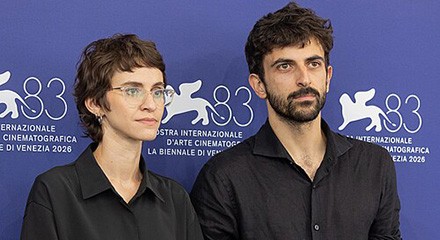
Anne McShane reviews Yuval Abraham and Rachel Szor (directors) NAZA. Daniele Rugo and Kyle Oakeson (directors) Life support. Both on general release
NAZA is the acronym used by the Israeli military for ‘collateral damage’. It is code for the systematic massacre of the Gazan population.
In the film of the same name we hear the testimony of 24 Israeli soldiers, who give their accounts anonymously - hidden in darkness on the rooftop of a Tel Aviv apartment block. As they speak, through the windows of opposite buildings we see Israelis coming home at the end of the day. Families eating dinner, watching TV, reading, chatting, and then turning off the lights to sleep. Everything feels very calm, very ordinary.
Gaza City is 70 kilometres from Tel Aviv. One Israel Defence Forces operative tells us that the Rimal neighbourhood of the city reminded him of Tel Aviv, with its glass-fronted buildings and sandy beaches. It was one of its most prosperous districts, modern and beautiful. Now it lies in ruins, with its inhabitants displaced or dead, some still rotting under rubble or eaten by dogs. Operation Lavender is the AI-based programme which murdered the Gazan population as they slept. It tracked up to 70,000 phones of ‘Hamas’ targets and spied on their families. The policy was to wait until targets returned home at the end of the day, and then that night to hit their building, killing their entire family, along with all others in the building. There were times when the target did not come home, but the attack went ahead anyway. Also “sometimes the technology did not work”, according to another IDF soldier, and the wrong people were killed. But this was not something to be concerned about for the individual operative - “quantity, not quality, was what was important”.
Those on the hit list included members and ex-members of Hamas, and at least 15% of those targeted had never been members. Benjamin Netanyahu’s claim that they were targeting homes because Hamas was using women and children as human shields was dismissed by one soldier as complete nonsense - “We bomb them in houses because that’s how we find them … They just come home to sleep. That’s where we catch them.” People tend to have their phones by their beds, making it easy to locate them. The intention was to kill the largest number of people - with the standard number of those approved for death being 20, and the largest 500. The method is arbitrary, designed for systematic elimination.
The majority of people in Gaza City lived in apartment blocks, as they do in Tel Aviv. Operatives were provided with maps with numbered targets: eg, buildings with four floors and two apartments on each floor, with an average of 32 people living there. Using IT, they could see into the building. If any victims were left alive, they would be targeted again until they were ticked off as dead.
In situations where the IDF orders evacuations, those unable to move because of illness or age are fair game - it’s a question of ‘good luck to them’. If people run back for other family members or possessions they too are shot - “If they do not leave it’s their own problem”. One operative saw a boy run back to his home and shot him without a thought. Yes, it was “their own problem”. The IDF is not responsible for avoiding civilian casualties and will not assist with evacuations. It just waits to kill.
Once residents are killed, the army on the ground sets about burning down their ruined homes. The soldiers boasted that they have “become expert in burning houses”, using gas, olive oil, furniture and clothes to set them alight. They are ordered to make sure that there is nothing left, in case families try to return. This is the long-used strategy of ethnic cleansing devised in 1948, aimed at ensuring the erasure of the Palestinian people, culture and history. Towns, cities and national parks in Israel today are built on the demolished remains of Palestinian life.
One of the most disturbing aspects of the film is the way the IDF men talk about killing in such a mundane manner. This is particularly true when they discuss the massacres during the 2025 famine. From May to October of that year, more than 2,600 men and boys were killed, and many thousands were seriously injured, when queuing to get food at the deadly Gaza Humanitarian Foundation depots, set up by the US and Israel. People, weak and desperate to eat after months of deliberate famine, were lured to their death. IDF operatives spoke of the “great fun” of being snipers. It was like playing a video game, where they “picked off” the men and boys running to get food. If they “stepped out of line” or ran in the wrong direction, they were shot and “fell flat on their faces”, with “bodies piling up on top of each other”, and left for the rats and the dogs - “We saw it all from the cameras”.
One operative spoke of how their “hormones would be going crazy” with “the excitement of killing” being stirred up by “escalations”. They would feel very satisfied afterwards by “the completion of successful missions”. Another said that he and his colleagues refused therapeutic support, stating simply that “there was no need for psychologists - we were not traumatised”. Yet another said that he had previously wondered “how Germans could live with themselves” after World War II, but “now I know how a man can kill and still go home to a normal life”.
The overall strategy is to get the job done as quickly as possible; to exterminate Palestinians before Israel lost international support. Meanwhile life in Israel must remain calm and unaffected.
I can understand why Palestinians are so outraged at this film. It is unbearable to listen to men who have been granted anonymity to speak about their mission to deliberately erase your people. Palestinians know that the problem has never been Hamas and that Netanyahu’s claim that the war is one of national defence is an utter lie - a lie which continues to be retold by western governments and their compliant media. NAZA gives us a partial glimpse of the nature and operation of the Israeli project. But there is far more to be said.
Determined
Life support, sponsored by Medical Aid for Palestinians, shows the immense battle of Palestinian healthcare workers to prevent the slaughter of their people, and reveals in stark terms how they are constantly thwarted by a state which cuts off every source of life.
The group of doctors who came together to make the film are surgeons, intensive care, maternity and paediatric specialists from outside Gaza. They are all very familiar with the Strip, having gone there to work and train Palestinian doctors for many years. Before October 2023, Gaza had 35 hospitals serving the population of over two million. Despite the numerous problems resulting from Israeli attacks and the 16-year siege, its healthcare system worked relatively well, with a very dedicated workforce. Israel’s actions in the aftermath of October 7 were aimed at destroying all that had been achieved and ensuring that Palestinians maimed in its attacks would have nowhere to turn.
Dr Nick Maynard, a surgeon, entered Gaza in December 2023 and was overwhelmed at the obliteration of life, the thick smoke and the smell of war hanging in the air. The sound of bombing and artillery fire from Israel was “terrifying”, he said. Hospitals were under sustained attack, with the World Health Organization then reporting 427 attacks (as of October 2026, that number is 2,137). Netanyahu insisted that the strikes on hospitals were essential to eliminate Hamas militants sheltering within. Dr Maynard made it his business to check out this claim: to walk every corridor and inspect all parts of the hospitals he worked in. He found no Hamas members and no weaponry. On his return to Britain he spoke out to expose the propaganda, which has been endlessly repeated by governments and the media.
The part played by visiting healthcare workers has been vital. As well as providing physical and moral support to their colleagues, they have used every opportunity to protest against the mass murder of the civilian population, which they have seen with their own eyes. Dr Victoria Rose, a plastic surgeon, arrived in Gaza in March 2024. She brought 23 large suitcases of medical equipment with her, as all normal supplies had been blocked. As she crossed the border, she saw hundreds of aid trucks lined up, unable to enter Gaza. At the European Hospital in Khan Younis she saw what she describes as “a concentration camp”. Hundreds of displaced families were sheltering in its corridors and its wards.
Local medics work relentlessly to save lives - fainting with hunger and exhaustion, and not stopping to deal with the grief of losing their own families. They do long shifts with little equipment to help. Yet they fight on, operating on the wounded non-stop, amputating limbs and removing bullets and shrapnel.
Dr Rose was able to bring supplies in early 2024. Now Israel forbids any assistance - doctors entering Gaza are only allowed one suitcase and none of the contents can be medical equipment. Staff have no gauze, no antibiotics, no clean surgical instruments, no general anaesthetics. The lack of antibiotics and other aftercare supplies means that even those who survive operations often die of infections. Cancer patients die in terrible pain.
The attack and forced evacuation of Al Nasr children’s hospital in November 2023 left premature babies to die in incubators. The following February, Nasser Hospital was put under siege and then attacked. The hospital had no fuel and corridors were flooded with sewage. There was no electricity, food or oxygen. Patients who tried to leave came under constant gunfire. Medical staff were taken away by the IDF, which reported that it had arrested 100 “suspects”.
Dr Maynard reports on the nature of the injuries inflicted during the 2025 attacks on Gaza Humanitarian Foundation depots. He found a pattern of shotgun wounds to the neck, head and abdomen, and a large number of young boys who had been shot in the testicles. He believed that the IDF was conducting target practice on these young people. This was the systematic killing or maiming of Palestinian boys, so they could never have children - a repulsive act that could not be more genocidal.
Today Gaza has the largest number of child amputees in the world, while the UN published a long list of physical disabilities and illnesses caused by malnutrition and trauma. Vegetables and fruit are scarce, if not impossible to obtain, and up to 80% of children are malnourished. Pregnant women are hungry and there is little possibility for safe births.
Healthcare is at the centre of the struggle to survive. More than 1,700 doctors and other medical staff have been killed since October 2023. Many more are missing. Those talented, hardworking professionals who care for the population are being murdered because Israel fears even their limited success. Their courage and humanity are powerful - they are giants, compared to the dehumanised IDF operatives.