
05.11.2026
Riot, loot and burn
France’s huge protest movement began with schoolers and now there is the November 5 general strike. Inevitably the disaffected, the backward, the plain criminal see an opportunity. However, says Jack Conrad, the task of Marxists is to raise consciousness, encourage organisation and inculcate discipline
Hundreds of thousands have taken to the streets of France’s towns and cities over the last two months. Things began with schoolers protesting against poor classroom conditions, lack of teaching staff and a two‑tier education system that leaves most badly disadvantaged. They blockaded their school buildings and marched, marched and marched again. Parents joined them. So did teachers.
Now five trade union federations have organised the November 5 general strike - a much-needed show of strength by the organised working class. After all, next year there are crucial elections. Marine Le Pen is the clear frontrunner to become the Fifth Republic’s next president - Jean-Luc Mélenchon is a distant second. If, on April 18 2027, those two are the country’s choice, it is not difficult to guess which option bourgeois France will go for in the second round. Given a Le Pen-Mélenchon runoff, pollsters say Le Pen would win by a landslide, with up to 65% of the vote (so-called centrists and moderates either staying at home or voting for her rather than supporting the left).1
While a Le Pen presidency does not mean fascism, it does mean a shuddering right turn. We can predict savage state attacks on democratic rights, migrants, pensioners, and the terms and conditions gained by workers over many decades of struggle. That is why November 5 matters. It is, or at least ought to be, about more than expressing much needed solidarity with schoolers. It should certainly be more than an opportunity for routine speech-making, posturing in patriotic red, white and blue sashes and letting off steam. It is, or ought to be, a call to arms, given the distinct danger of a Le Pen presidency and a Rassemblement National-dominated government headed by Jordan Bardella.
While a RN government is by no means a foregone conclusion, France has clearly arrived at a crossroads politically … and economically too. Fitch, the ratings agency, downgraded the country on October 30 from ‘stable’ to ‘negative’. Borrowing rates are already high and a recession is expected after stagnation or contraction during three of this year’s quarters. Roland Lescure, economy minister, ominously warns that, without “fiscal consolidation” - ie, still further austerity measures - “we will crash”.2
Glorifying
Meantime, over at PO Box 74955, Socialist Worker has been running authoritative articles glorifying riots and looting. What articles? I have in mind Camilla Royle’s ‘Streets of Paris burn after day of rage at the system’ and more importantly its companion piece, ‘The left must defend riots and looting’ (October 21). Also Judy Cox’s ‘Riots aren’t mindless - they are political’ (October 28). Why authoritative? Both comrades regularly feature in the pages of Socialist Worker and, more to the point, both are on the recommended slate for the next central committee, to be elected at the January 8-10 2027 Socialist Workers Party conference.3
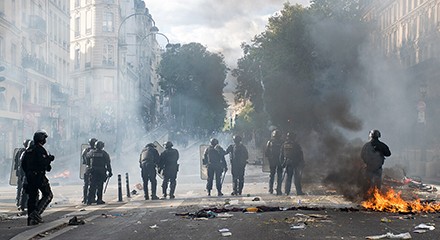
Their articles follow, in particular, the October 17 mass protests, which saw some 800,000 marching, including 400,000 in Paris alone. Of course, that was not the prime focus of the capitalist media on the day neither in France nor internationally. No, what got column inches and prime airtime was the entirely peripheral clashes between the police and small groups of rioters and looters afterwards - that is, when most people had already headed off home.
There were approximately 2,700 arrests, not a few injuries and a couple of high-profile arson cases. However, it all made for terrific pictures of smashed windows, burning bins, wrecked shops and masked young men being sadistically beaten and tear-gassed by police goons. Something like the same happened on October 24 and October 31 too. Mass demonstrations followed by entirely peripheral clashes between the police and small groups of rioters and looters.
Grist to the mill of the party of law and order. Virtually ignoring the hundreds of thousands peacefully demonstrating, Emmanuel Macron and his prime minister, Sébastien Lecornu, vowed to ensure stiff prison sentences. Simultaneously, they imposed curfews, banned marches and forced those which were permitted, such as in Paris, onto ring roads and outer districts. There was also much talk of outside infiltrators, bringing in the military and even outlawing Mélenchon’s La France Insoumise (France Unbowed).
As for Le Pen, she blamed Macron for a lily-livered lack of decisiveness in the face of what she calls a concerted attempt to maximise disruption in the run-up to April 2027. So the black and brown rioters and looters were not just attacked for their ensauvagement (savage-like behaviour). They were credited with being “insurrectionary activists”, albeit orchestrated by the ultra-left. The aim? Nothing less than bringing about the downfall of western civilisation. Rioting and looting is thereby linked with immigration and a dastardly global conspiracy hatched by sinister forces. George Soros being darkly mentioned.
Naturally, Le Pen and RN line up four-square with the police and rail against the interior ministry for its weak response. Instead there must be the iron fist. Strip citizenship from dual nationals found guilty of rioting or assaulting the police. Parents of minors should have benefits and social housing access withdrawn.
A narrative that has certainly benefited Le Pen and RN. An extra 1%-2% have sought refuge in her camp and helped consolidate her front‑runner position with some 34%-38% of the poll. Meanwhile, the potential centrist successors to Emmanuel Macron - Édouard Philippe and Gabriel Attal - have seen their support visibly crumble.
None of that matters much, if at all, for comrades Royle and Cox. Fielding candidates, votes, winning elections, controlling representatives, assembly debates and motions, coalition deals, forming governments - all are almost irrelevant. What really counts for them is strikes and streets ... and riots. As if different forms of the class struggle should be counterposed one against the other, rather than concretely evaluated, and, when advantageous, combined, in terms of their strategic usefulness, given this or that historical circumstance.
During the revolutionary year of 1917, the Bolsheviks combined street‑corner agitation, conference debates, newspaper polemics, contesting all manner of elections, and not only soviet elections …with political mass strikes, armed demonstrations and finally insurrection. In fact, Marxism does not reject any tactic as a matter of principle. We leave all such nonsense to others. Eg, anarchists and their ilk reject, as a matter of principle, standing in bourgeois elections in the name of proletarian revolution; reformists, on the other hand, reject proletarian revolution, as a matter of principle, in the name of standing in bourgeois elections.
Basically, comrades Royle and Cox present a mirror image of the party of law and order. Hence they not only stand opposed to Macron and Le Pen, but everyone who does not politically defend - even fete - rioters and looters. Comrade Royle thereby insists that Jean-Luc Mélenchon is wrong to distance himself from “looting and pillaging”. He is further taken to task for posting on social media that: “Whatever the responsibilities of those in power and their incompetence and their violence, we must refuse to take part in actions without political meaning and contrary to our methods.”
Let us ask comrades Royle and Cox this simple question. Should the left “take part” in looting and pillaging? They do not expressly say ‘yes’. But the implication is that we ought to ... or at the very least that we ought to incite, cheer on, politically tail, rioting and looting.
After all, Socialist Worker readers are positively assured that “riots work” and “looting works”. It forces governments to invest in deprived areas. Sometimes, admittedly, but hardly always. It gets rid of hated laws. Again, sometimes, but hardly always. In fact, rioting and looting often invites especially draconian legislation. Again, rioting and looting grabs media headlines, which peaceful protests fail to do. True, but so what? After all, we are talking about the capitalist media. It not only has to sell advertising, it has its own political agenda. The fact that mass, peaceful demonstrations do not get a look in should, once again, underline the need for our own mass media.
Along the exact same lines, we are told that looting “enables the poor to enjoy the exclusive commodities held up as symbols of success”. Looting also “means families get basic necessities they can’t afford”. Even this: “Looting - or ‘proletarian shopping’ - is an effective means of direct expropriation.” Rioting and looting, it should be added, is a fast track into the criminal ‘justice system’ and more poor sods rotting away in overcrowded, rat-infested prisons.
Riots are admittedly “chaotic and destructive, especially when rioters are prevented from reaching centres of power and wealth.” Apparently, though, while many can understand the “looting of designer stores”, they “recoil from the destruction of small, family-owned businesses.”
But don’t worry. All “serious protests”, from civil disobedience to strikes, make life difficult for some ordinary people. To provide revolutionary justification the 1960s Black Panther, Assata Shakur, is approvingly quoted. Asked to condemn rioters who set fire to their own neighbourhoods, she replied: “They don’t own those stores. I’m glad they burned down those stores because those stores were robbing them in the first place.” Which only goes to show how politically disorientated Assata Shakur was at the time (after being arrested on murder charges, she escaped and ended her life in Cuban exile). For the SWP to elevate Shakur into one of their authorities, when it comes to rioting and looting, testifies to the fact that today it is politically disorientated.
We would never join the reactionary clamour for the police to hunt down rioters. On the contrary, communists demand an amnesty, a demand we would justify by citing their age, inexperience, desperation and lack of disciplined organisation. But to express approval is a dereliction of our duty to provide programmatic leadership and an alternative to the dead-end of rioting and looting. In that strategic context too, expressing approval of rioting and looting guarantees that we fail to win potential allies: indeed it drives the petty bourgeoisie straight into the arms of the far right.
Historically
Mélenchon “rightly blames the state for the breakdown in public order” and he “rightly reaffirmed his support for the demands of school student protestors and solidarity with those facing police violence”. However, he is “wrong”, says the SWP, when he maintains that looting does not have any “political meaning”. Here, at least, the comrades are on firmer ground. Looting does have a political meaning.
Before exploring that subject, allow a brief aside. I will momentarily appoint myself as Jean-Luc’s defence attorney. What my client is saying here is that rioters and looters have no coherent political programme. If that is what he meant, and I think that is beyond reasonable doubt, would comrades Royle and Cox disagree? Readers of the Weekly Worker can act as judge and jury.
If we view rioting and looting historically, there can be no doubt whatsoever that this form of the class struggle occurs and constantly reoccurs. Anyone even with a passing knowledge of ancient Greece and Rome will be familiar with the numerous instances of the demos, the plebs, the townspeople, the peasantry, protesting using their most effective weapon: they could riot.4 While not a daily event, the possibility of a riot “was always there, and there was no hesitation to join the action”.5 One popular form of riot was to lynch a detested official, or burn down the houses of local big wigs deemed responsible for this or that popular misfortune.
In the best-case scenario that resulted in the citizen-peasant democracy of Athens or, falling somewhat short of that, the so‑called mixed, balanced, popular-elite constitution of republican Rome, but in both cases there were coherent politics involved - crucially from below (albeit, as it comes down to us in written form, as articulated by members of the ruling class).
Obviously, such outcomes were the exception, not the rule. Riot and looting was mostly economic. Peasants in medieval Europe rebelled against food shortages and excessive tithes and taxes. If strong enough, they would overrun the local manor house, seize stores of food, cloth and drink. Again, if strong enough, they would head off to the nearest urban centre. Here, often in an alcohol‑driven frenzy, the palaces of the local baron and bishop were set ablaze. After that it was the turn of the Jewish money‑lending class. What goes for ancient and medieval times has essentially continued into modern times.
Eric Hobsbawm famously wrote about “collective bargaining by riot”.6 Eg, in the 1760s the silk weavers of Spitalfields frequently took to the streets of the City of London and broke into the homes of masters who paid below subsistence wages. Before effective trade unions, this is what effective industrial action looked like.
However, there have been notable political riots: the 1780 anti-Catholic, anti-government Gordon riots, the repeated riots during the course of the great French Revolution, including the celebrated 1789 storming of the Bastille, Beijing’s May 4 1919 riot, Detroit’s 12th Street riot in 1967, the 1969 Stonewall riot, the 1990 Trafalgar Square anti-poll tax riot, etc, etc.
Our epoch
But, given our present epoch, riot and looting are primitive forms of the class struggle. That was certainly the considered opinion of Karl Marx and Friedrich Engels. Two examples, both from Engels: one con, the other pro.
The West End riot was not at all to his liking. On Monday February 8 1886 the Fair Trade League organised a meeting in Trafalgar Square. The promise was that their policy of higher customs tariffs would act as a cure for unemployment. Not a few “genuine working men attended”.7 The Social Democratic Federation rallied the unemployed for a counterdemonstration. Henry Hyndman, John Burns and Henry Hyde Champion delivered “very injudicious and dangerous speeches” (Hyndman’s words).8 All in all, they did their utmost to fire up their crowd, so that they would, in the words of Socialist Worker, “rage against the system”.
According to Old Bailey records, Burns told them that the House of Commons was “composed of capitalists who had fattened upon the labour of the working men, and in this category he included landlords, railway directors and employers, who, he said, were no more likely to legislate in the interests of the working men than were the wolves to labour for the lambs”. To hang them, he said, “would be to waste good rope and, as no good to the people was to be expected from these ‘representatives’, there must be revolution to alter the present state of things. The people who were out of work did not want relief, but justice.”9
To avoid a violent clash with the Fair Traders, SDF leaders then led their people away from Trafalgar Square, down Pall Mall and towards Hyde Park for a hastily planned meeting at the Achilles statue. Burns headed the march, carrying a red flag.
Trouble began almost straightaway, at the Reform Club. Arrogant aristocrats, members of the high bourgeoisie and their paid retainers jeered at them. Bits of rubbish were thrown. This provoked the unemployed to retaliate with stones. The club’s windows were shattered. After that what was now an enraged mob set about looting shops, especially vintners, tailors and hosiers, along Piccadilly and South Audley Street. Respectable ladies had purses and jewellery snatched. Some bright sparks set up impromptu stalls to sell off their ill-gotten gains. Only when they reached Oxford Street did the police intervene. The three SDF leaders were arrested and charged with seditious conspiracy. All were acquitted.
The SDF leaders, like the SWP today, deluded themselves that there was something revolutionary about rioters smashing windows and looting shops. Hyndman stupidly hailed the West End riot as “the beginning of the great English Revolution of the 19th century”.10
Engels was withering. Writing to August Bebel in Berlin, he told the story of the West End riot, as recounted to him by Karl Kautsky (a first-hand witness). Engels accused the SDF of mobilising rogues, idlers, the lumpenproletariat, many of whom were just “out for a lark”. Moreover, by encouraging hooliganism, Hyndman and co had “done an irreparable damage to the movement”: socialism had been “identified” with looting. SDF leaders had tried to “conjure up a movement by force and overnight”, without carrying out the necessary long-term organisational work among the mass of working people, and for what? “[C]hildish actions such as we are usually accustomed to seeing only from the anarchists.”11
The 1889 dockers’ strike was an entirely different matter. Here was a traditionally unorganised, wretched, impoverished section of the working class in London’s East End. Most were hired casually on a daily basis. One violently competed with the other at the dock gates in an attempt to get chosen by a foreman. They could be laid off after just an hour’s work. However, with the help of the left activists, such as Ben Tillett, Tom Mann and John Burns … and a substantial donation from Australian dockers, they began to unionise.
On August 12 the strike began in the South-West India Dock. By August 20 it involved some 40-45,000. The key demands were 6d per hour pay, 8d for overtime and the abolition of the hated ‘call-on’ system. The strike proved a tremendous success. London’s docks were brought to a complete standstill and on September 16 the dispute was officially concluded. Substantial concessions were gained, including the ‘docker’s tanner’ and the abolition of the ‘call-on’ system.
What impressed Engels was the discipline. He contrasted it with the regrettable Pall Mall and Piccadilly scenes. When the dockers marched, they did so peacefully, maintained strict internal order and prevented any looting. Engels wrote that, when the organised working class takes the lead, rioters and looters are pushed aside, noting that “a ne’er‑do‑well who tried to go on a rampage would simply be put down” by the workers themselves.12
Unlike the Marx-Engels team - who centred their strategy on organising the working class into a mass party, contesting elections and leaving behind primitive forms of the class struggle - Mikhail Bakunin, the founder of modern anarchism, decried working class discipline, contesting elections and took an entirely positive attitude towards the lumpenproletariat and its riots and looting.
Bakunin saw rioting and looting as a necessary prerequisite for establishing his stateless commune - his revolutionary philosophy being encapsulated in this line, written in 1842: “The passion for destruction is, at the same time, a creative passion.”13 For Bakunin, revolution cannot be planned by a mass political party or an electoral majority used as its midwife. Revolution has to be an elemental act from below (albeit secretly directed by one of his largely fanciful conspiratorial operations). Riots and looting, the ‘negative’, culminate in the ‘positive’ - the state, the church, the law courts, the army and all that old crap being swept away in a joyful tsunami of destruction.
Interestingly, revealingly, to provide underpinnings for their argument, we find comrades Royle and Cox turning not to Bakunin himself. As they should. Rather they turn to Vicky Osterweil’s In defence of looting (2020) and Delio Vasquez’s The poor person’s defence of riots (2014). In other words, anarchist and semi-anarchist ‘experts’. Hence we read this ‘History and theory’ version of second-hand Bakuninism from comrade Cox:
Rioting and looting are disturbing to the establishment because they disrupt the core assumptions of capitalist society - the legitimacy of private property and the right of the police and military to protect it. When something is looted, it ceases to be a commodity and is removed from the cycle of exchange and profit. It is liberated through shared activism - rioting and looting are not individual acts.
The third generation of SWP leaders clearly represent political retrogression. One might just as well praise professional criminal gangs, such as the Triads, the Mafia, the Krays, the Yakuza and the Medellín and Cali cartels. Well organised and strictly hierarchal, these collectives disrupt the “core assumptions of capitalist society” and the “right of the police and military to protect” private property. Through “shared activism” they remove commodities from the usual “cycle of exchange” and into the illegal “cycle of exchange”. Those at the top amass fabulous riches.
We arrive at the core of the argument between Bakuninism and Marxism. Bakuninism focuses on the distribution of property and the tyranny of the state. Marxism focuses on the mode of production and the organisation of the working class. Liberating luxury and everyday consumer items from their legal owners, leaves the state intact and capital still in control of the means of production. In short, robbery, no matter how dressed up, has nothing to do with organising the working class into the ruling class, gradually socialising production, beginning with the commanding heights, and the transition to a stateless society.
Russia
The Marx-Engels hostility towards rioting and looting in the modern epoch was upheld by the Socialist (Second) International, including the Russian Social Democratic Labour Party.
Hence, writing in 1903, Lenin outlines a plan for party committees to organise agitation amongst the rural poor. He argues that, instead of leaving peasants to blind, spontaneous actions, such as breaking into the landlord’s barns and looting the grain (which leaves them open to tsarist accusations that they are common criminals), the social democrats should, instead, beginning cautiously, forge a class alliance with the peasant masses. He urges his comrades to distribute leaflets to the peasantry, starting with the more intelligent, those who can read. The immediate task is to popularise the RSDLP’s three main demands: (1) political liberty, (2) an elected national assembly, (3) abolishing all forms of bondage suffered by the peasantry.
The peasantry needs coordination with the urban working class. Lenin recommends strikes in the busy agricultural season of harvesting. By taking this approach, Lenin believes, the peasants will come to recognise the advantages of disciplined action over rioting and looting.14
During 1905 there is nothing that can be found in Lenin’s writings about the camp of revolution indulging in rioting and looting. True, there is the slogan, ‘Loot the looters’. But, as Lenin later insisted, that had nothing to do with individual gain, not even of a single kopeck. However, maintaining party finances became an urgent necessity after December’s defeat in Moscow. The Bolsheviks organised the seizure of arms and broke into banks to obtain badly needed funds. Stalin (comrade Koba) proved to be particularly successful in secretly directing the expropriation work conducted by Bolshevik fighting squads in the Caucasus. Hundreds of thousands of roubles were channelled abroad to the Bolshevik treasury.
The Bolsheviks never called such seizures ‘robbery’. It was always ‘expropriation’ as in the ‘expropriation of the expropriators’. True, the Mensheviks raised a stink. So did Leon Trotsky. Doubtless for factional reasons, the 4th (Stockholm) Congress in 1906, and the 5th (London) Congress in 1907, of the temporarily unified RSDLP condemned the “unauthorised expropriations” carried out by the Bolshevik fighting squads. Supposedly their actions resembled criminal looting and gave the party a bad name. The Mensheviks, the Bund, the Poles voted for the resolution. Eventually the Bolsheviks chose to diplomatically abstain. A calculated manoeuvre. The resolution was studiously ignored. Expropriations only came to an end in 1908, when it was recognised by all factions, the Bolsheviks included, that the revolution was not about to revive. The fighting squads disbanded and slow, patient, mass work re-emphasised.
Where Lenin discusses rioting and looting in 1905, it appears in the context of condemning Okhrana agents, Black Hundreds and heavily intoxicated lumpen mobs for their attacks on Jewish businesses, synagogues and neighbourhoods. He brands them the “scum of the population”, who are cynically used by tsarism to divert economic discontent. There were repeated pogroms and full-scale massacres of Jews. Lenin calls local Bolshevik appeals for “aid in money and arms most timely”.15 He envisages the future revolutionary army executing the organisers, along with looters. Note, Lenin wrote as an onlooker, from “afar”, from the hateful “abroad”, mostly Switzerland.16
Not the case with Trotsky. He was on the ground - indeed he was elected to chair the St Petersburg soviet, till December’s Moscow uprising, the storm centre of revolutionary events. Here the phenomenon of workers breaking into state-owned liquor stores, getting hopelessly drunk and causing a terrible nuisance was far too common. He blamed desperate peasants and the unorganised as the main culprits. A convenient alibi, which excused organised workers, who by tradition were undoubtedly also more than prone to drink to excess. The danger was therefore clear: the revolution would drown in an orgy of drunkenness.
Trotsky already had the splendid example of the Ivanovo-Voznesensk strike before him. The very first act of its soviet included shutting down all liquor stores. Its workers’ militia patrolled the streets and, when they caught some drunk, they would confiscate bottles of booze and smash them in the gutter. If needed, the workers’ militia would detain the drunk for a short period till they had sobered up. An approach which confirms the Marxist viewpoint: a revolution is not the absence of order, but the replacement of bourgeois order with proletarian order. As vividly described in his book, 1905, Trotsky applied this model to St Petersburg.
The year 1917 is also instructive. This time Lenin was on the ground (well before Trotsky). He therefore knew all about workers and soldiers - ie, our people - breaking into “liquor shops and wine cellars”. However, it was after the Bolshevik overthrow of the provisional government that the problem reached crisis point.
The Winter Palace had massive wine cellars. There were many priceless vintages. The ultimate temptation for those after luxury goods that they could otherwise never hope to obtain through the usual “cycle of exchange”. Soldiers swarmed to the Winter Palace and got hopelessly drunk. The ‘wine pogrom’ began. Soldiers sent to the Winter Palace in the attempt to restore order got hopelessly drunk too. For days on end, drunken soldiers roamed the streets of Petrograd. John Reed testifies that the hand of the counterrevolutionaries soon became apparent. They distributed maps to soldiers showing the location of liquor stores. Pitched battles between drunken soldiers and the Red Guards followed.
Finally, amidst mounting chaos, the Military Revolutionary Committee dispatched sailors and machine gunners, who “mercilessly fired upon the rioters”.17 Many were killed. Lenin himself stepped in, writing furious directives declaring an emergency. The Committee to Combat Looting was established in December 1917 with a hundred “absolutely reliable” serving commissars.18 This precursor of the Cheka was headed by Vladimir Bonch-Bruyevich.
Wine cellars were invaded. Bottles and barrels smashed. There was even the use of dynamite. Orders were issued, chillingly stating that anyone caught looting, robbing or getting publicly drunk would be shot on the spot. The revolution had to be saved and that could only be done through establishing proletarian order.
-
France 24 English - www.youtube.com/watch?v=fQkuSvnCFkE.↩︎
-
Le Monde October 31 2026.↩︎
-
Preconference Bulletin No1, October 2026.↩︎
-
GEM de Ste Croix The class struggle in the ancient world London 1983, p318.↩︎
-
R Knapp Invisible Romans London 2013, p41.↩︎
-
E Hobsbawm Labouring men: studies in the history of labour London 1986, p7.↩︎
-
Engels to August Bebel MECW Vol 47, New York NY 1995, pp406-10.↩︎
-
HM Hyndman ‘The West End riots’ The record of an adventurous life - www.marxists.org/archive/hyndman/1911/adventure/chap24.html.↩︎
-
www.oldbaileyonline.org/record/t18860405-465.↩︎
-
Quoted in M Sullivan ‘Rioting and Marxism’ What Next? No19, 2001.↩︎
-
Engels to August Bebel MECW Vol 47, New York NY 1995, pp406-10.↩︎
-
Engels to Eduard Bernstein MECW Vol 48, London 2001, pp364-65.↩︎
-
www.marxists.org/reference/archive/bakunin/works/1842/reaction-germany.htm.↩︎
-
VI Lenin CW Vol 6, Moscow 1977, p425.↩︎
-
VI Lenin CW Vol 9, Moscow 1977, p204.↩︎
-
VI Lenin CW Vol 10, Moscow 1977, p19.↩︎
-
J Reed Ten days that shook the world Harmondsworth 1970, p245.↩︎
-
VI Lenin CW Vol 44, Moscow 1977, p48.↩︎