
17.09.2026
War is always hell
Mike Belbin reviews Christopher Nolan (writer and director) The Odyssey 2026, general release
Even before Christopher Nolan’s The Odyssey was released, YouTube was full of attacks on the film as a desecration of Homer’s ancient epic poem, accusing it of lack of fidelity to both the text and the period. But adaptation, like translation, is always an interpretation.
The whole situation began with Helen, whose departure from her Greek husband provoked a war against the city of Troy. Helen “followed” the Trojan Paris, as Homer puts it, indicating a voluntary relationship - other classical writers (Hesiod, Herodotos) called it an abduction. Whatever it was, it was taken as an insult by the Achaeans (the Greeks) and they set out to punish the culprit and his city. In the movie, control of trade routes is also mentioned as a motive.
The events of the poem occur after the defeat of Troy and an Achaean named Odysseus sets off home for the island where he was chief, accompanied by a crew of his fellow warriors. Stories are about characters who need something, whether they know it or not - to grow up, to form a stable relationship, to defeat a monster. Odysseus needs to reach home.
Nolan has said his inspiration was partly a translation of the Greek text by Emily Wilson.1 Wilson believes that if you do a translation it should not be a repetition of a previous version: “Many retranslations of ancient texts,” she writes, “do not have good reasons to exist, because they offer very little that differs from what came before.”2 One change Wilson made in ‘The Odysessy’ was to replace a Victorian euphemism by using the word “slave” for the servants. This was historical accuracy, if not literal fidelity (classic texts have always been a site for disagreement over accuracy and political appropriation).
In his recent book, The white pedestal, Curtis Dozier shows that identifying the Greeks as westerners fighting foes from the east (the mythic Troy has been located in Turkey) did not start with neo-fascist websites: “The interpretations of the past that, white nationalists argue, support their policies are very often traditional interpretations.”3 That is, from 18th and 19th century depictions. So what does Nolan make of it? In a film of two hours and 50 minutes, he includes most of the story. Even at this length he keeps you interested by varying the rhythm, cutting between characters (like Odysseus and his son, Telemachus, who goes looking for his father) and alternating between rowdy sequences and dialogue.
Now, despite the social media attacks on the casting of Lupita Nyong’o as Helen, even if the poem never mentions whether she is a natural blonde, Nolan’s approach is more than one of DEI casting: he introduces psychology. Not deep though - no time for that: an anguished face suffices.
If the film has one idea, it is the weariness of Odysseus with war and loss, whether that be the destruction of Troy or losing his crew in the effort to reach home. In other films of his Nolan has a thing for heroes who realise how responsible they are for conflicts - Oppenheimer for the nuclear age, Batman for the trouble that defeating the Joker entails. Here Nolan not so much rejects the requirement to fight (it is still an adventure, after all): rather he focuses on the trauma of the warrior(s), not the triumph over monsters.
For this emphasis, Nolan and Hollywood have been accused of having an “agenda” which they have forced on the audience. But how many spectators now accept screen stories where heroes have the jaunty demeanour of an Errol Flynn or the dogged charm of a Sean Connery? Even the James Bond franchise reached a stage where the lead played by Daniel Craig suffered grief and a lonely defensiveness. Many in the audience may well accept this as a hero for our times, not a character of the sort their grandparents expected. Consequently, in Nolan’s movie, Matt Damon plays Odysseus as often expressing his pain over how many of his lost crew he does not have time to bury with honours, survival being more important.
Other characters in the film are more traditionally good or bad, proud or weak. Robert Pattinson, for example, plays Antinous, the leading ‘suitor’, who is overstaying at Odyessus’s home. He is a familiar bad guy - arrogant, presumptuous (in wooing Odysseus’s wife, Penelope) and in the end cowardly, hiding behind a pillar, while giving orders to others who are fighting. He is like so many of the emperors in 1950s epic films (such as Demetrius and the gladiators): not so much proud as pathetic, judged beside the courage of the hero. The more recent Gladiator (2000) presented the emperor Commodus as a boyish schemer. Just to make sure: the actual Commodus liked to go into the arena as a fake gladiator himself, garbed in lion skin like Hercules, and shoot giraffes with poisoned arrows.
On the other hand, Penelope, played by Anne Hathaway, is someone who wants to show how loyal she is to her husband, gone 20 years, but also wishes to be treated like a queen, trad wife and boss lady. As to other Odyssey women, Samantha Morton plays Circe, the woman of magic who justifies turning the crew into pigs by telling Odysseus that men are pigs. He accepts this, but, unlike in the poem, does not stay with her for a year.
My favourite performance here was that of Himesh Patel as Eurylochus, Odysseus’s second-in-command, who criticises his captain for rashness. We know he is going to die, after Odysseus has been told so by the ghosts of dead heroes, which Odysseus conceals from him. Perhaps this is one of the details which is downplayed, so as not to shake our faith in the commander.
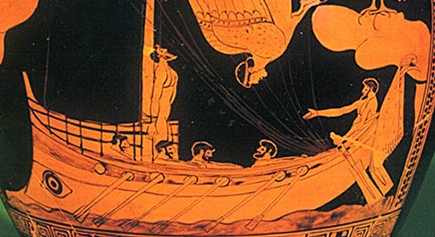
In their travels the crew meet many creatures, from robot-like giants to singing mermaids, about which Nolan is very proud of not using any computer-generated imagery. One of the best sequences is the confrontation with the cannibal, Cyclops, played by Broadway and TV clown Bill Irwin, with slow, impressive movement and very effective make-up.
The Odyssey is in fact closer to tragedy than epic, and suits our world of ‘war is hell’. These days we question the need of leaders to reach goals, regardless of how many people are sacrificed. Nolan’s direction does not mess up the tale so much as emphasise certain emotions, while leaving bits of the poem out. These selections are maybe there for a shorter duration, but also to avoid presenting Odysessus as the toxic male, which even the most bloodthirsty spectators might condemn. He is a war leader we can feel sorry for.
Late in the film though, Odysseus loses his pyschological exhaustion and rediscovers killing (as the poem’s story requires). He takes out those men, “the suitors”, who are staying in his palace. He may have been sensitive about striking Trojans, but he observes what is referred to more than once as “Zeus’s law”. This condemns those who behave improperly as guests. Nolan might well have wished to change the ending too, but that would have meant a field day for those attacking his interpretation. So he is stuck with Odysseus, the hero, who ferociously cleanses his home of usurpers.
Whatever interpretation an adaptation gives a work, it can still be faithful to all kinds of things from shoe buckles to ship design. But a good historical film can be faithful too, in that, while bringing the characters close to us, it can still acknowledge the past’s “strangeness” (Wilson) and the particularity of its context, in films like David Lean’s Lawrence of Arabia (1962), James Ivory’s Jefferson in Paris (1995) or Ken Loach’s Land and freedom (1995).
Every adaptation is a commentary on the past, as well as reflecting our modern concerns.