
26.02.2026
Escape from paradise
Under a catastrophic US oil blockade, the country is suffering blackouts, shortages of basics and a draining exodus of young people. Yet there are still those on the left who imagine that small and medium-sized countries can be really independent and even build their very own socialist society, writes Eddie Ford
Cuba is now on the verge of a humanitarian catastrophe - possibly the regime itself is facing a terminal crisis. Possibly, though, the US is banking on doing another Venezuela: there are reports of Raúl Guillermo Castro (grandson of former president, Raúl Castro) holding secret talks with Marco Rubio. The talks, described as being about the “future of Cuba”, bypass official government channels.
Meanwhile the US blockade of Cuba’s oil supply is not only crippling the island’s economy: it is threatening “basic human safety”, health minister José Ángel Miranda recently told The Associated Press.1 For instance, five million people with chronic illnesses will see their medications or treatments affected, including 16,000 cancer patients requiring radiotherapy and another 12,400 undergoing chemotherapy. Ambulances are struggling to find fuel to respond to emergencies, deteriorating hospitals are persistently hit by outages, and the Cuban government is unable to refuel airplanes and therefore has to suspend vital supplies.
As we all know, the US has maintained an embargo on the island since 1960, preventing US businesses and citizens from conducting trade or commerce with Cuban interests.2 That was significantly tightened two years later by the Kennedy administration in a Trumpian-style executive order that included all imports of products containing Cuban goods, even if the final products had been made or assembled outside Cuba. It prohibited aid to any country that provides assistance to Cuba - formally expanding the embargo a few months later to include all Cuban trade except for the non-subsidised sale of food and medicines.
Socialist state
US imperialism expected Fidel Castro’s revolutionary regime to collapse pretty damn quickly, faced as it was with extraordinary punitive measures, but collapse it did not. In April 1961 Fidel Castro declared Cuba a socialist state. Later that year, in December, he announced that he was a communist and would remain one till the end of his life. Indeed, Cuba went on to provide its population with especially good social services - including universal healthcare and education - giving it a life expectancy above that of the US. That stands as a condemnation of the privatised American health service, it goes without saying, where a sudden medical emergency can plunge you into economic ruination. But it also shows you what you can do, even in a poor Caribbean country, when the profit motive is not supreme and society is organised on a different basis.
Yet there is no mystery, of course, as to why Cuba survived the embargo, together with constant threats and intimidation from its imperialist neighbour. Yes, there was local effort, ingenuity, pride in the revolution and so on. But the straightforward explanation is called the USSR and cold war politics (followed later by Venezuela).
Perhaps stating the obvious, the Soviet Union was absolutely crucial for Cuba’s economy, especially in buying its sugar. In return Cuba got oil, industrial goods, grain and arms. In 1972 it joined the Council for Mutual Economic Assistance (Comecon). That provided Cuba with more trading partners, but the USSR was always paramount. Therefore the collapse of the Soviet Union, and with it Comecon, had an immediate and devastating effect on the island, as oil imports - for example - dropped from 13 million tons in 1989 to about three million in 1993 from the Russian Federation.
The isolation and grinding economic hardship that hit Cuba at this time, officially known as the ‘Special Period’, was most severe in the mid-1990s. Rations of food and other essentials were massively reduced. The government turned to tourism and market relations. Hotels and other tourist infrastructure accounted for 37.4% of investment in an attempt to save the system. Private homestays also played a big role.
But the situation improved somewhat with the emergence of Hugo Chávez’s Venezuela and his Bolivarian revolution. Venezuela and Cuba formalised their alliance in October 2000, and started to integrate their respective economies through a Comprehensive Cooperation Agreement. This led to the development of the Bolivarian Alternative for the Peoples of Our Americas (ALBA), a regional trade organisation that was proposed by Chávez as an alternative to the Free Trade Area of the Americas (FTAA) being advocated by the US, which in the end actually never happened.3 The ALBA was essentially aimed at the exchange of medical and educational services for oil.
Following the 2002 coup attempt against Chávez, he naturally drew closer to Cuba, as he could no longer trust his own crew in the ‘situation room’ and instead brought in the Cuban G2 intelligence and significant numbers of military personnel. In return, Venezuela supplied about 96,000 barrels of oil per day from its state-owned oil company, PDVSA, at very favourable prices. Then in 2007 the two countries signed an agreement to develop a range of production projects, which involved nickel, electricity and rice, plus the construction of an underwater fibre optics cable to bypass a US embargo. Furthermore, from 2008 to 2011, Venezuela gave Cuba $18 billion in loans, investments and grants, even if trade did begin to decline somewhat in later years.
But this all came to a dramatic end with Donald Trump’s abduction of Nicolás Maduro and the resulting blockade of Venezuelan oil destined for Cuba. An executive order signed on January 29 2026, authorised the imposition of additional tariffs on imports into the United States from countries that directly or indirectly supply oil to Cuba. According to The New York Times, this is the “first effective blockade” since the Cuban Missile Crisis, and the results are predictable - the island is running out of fuel fast and we are seeing widespread suffering, with Trump calling on Cuba to “make a deal before it’s too late”.
So we have constant electricity outages and no tourist flights. Not because they are banning tourists, of course, but because there is no aviation fuel to fly them out. Meanwhile, Cuba has the highest exodus rate in the world except for Ukraine - from where vast numbers of women, children and old people fled to Europe to escape the Russian invasion.
According to official figures, the current population of 9,748,007, compared to the 2022 census of 11,089,511, means an incredible decline in such a short space of time. In December, the authorities confirmed that Cuba’s population had declined again in 2025 and, according to current projections, by 2050 the country will have barely 7.7 million inhabitants. The result is a country that is no longer reproducing itself, that is rapidly losing its labour force, and whose population is ageing rapidly at a pace comparable only to nations that are in a state of war. More and more young people are leaving in search of a future - any future - abroad.4
Telling you a lot, unlike the Mariel boatlift in 1980, which saw the exodus of 125,000 Cubans to Miami,5 there are no longer government-orchestrated insults at those fleeing, as being “lumpen”, “worms” or “trash”. If anything, the regime has encouraged them - for example, by facilitating entry into Nicaragua without a visa, ensuring that those who have the money can get out. That is simply because emigration is now a pressure valve, letting off some of the despair that exploded in mass protests in 2021, with repeated flare-ups every year since then. The blame for this lies squarely with US imperialism. Hence, we have no hesitation in raising that old slogan: ‘Hands off Cuba!’
Nationalism
Yet we still have people looking at Cuba as some sort of model. Yes, the health service was admirable and life expectancy is a great measure of a society. But you still have the idea on the left that the answer to capitalism is national socialism and making ourselves ‘independent’. Well, Cuba was never independent - get real, comrades. It was dependent on the Soviet Union and then Venezuela. Now such support has been removed, and the country is being thrown into poverty.
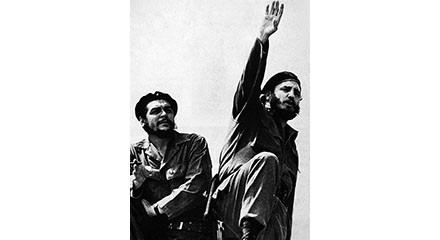
Of course, seeing Cuba (or Venezuela) as a way forward was illusory, but we have an unthinking left still seeking to emulate the model. Interestingly, Che Guevara, one of the original leaders of the Cuban revolution alongside Fidel and Raul Castro, was an internationalist to his very core. He knew that the revolution had to spread if it was going to survive. Hence his “one, two, many Vietnams” slogan and his attempt to establish guerrilla foci first in the Congo and then Bolivia (where he met his death). Not that Guevara had a viable strategy. He didn’t.
In reality the Cuban revolution was not just brought about by 82 seasick revolutionaries disembarking on the coast from that famous yacht, ‘Granma’. The Batista regime was rotten to the core and what really swept it away was the general strike called by the historically rooted and widely supported Popular Socialist Party (an ‘official’ Communist Party). Castro’s July 26th movement formed an alliance with the PSP and then merged with it, forming the Communist Party of Cuba in October 1965. Castro’s system was modelled on the Soviet Union: ie, ‘bureaucratic socialism with Cuban characteristics’.
The Cuban revolution of 1959 and its transition to what it called ‘socialism’ cannot be repeated … and yet here we have the vote by Your Party Scotland by 63% to separate off from comrades in England and Wales and fight for an independent Scotland. This, apparently, is the “best route” to improve the lives of people in Scotland and achieve socialism.6 We are further told that members have “fundamentally recognised” that a socialist programme and Scottish independence “go hand in hand”.
Are you kidding, comrades? Imagine what Britain - or crucially the US - would do to a ‘socialist’ Scotland: they would reduce it to grinding poverty in next to no time. People would be exiting Scotland and going south in huge numbers.
What is the left thinking about? According to the Socialist Workers Party, a breakaway Scotland is about “weakening” the British state and therefore can only be good for the working class. That is like wishing for another pandemic. Then there is the even more bizarre Mandelite idea from Duncan Chapel that independence is “not a nationalist project: it is part of the democratic dissolution of the monarchical UK state”.7 An independent Scotland is as likely to lead to the “democratic dissolution of the monarchical UK state” as did the establishment of the Irish Free State in December 1922. The Scottish National Party is certainly committed to retaining the monarchy. As are comrade Chapel’s England and Wales Mandelites. They do not want to “push” republicanism on broad left formations, and, therefore, one presumes, society at large (a very broad formation).8 A strange case of monarchal socialism.
Nor should we forget how the Scottish Socialist Party imagined that Scotland could succeed where others have failed, because it has “long coastlines” and a “clean environment”, is “fabulously wealthy” and has the “material foundations” for a “thriving” socialist democracy due to its “flourishing” culture with “legions” of internationally acclaimed musicians, writers, actors, film directors, etc, etc.9 Self-deluded left nationalism.
Communists, on the other hand, say unity is strength. We want working class unity against the British state. We want to unite with European comrades to coordinate across the continent. We want to be part of a Communist International. Capitalism is a global system and can only be overcome globally. Nationalism is antithetical to socialism, which is internationalist or it is nothing.